I’m melting…. – Weeknote #21 – 26th July 2019

Valentine Bridge in Bristol
The view from Mead Reach Bridge looking towards Valentine Bridge in Bristol.

This week, we melted, we had a new Prime Minister, we had a new government and I didn’t go to London.

Monday I was back into the office to do what I initially thought was going to be a demonstration of Jira and Confluence, but in the end turned more into a discussion on how people are using the tools across Jisc.

Had to make a phone call on Monday, something which in work I don’t actually do that often. I make lots of audio conferences and skype calls, but I don’t use the phone as much as I have in other roles. I am part of a telephony project at Jisc and as a result I am now using Teams for making and receiving calls. It was a seamless experience, and it was nice making a call using a sound cancelling headset with microphone, rather than holding a handset or mobile phone to my head! I did feel that it was somewhat odd to use my laptop to dial the number rather than a number pad. A few years back I was looking a telephony and I remember thinking back then that there was a real culture shift needed by organisations moving from traditional PBX (Private Branch Exchange) system to a modern telephony system used through Teams. Even now I think there is still need for a culture shift that isn’t easy for some people to just get and then move on.

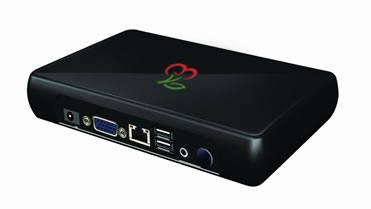
This week, eleven years ago I wrote a blog post about the CherryPal mini PC which cost $249.
CherryPal launches $249 cloudy mini PC

CherryPal launches $249 cloudy mini PC

It was funded by advertising…

Today you can buy a better specified Raspberry Pi for under £35 and no advertising.

How things change….

Decided that I would become a Thought Leader and luckily for me, and thank you to Lawrie Phipps for the link, there is a course to do this on LinkedIn Learning…

I’ll let you know how I get on.

I wrote a blog post in response to a tweet I had seen earlier this year about using facial and emotion recognition with gauge the degree of student engagement in a lecture.

This week ten years ago I saw this video from Steve Boneham about something called micro-blogging…

Wonder if it ever caught on….

Crowd
Image by Brian Merrill from Pixabay

Talking about data, read this Guardian article, ‘Anonymised’ data can never be totally anonymous, says study.

“Anonymised” data lies at the core of everything from modern medical research to personalised recommendations and modern AI techniques. Unfortunately, according to a paper, successfully anonymising data is practically impossible for any complex dataset.

The article discusses the how data which has been anonymised data can in a number of methods be deanonymised to identify real people.

This has implications for universities and colleges, who are looking at using deanonymized data for intelligence and informed decision making.

If you think of anonymised data tracking students movement across campus, using wifi, this could be easily deanonymized using attendance data, swipe card data, PC logins, library card data.

Something to think about. The research is published in the journal Nature Communications.

Thursday, I was going to go to London for a meeting with colleagues from the DfE. However due to the heat we decided to have the meeting virtually. Though there are advantages in meeting face to face, the fact we now have the technology to make meetings virtual means that we don’t need to cancel or re-schedule meetings. There are also affordances with virtual meetings, I like using the chat to post relevant links rather than interrupt the flow of the meeting. The fact the links are “live” and saved, means people don’t a) need to copy them down or b) wait until the links are e-mailed to them after the meeting.

microphone
Image by Florian Pircher from Pixabay

I spent some time working on abstracts and proposals for various conferences I am attending in September. Working for an organisation like Jisc, I obviously need to talk about stuff we’re doing at Jisc. I kind of miss the keynotes I was doing ten years ago, when I had a lot more freedom on the topics and subjects I was presenting on. Back then I spent a lot of time talking about the future of learning, which the main thrust was that change is going to happen, but the important part of that journey was people, academics and students. The technology facilitates and provides affordances, but in the end it’s people who will want to change the way they do things and people will need to demonstrate leadership if they want change to happen. For the conferences in September I will mainly be talking about Education 4.0.

Friday I was back in the office in Bristol working on my preparation  for my end of year review. This year has been interesting as I changed roles in March so did not complete my previous objectives and inherited a number of new objectives.

I was reminded of the problems heat can cause this week with this photograph from seven years ago in 2012, my Google Nexus One got so hot I had to put it in the fridge….

my Google Nexus One got so hot I had to put it in the fridge....

My top tweet this week was this one.


Understanding your audience

puppets
Photo by Umut YILMAN on Unsplash

Back in February I saw this tweet on the Twitter

I started writing a blog post about this and then never finished it, so then I found the draft and decided to reflect on this technological development.

Imagine if such a technology existed and was in use. A lecturer using an Augmented Reality headset, which uses facial and emotional recognition gauges student engagement.

Now there is a huge question mark over whether we could even develop such a technology and create the unbiased algorithms  that would be required to both define student engagement and how using facial and emotional recognition would actually be able to measure that engagement.

Just because someone said they were engaged in a session doesn’t mean always they were.

One of the other key questions for me that needs to be answered is, what does a lecturer do if using such a system, found their audience disengaged. Do they continue despite knowing this, stop and send people home, or do they launch into a song and dance routine or even a puppet show?

What do lecturers do now when they believe that their students are disengaged?

Doing the Inbox Zero – Weeknote #20 – 19th July 2019

Extinction Rebellion in Bristol

Monday I was off to our Bristol office. There was quite a bit of disruption across the city with Extinction Rebellion demonstrating across the centre.

I was into the office to deliver some training on Jira for personal use. Though Jira and Confluence make great tools for projects I have been using it myself over the last few years to manage my work and individual projects.

As the main focus was on productivity, we did discuss manging e-mail and tasks. I use an Inbox Zero approach that I discovered back in 2007 when listening to a podcast.

I recently wrote two blog posts on Inbox Zero on my tech stuff blog, the first I discuss how I deal with e-mail.

Do you do the Inbox Zero?


In the second post I expand on that with more detail and some further thoughts.

Not quite Inbox Zero


I found the Atlassian documentation really easy to follow and provides a good starting point for users of both Jira and Confluence.

Confluence is a wiki platform for creating documentation and some companies even use it for their actual website. Jira is an issue tracking system. You can embed macros in Confluence that can show details about your Jira issues.

I did manage to get out of the office and get a coffee at a new coffee place that has opened this year.

Spiller & Cole Coffee Shop

This week on my technology stuff blog I published a post about a QR Code which failed to work ten years ago with a specialised QR Code reader on my iPhone 3GS, but worked fine with the in-built QR Code reader in the iPhone 8 camera.

Ten years later, it works….

In the next few weeks I have a fair few meetings in London, so I have been booking travel and hopefully it will be slightly cooler than recently, as travelling in this heat is a real nightmare.

Last week I followed my colleague, Lawrie, on Twitter as he attended an event on Microsoft Teams.

https://twitter.com/Lawrie/status/1149298660557164544

He published a blog post about the event.

Thinking in the open about Microsoft Teams

I could argue various points, but these are my early thoughts. I’m remaining engaged with Microsoft Teams, I’m looking to see if this can be a “Digital Ecosystem” as we envisaged during the Co-design work. 

I have always seen the VLE as a concept more than an individual product and I do like the term “Digital Ecosystem” as it kind of describes that viewpoint. If you say VLE or LMS then people think of products such as Blackboard, Canvas or Moodle. For me the VLE was something more than an individual product, it was a series of ways of working online using a range of online tools and services that were inter-connected. Teams is one such tool that can be connected into such a VLE concept.

The view from St Phillips Bridge

Facial recognition was again in the news, this time the The House of Commons Science and Technology committee expressed their concerns on the technology.

MPs call for halt to police’s use of live facial recognition – BBC News

The police and other authorities should suspend use of automatic facial recognition technologies, according to an influential group of MPs. The House of Commons Science and Technology committee added there should be no further trials of the tech until relevant regulations were in place. It raised accuracy and bias concerns.

Also this week everyone was talking about FaceApp with lots of different news outlets reporting on the app and concerns people had about it. There was concerns about the biased algorithim that the app used to make people “hot” was in fact racist. There was worry over privacy and security over the use of images and even if there was Russian collusion! Of course some people thought it was all a bit of fun!

My top tweet this week was this one.

Inexcusable – Weeknote #19 – 12th July 2019

St Nicholas Market stall

Monday I was off to Lumen House, location of the Jisc offices in Harwell. This was for me, my first meeting of the Jisc Group Senior Leadership Team. In my new role I am now part of GSLT. We are going to be discussing strategy.

During a break I did read this article from BBC News.

Reminded me of last week’s weeknote, in which I said about the Guardian article on the same subject, Police face calls to end use of facial recognition software.

…independent analysis found matches were only correct in a fifth of cases and the system was likely to break human rights laws.

Relying on new technology for some stuff can be excused, but using unproven technology that could result in negative impacts on people’s lives is inexcusable. Actually relying on technology without a human element is also inexcusable. The number of times we hear the phrase “well the computer says…”.  We need to remember that computers and software are designed by people and people can be wrong, biased and will make mistakes.

Temple Way in Bristol

Tuesday I was back in our Bristol office and had a few meetings across the day on various subjects from our student partner programme to the Twitter.

The meeting about the Twitter was interesting as it reminded me of the many blog posts I have written about using Twitter. My overall perspective after using the Twitter for over twelve years now is that I still don’t know how to use the Twitter and saying “the Twitter” really annoys people.

Wednesday with no meetings in the diary, I decided to work from home. The office when busy can be noisy and distracting. Sometimes that is a positive thing, and sometimes distractions allow you to interact and engage with people, sometimes though you just need to crack on and get the writing done.

One of the main things I have been working on this week is mapping the Learning and Research TCP to the SIFA Framework. This will allow us to have consistency across all the TCPs in Jisc. However one area which the SIFA is lacking in is the research side, so further work will need to be done in that space.

Despite having left the project six months ago, I still get the odd e-mail about the Intelligent Campus project, having been linked to the project for so long I am not surprised. It’s an area which still interests me and I do like to keep on top of what is happening in this space not just in the HE sector, but also wider as with Smart City developments.

The University of Bristol tweeted out this week

They have been awarded £100million by Research England to research and develop cutting-edge tech, which will benefit society and change the world, at the new Bristol Digital Futures Institute, which will be in Bristol’s new Temple Quarter development.

Lots of discussion about the recent announcement that Alexa will start offering NHS Health Advice.

People will be able to get expert health advice using Amazon Alexa devices, under a partnership with the NHS, the government has announced.

Certainly the use of voice assistants has been growing in recent years, but also concerns about privacy, and this will only add fuel to that fire.

On Thursday I followed my colleague, Lawrie, on Twitter as he attended an event on Microsoft Teams.

https://twitter.com/Lawrie/status/1149265591582253056

https://twitter.com/Lawrie/status/1149298660557164544

It certainly sounded an interesting event and from what I hear Teams is gaining traction with the sector.

My top tweet this week was this one.

Looking back – Weeknote #18 – 5th July 2019

The beach at Sand Bay

A busy and confusing week for me with various non-work activities taking place, resulting in a more agile and flexible way of working.

On Monday, that Amazon Photos reminded me that on the 1st July in 2007 I was taking photographs of our brand new library at the new Gloucestershire College campus on the quays.

Gloucestershire College Library

What really impressed me back then was that my library team came in over the weekend to unpack everything and ensure that the library was ready to open. They didn’t tell me they were going to do that, as they wanted to surprise me (and everyone else as it happens). The library was welcomed by staff and students. It would take a little time to embed the use of the library across the student body, but within a year or two we were there.

At Gloucestershire College I was responsible for TEL, the libraries and learning resources from 2006 until 2013. Ofsted at our March 2013 inspection. Ofsted said “Teachers and learners use learning technologies extensively and creatively inside and outside the classroom. Most courses provide a good range of materials for learners through the college’s VLE. Outside lessons, many learners make constructive use of the college’s libraries and resources.” This was achieved by working with curriculum teams and students on show how the library and technology could be used to support learners and enhance the learning experience. I was very proud that all the work myself and my team had put into the use of learning technologies, the VLE and the library was recognised.

I quite enjoyed the tweets this week from Microsoft celebrating the 1985 initial release of Windows.

My first experience of Windows was some time later with Windows 3.0 and remembering the big advance that Windows 3.1 brought to computing. It was probably Windows 3.1 that really made me appreciate the affordances that technology could bring to teaching.

I remember the huge fanfare that was Windows 95 and what a step change it was from 3.1. We even had video now on Windows, though it was quite small.

I never really moved to Windows 98 and moved straight to Windows 2000 when I started a new job in 2001. Well the laptop I was provided with did use Windows Me, but I soon moved over to 2000. I liked Windows XP and thought it was a huge improvement over previous versions of Windows.

After that I was more of a Mac person and rarely used Windows. I did have to use Windows 7 for a while, but found it confusing as I hadn’t used Windows for a long time. Today I have been known to use Windows 10, but my main computing platform these days is still OS X.

David Kernohan of Wonkhe wrote an interesting blog post Visualising the national student survey 2019.

I’ve long argued that NSS by institution only isn’t helpful for prospective students or others – you include so many different student experiences l that an average doesn’t offer much help for understanding how your experience may compare.

He then goes through a range of visualisations including results that allows you to get as close to results for an individual course as the data allows.

I liked the use of Tableau to enable you to interact with the visualisations.

Another news item this week caught my eye. Police face calls to end use of facial recognition software.

…independent analysis found matches were only correct in a fifth of cases and the system was likely to break human rights laws.

Relying on new technology for some stuff can be excused, but using unproven technology that could result in negative impacts on people’s lives is inexcusable.

Actually relying on technology without a human element is also inexcusable. The number of times we hear the phrase “well the computer says…”.

We need to remember that computers and software are designed by people and people can be wrong, biased and will make mistakes.

On Thursday, that Amazon Photos once more gave me a blast from the past and reminded me that thirteen years ago in 2006 I had presented at the EU e-Learning Conference in Espoo in Finland. I was presenting on behalf of Norton Radstock College (now part of Bath College) about a joint European project they had been working on. At the time I was Director of the Western Colleges Consortium of which Norton Radstock was the lead college. I was on holiday when I got the call to see if I could attend, so it was a somewhat mad rush to sort out the travel. I started off in Bristol Airport and then there was a bit of a mad rush at Schiphol where I had to change to a flight to Helsinki. Schiphol is one huge airport…

Schiphol Airport

Having arrived at Helsinki, I needed to get to Espoo and travelled by shared taxi to the hotel. I spent part of the evening walking around the area, before ending up in the hotel restaurant.

Espoo

It was lovely and sunny, and as being so far north, the sun never really set. I also remember trying to access the BBC News website connected to the hotel wifi and being surprised by the advertising all across the BBC site. I then connected to the VPN in my office in Keynsham and all those adverts disappeared…

The conference was opened by a string quartet which I remember been something I hadn’t seen before at an e-learning conference. My presentation went down well, but the humour didn’t!

EU e-Learning Conference 2006

The conference meal was a little disappointing, I had been expecting a meal that would be full of Finnish delicacies and national dishes. What actually happened was we went to an Italian restaurant and had a buffet of Italian food.

It’s quite happenstance that I was reminded of that conference and trip, as in my new role I am now working with NREN colleagues across Europe on different projects,

Helsinki Tram

I had some time the following day before my flight to have a quick look around Helsinki. I caught a bus to the centre and back.

Helsinki

As I didn’t know any Finnish I thought I did quite well to not get lost.

Helsinki

Spent some time reviewing and planning the Data Matters 2020 conference. I presented on the Intelligent Campus at Data Matters 2019 and in my new role the responsibility for planning the next conference falls of my shoulders.

I also spent a fair amount of time working on the Learning and Research Technical Career Pathway I am working on at Jisc.

My top tweet this week was this one.

Presentation Styles – Weeknote #17 – 28th June 2019

Paddington

It was another Monday and another day travelling to London. I was interviewing a candidate for a job. Preparation and post-processing (?) always takes longer than you think it will.

On Tuesday I spent some time preparing for the a knowledge call on presentation skills that I am leading on.

These two blog posts were very influential on my presentation style

Gates, Jobs, & the Zen aesthetic

Learning from Bill Gates & Steve Jobs

Back in 2010 I was invited to deliver a 15 minute keynote, which was then shortened to 12 minutes as other presenters had over run. I always think it’s just selfish of other presenters to run over their time slot, it’s unfair to the other presenters and the audience. A good chair will ensure that this doesn’t happen, and should cut presentations short if needed.

I always plan for the time allocated so I don’t run over. Now the accepted model for powerpoint presentations is 2-5 minutes per slide, so if I was presenting according to the accepted model I would have had no more than six slides.

So how many slides did you have?

I used ninety six slides.

Did you really?

Yes I did.

96 slides in 12 minutes – Presentation Styles

I am also going to use this link about a presentation on presentations at a recent Jisc TEDx event A duck goes quack…

Some final thoughts on presentations

  • When presenting read your slides out.
  • Make sure you fill with slides with as much text as possible, just so you can ask people at the back can they read them.
  • Ensure graphs and diagrams are taken from a document so that the details are unreadable even from the front row.
  • Cover your presentation with organisational branding, so that everyone knows where you are from and can be distracted from the actual content.

Okay…

  • Seriously do think about your presentation. Think of the session as a story.
  • Don’t read your slides out, use the slides to inform and talk to the audience about the stuff you did or are doing. The slides should inform this not be all the talk written down. Despite everyone saying don’t read your slides, people still do it.
  • Less is more, sometimes more is better. So don’t cover your slides in lots of text. One slide with six bullet points has less impact then six slides with a single piece of information. Use less words (or even just a single word) and expand this when you present.
    Images can be very powerful and can replace words.
  • Don’t use clipart though, go somewhere like Pixabay or Unsplash and find some decent photographic images.
  • When using graphs and diagrams, don’t just copy them from your report or Excel spreadsheet, simplify them. Do they add to the story you are telling?

Wednesday I was in the Bristol office. It was nice to meet people, as I haven’t been in the Bristol office for a while now.

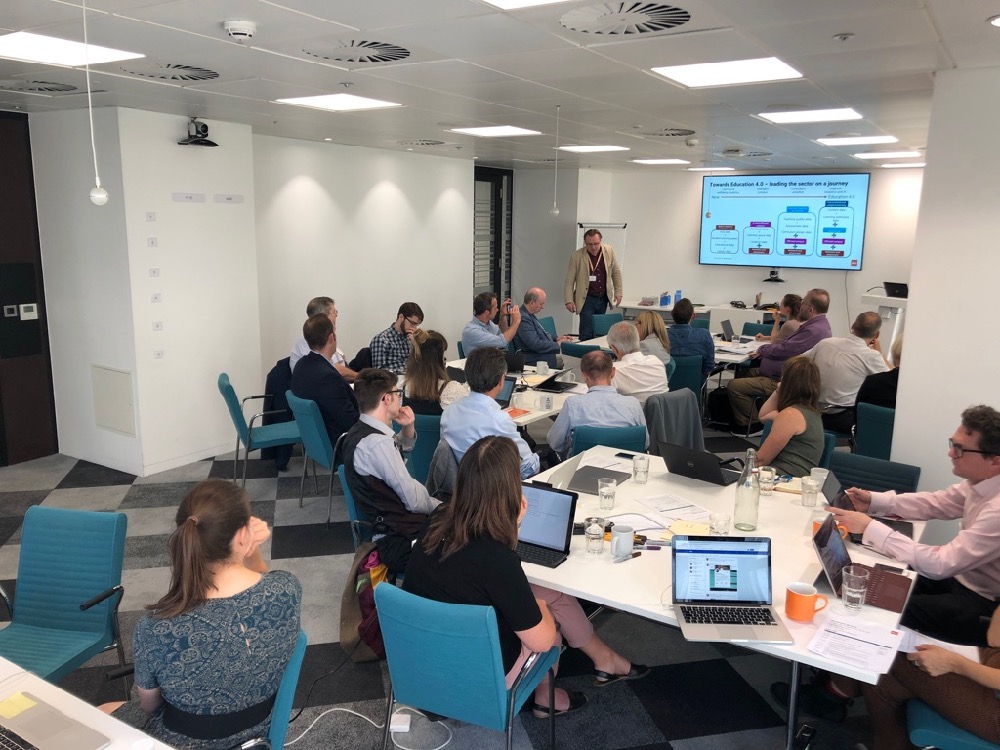
Thursday I was back in London for the Jisc Horizons meeting on assessment. The aim of the meeting is to explore the future of assessment in universities and colleges and how technology could be used to help address some of the problems or opportunities we face. My main role for the day is to act as a scribe noting down the comments and ideas from the participants.

It was an exhausting day, but I do feel that we delved deep into the assessment space and identifying some of the challenges and problems universities and colleges face. We also identified some of the opportunities that are out there as well. What can Jisc do in this space, well we’ll discover that later this year.

I also wrote a blog post reminiscing about the Jisc Pedagogy Experts meeting I had attended back in 2007, twelve years ago.

On Friday I was back to the Bristol office, twice in a week. I had various back to back meetings.

In the afternoon we had the knowledge call on presentation skills. Though attendance was low the format appeared to work well. I used a tweetchat format, but used Teams as the platform.

My top tweet this week was this one.

Giving feedback….

Jisc Pedagogy Experts Group meeting in Bristol

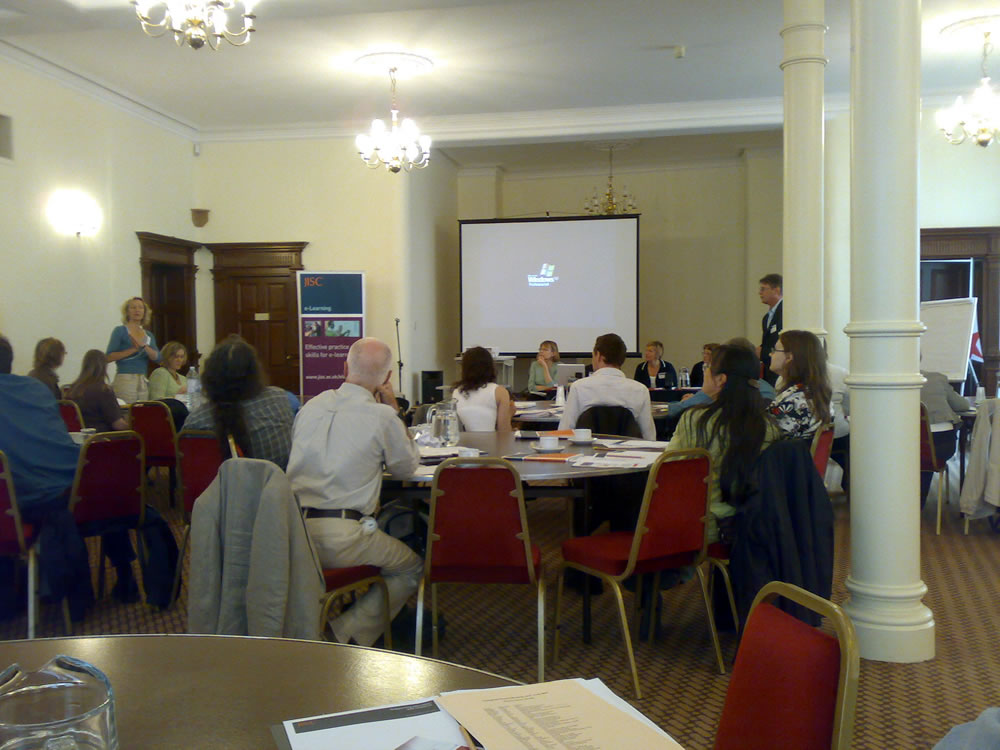
I was reminded today by Amazon Photos that twelve years ago in 2007 I had attended a Jisc (or should that be JISC) Pedagogy Experts Group meeting in Bristol.

I did blog about the meeting. This was one of the first blog posts I wrote for this blog, but I had been blogging for a few years on my old Western Colleges Consortium blog.

The meeting brought together people from across the UK.

The aim of the meeting is to inform the group of the current issues and investigations into many of the JISC e-learning Learners’ Experience projects, also to consult the experts own expertise in relation to learners’ experiences.

It was not a meeting, much more a discussion and not a series of presentations with a few questions.I was on a panel in the afternoon looking at how can we help to meet learners’ changing needs and expectations.

I remember one session, where we were split into groups, and we were discussing learner experiences. We were challenged to provide feedback using a single PowerPoint slide. I decided that this didn’t give us much choice, so myself and Alistair McNaught decided to give our feedback as a rap. I used Garageband on the Mac and provided the background drums and music, and Alistair did the rapping. Luckily for everyone it wasn’t recorded, so the rap is now merely a memory….

Blended Learning – Weeknote #16 – 21st June 2019

London

It was Monday, so as well as having a few online meetings, responding to e-mails, I was also writing stuff too. There was an interesting discussion on the Twitter about the term blended learning. Started off by this tweet from Peter Bryant.

I do agree with the sentiment of Peter’s tweet that the assumption blended is somehow better than other kinds of learning is flawed.

Reflecting on this more I thought about it, I realised that we’ve always had “blended” learning.

I posted my response to his tweet.

There are many ways to deliver learning (is that even a thing, can you even deliver learning) and ways for people to learn. My experience is that people like to learn in different ways and in different contexts depending on what they are learning, how they are learning, with whom they are learning, the topic, the subject and even the outcome of that learning and how it will be assessed. Don’t fall into the trap of learning styles, thinking that each individual has an individual way of learning, as the way in which people learn varies all the time and what works one day, may not work for them the following day. Sometimes your don’t even have a choice about certain aspects, as in I have to attend that compulsory lecture regardless of how I actually feel about it and the subject.

I think technological advances have allowed people a much wider choice of ways to learn. I expanded this in another tweet.

Since writing that tweet, I realise that the control aspect is both enhanced and diminished by the advances in technology.

We want to “measure” learning by using tools such as the VLE, whilst students can subvert that control by using tools such as WhatsApp or historically Facebook groups (are Facebook groups still a thing these days?).

So what do you think? Is blended learning new or has it always been here?

Tuesday I was back in London, it was warm and sunny and we had blue skies, alas as the day went on it started to rain. I was in London for an event by London Higher on research they had undertaken on commuting students, and the impact of commuting on student outcomes and wellbeing.

I made a sketch note of the event.

These sketch notes are mainly for my benefit, as they collate and coalesce my thoughts from the event.

The event took place at the BT Tower and I did initially think we would be at the top of the tower, alas it wasn’t meant to be, the event took place in a room on the ground floor. I was close, but not close enough.

In between meetings I went to a new coffee place and enjoyed a flat white as I caught up with my correspondence.

In the afternoon I was off to the RVC for a meeting with an old friend to discuss learning and teaching in higher education and her thoughts about what Jisc can do in this space.

The end of the week saw me once more off to London, this time for a meeting with officials from the DfE. It was really nice and sunny compared to Tuesday.

Oh had more coffee as well…

My top tweet this week was this one.

State of play updated

On this day nine years ago I was presenting and giving an  overview of the current state of play of mobile tech and MoLeNET for the JISC Cetis Mobile Tech Event on the 15th June 2010 in Bolton.

Here are the presentation slides I delivered.

I created the slides in Apple’s Keynote application before saving them as images which I then imported into Powerpoint.

I thought it would be interesting to reflect on what we thought then was the state of play then and what the current state of play is.

June 2010 was just two weeks after the iPad was available in the UK and people were still wondering what to do with it and what it’s potential was, I used the image of iPad boxes to show that this was going to be a “something” and I think we can say it certainly had impact. 

Not just putting the tablet as a mobile device into the heads of consumers and educators, but also the influence it had on smartphones as well. I don’t think we would have the huge large screen smartphones we have today if it wasn’t for devices such as the iPad and notably the iPad mini.

In most of my presentations I usually put a slide like this in.

There was still a culture of presenters asking people to turn off devices, give me your full attention and all that. Today I think we have more idea of if we want to use our device or not at conferences and presentations. I certainly wanted people to think about what I was saying, but also join in the conversation using new tools such as the Twitter!

In the presentation I started to look at the news headlines of the day

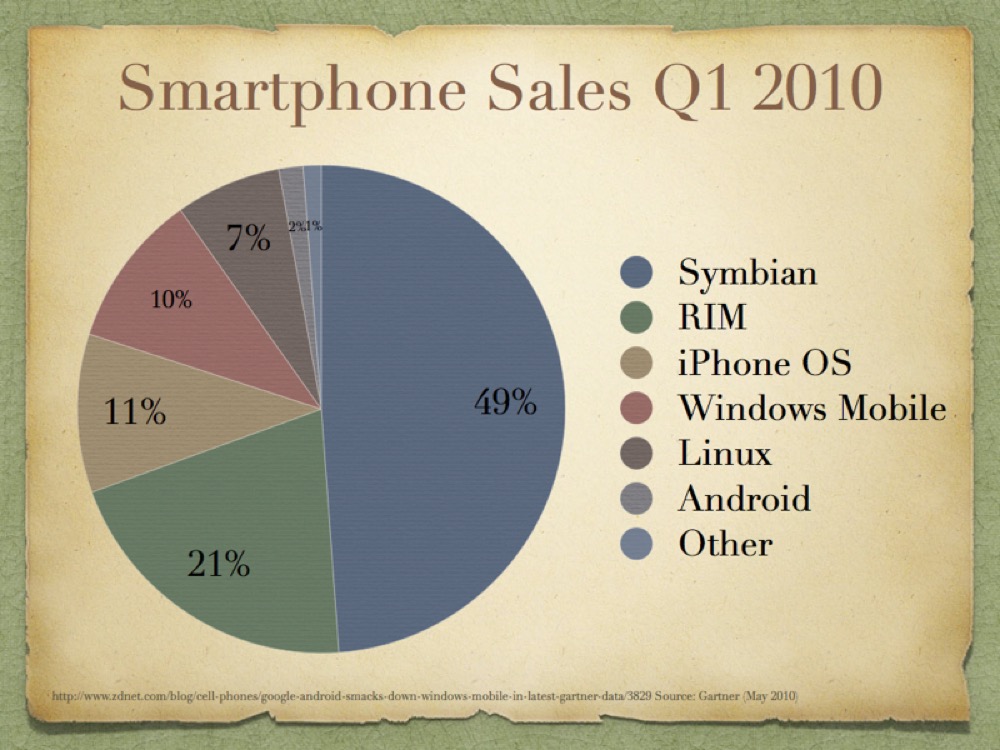
Apple had released their iPhone in 2007, now three years later it was having a huge impact on the market for phones.

Today the figures are somewhat different, there is no more sign of Nokia, RIM, HTC or Motorola, but look how Samsung dominates that market along with Huawei and other Chinese manufacturers.

Another headline was the success of the iPad.

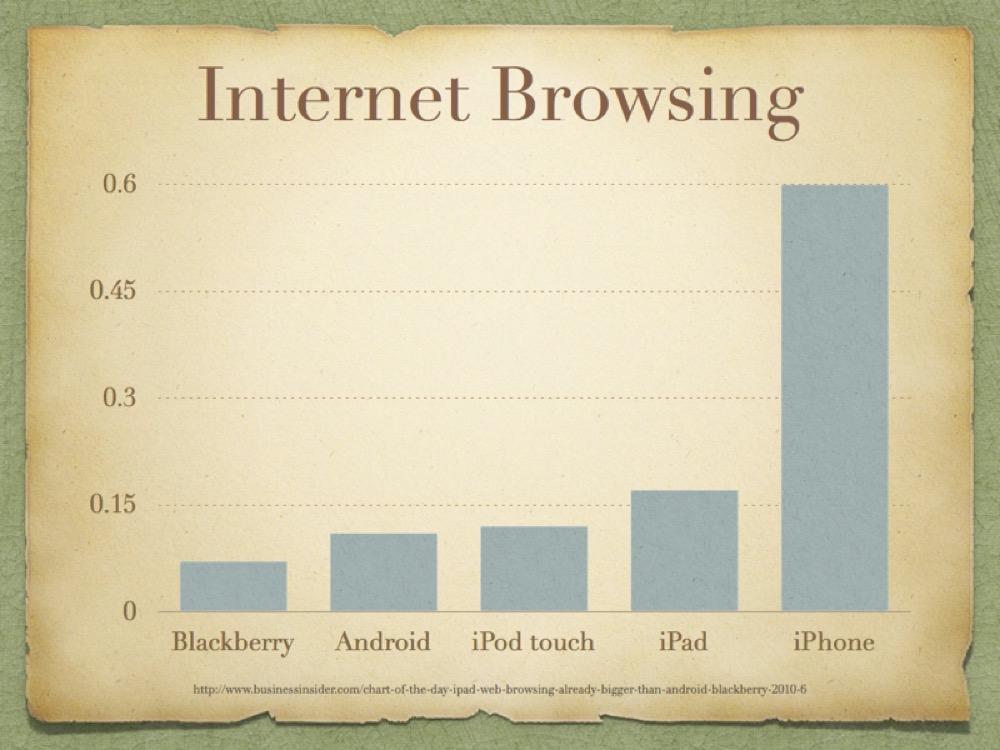
What was interesting was how much the iPhone (and the iPad) were used to browse the mobile internet back in 2010.

Today most smartphones are capable of web browsing, mainly as most websites are now mobile optimised, making it a much easier experience than trying to navigate a desktop enabled site on a mobile browser. The other big change has been the growth of smartphone apps.

Back then the data limits with mobile contracts was really limiting.

Though these limits are still here today, having an unlimited data contract is no longer the realm of business accounts, consumers and students can access contracts with unlimited data more easily and quite cheaply as well. The data landscape has changed as well with 4G speeds being widespread and we are on the edge of the 5G world as well. The other factor that has changed is the widespread availability of wifi.

I really find these data usage patterns for the O2 network for 2010 incredibly low compared to today.

I have been known to use between 50GB and 100GB per month on my mobile contract.

What’s the difference?

Hello Netflix!

I then had a link to a Jisc report published in 2009, on issues in mobile learning.

Identifying Emerging Issues in Mobile Learning in Higher and Further Education: A report to JISC

This report describes the results of a series of discussion workshops where experts and experienced practitioners explored visions of how mobile technologies and devices will influence practice in Higher Education (HE) and Further Education (FE) in the near future. The workshop series was funded by the UK’s Joint Information Systems Committee (JISC) as part of the Emerge Community within JISC’s own Users and Innovation research programme. This exploration focused on identifying emerging issues for the sector arising from the increasingly likely large scale use of Smartphones, PDAs and camera phones by learners in HE and FE, both on campus and in the workplace. 

One of the things that is apparent from the report is how different mobile learning was back then compared to now. The main difference is the increase in bandwidth and connectivity. Then there was quite a bit of reliance on offline mobile learning and SMS texting. Today we see the use of mobile optimised web sites and apps.

However some of the issues in the report, highlighted in my presentation are still relevant today.

Training is still an issue, and not just with the technical side of things, understanding the affordances of mobile devices and mobile learning as well isn’t something that just happens and people instinctively know.

As discussed above, the issue of connectivity. Luckily today we have much better and more reliable wifi and mobile connectivity. This allows for mobile learning without the learner having to worry about being connected. Faster speeds allow for real time video chat, as well as streaming high quality video whilst on the move.

Collaboration back then often meant asynchronous textual conversations, as poor or expensive connectivity meant that real-time chat and conversations were not a possibility. Today collaboration is so much easier and can be done with audio or even video chat.

I also mentioned the Twitter.

As well as issues I also in the presentation talked about the fears that practitioners often felt when it came to mobile learning.

The cultural shift towards the use of mobile devices and learning whilst mobile, was something that hasn’t really gone away. 

There is still resistance to change despite advances and increases in the use of mobile technology. Often though people are happy to discover and use mobile devices for their own stuff, using mobile devices for learner is still a step too far for some.

One reference I think still stands is how as learning technologists we often think we come over as Luke Skywalker, here to “save you”.

We do need to remember that others mainly see us as…

Resistance is futile.

One important aspect that is equally important today was privacy.

With the increase in data gathering, location data gathering and increase in analytics, what was a real issue in 2010 is a much bigger issue today.

Having discussed the state of play back in 2010, I then went into discuss the MoLeNET project.

It’s interesting to see what has changed and what has remained the same.

References 

Clay, J. 2010 ‘Mobile: The State of Play (featuring MoLeNET)’ [PowerPoint presentation] Available at: https://www.slideshare.net/jamesclay/state-of-play . [Accessed 14 June 2019].

e-Learning Stuff. 2010. Mobile: The State of Play (featuring MoLeNET). [ONLINE] Available at: https://elearningstuff.net/2010/06/15/mobile-the-state-of-play-featuring-molenet/. [Accessed 14 June 2019].

Wishart, J & Green, D 2009, Identifying Emerging Issues in Mobile Learning in Higher and Further Education. JISC (Joint Information Systems Committee), Bristol.

Realising the potential…. – Weeknote #15 – 14th June 2019

Senate House

Another Monday and another day back in London. The weather was awful, it’s June, it’s supposed to be dry and sunny, but all I had on Monday was rain and then more rain.

Tuesday was going to see me flying off early to Edinburgh for a meeting on Wednesday, however a last minute cancellation, meant that I changed my travel plans. I was also supposed to be going to our Harwell office on Friday, but that meeting was cancelled as well.

We had a short meeting about place, I mentioned in a previous weeknote about the Bristol One City project.

Student Experience 2030 – Weeknote #09 – 3rd May 2019

Having more time this week, enabled me to crack on with some reading and writing, as well as reflection about future events and meetings I am attending. I was reading and reviewing a range of internal documents.

One document I reviewed again was the government’s EdTech Strategy.

Realising the potential of technology in education: A strategy for education providers and the technology industry

DFE Edtech Strategy

For me some key areas need further discussion and development, how does technology support learning and teaching and the importance of digital leadership (which is not quite the same thing as leadership).

Friday saw us discussing the usage of Teams in higher education as a… Well I was going to say replacement for the VLE, but that implies that the VLE is one thing and Teams is another thing, but they are not the same thing.

I have always thought of the VLE as more of a concept rather than a specific product. A virtual learning environment (VLE) can have a range of functions and services. Certain products and fulfil some of these functions, others may plug into the product or live alongside it. So you could have Moodle as your core within your VLE, but have WordPress connected in to provide a blogging platform and Mahara to be the portfolio tool.

Microsoft Teams has many functions that enable it to be used as a core of the VLE, into which other functions could be connected or plugged in. It has all the functions you expect from a VLE or LMS, such as content, communication (individual and group) and assessment.

Teams Apps

The Apps ecosystem certainly enables a much wider range of functions, though certainly apps and functions appear to be “missing”.

Microsoft Teams is the digital hub that brings conversations, content, and apps together in one place. Create collaborative classrooms, connect in professional learning communities, and communicate with all staff – all from a single experience in Office 365 Education.

There are already universities and colleges out in the sector using Teams as their VLE, I am interested in not just who is using Teams as their VLE, but also how they are using it, and how embedded it is into practice.

One of the feature of Amazon Photos which I use to back up my digital image archive is it shows what photographs you took on the same date in previous years.

Twelve years ago in 2007 I was drinking coffee at my desk in the old Gloucestershire College Brunswick building in the heart of Gloucester Anyone else remember BBC Jam?

BBC Jam mug

Fifteen years ago this week I was taking photographs of a building site to demonstrate the differences between a range of digital cameras.

This photograph was taken with a Sony Cybershot camera.

construction site

This one was taken with the digital photo feature of a digital video camera.\construction site

This was taken with a Canon EOS 300D DSLR.

construction site

I also used a proper DSLR lens with optical zoom to show the difference between optical and digital zoom.

construction site

This was taken from the same location as the photos above.

My top tweet this week was this one.

news and views on e-learning, TEL and learning stuff in general…