
I was on leave this week, so no weeknote this week.
My top tweet this week was this one.
Personally I would blame Eric. 😉
— James Clay (@jamesclay) August 15, 2019

I was on leave this week, so no weeknote this week.
My top tweet this week was this one.
Personally I would blame Eric. 😉
— James Clay (@jamesclay) August 15, 2019

Monday was another trip to London, I had been expecting to participate in a workshop, but this was cancelled late last week, and I already had train tickets and another meeting in the diary so decided to head up anyhow. The weather was changeable, raining whilst on the train, but this cleared up by the time I arrived in London.
I saw this link in my news feed and it did make me think more about how we could use AI to support learning, but also reflect on some of the real challenges in making this happen. Also do we want this to happen!
I wrote a blog post about some thoughts I had on this.
In the afternoon in the office we were discussing Education 4.0 and how we are going to move this forward in terms of expert thinking and messages.
Tuesday was a busy day, first a meeting in the Bristol office, before heading up to Cheltenham for a meeting the HESA office.

I haven’t been on a CrossCountry train for a while now, so travelling to Cheltenham Spa from Bristol Temple Meads I was interested to see how the 3G connectivity issues I’ve always had on that route would be like, especially as I now have 4G with Three. Well same old problems, dipping in and out from 4G to 3G as well as periods of No Service. I would like to blame the train, but the reality is that there is poor phone signal connectivity on that route. As there is no incentive for mobile network providers to improve connectivity.
If I do go to Cheltenham again, I think I will take a book!
We were discussed the Data Matters 2020 Conference, which is now in my portfolio. Still a work in progress and the proposal needs to be signed off by key stakeholders.

Whilst I was in Cheltenham I bumped into my old colleague Deborah from Gloucestershire College and we had a chat about stuff. What was nice to hear was the number of my team and colleagues in that team that had started there in learning technology and were now doing new and more exciting jobs at universities across the UK.
Wednesday there was rain. I spent today preparing for a meeting in the afternoon and tidying up my inbox. Though I did find time for a coffee.

Thanks to Lawrie for the link, I read this report on the iPASS system, which uses data and analytics to identify students at risk.
The three institutions increased the emphasis on providing timely support, boosted their use of advising technologies, and used administrative and communication strategies to increase student contact with advisers.
This report shows that the enhancements generally produced only a modestly different experience for students in the program group compared with students in the control group, although at one college, the enhancements did substantially increase the number of students who had contact with an adviser. Consequently, it is not surprising that the enhancements have so far had no discernible positive effects on students’ academic performance.
Looks like that it didn’t have the impact that they thought it might.
In a couple of weeks I am recording a podcast and met with the organiser today to discuss content and format. Without giving too much away, we will be covering the importance of people in any digital transformation programme and ensuring that they are part of the process, consultation and are given appropriate training in the wider context of their overall skills and capabilities. You can’t just give people new digital systems and expect them to be able to use them from day one or with specific training. Familiarity with digital in its wider context is often critical, but is equally often forgotten.
Whilst writing a blog post about online learning I wrote the following
Conversations are really hard to follow in e-mail, mainly as people don’t respond in a linear manner, they add their comment to the top of their reply.
When I first started using e-mail in 1997, well actually I first started using e-mail in 1987, but then got flamed by the e-mail administrator at Brunel University, so stopped using it for ten years….
When I re-started using e-mail in 1997, there was an expectation when replying to e-mail that you would respond by writing your reply underneath the original e-mail, bottom posting, which really was something that I got from using usenet newsgroups. This from RFC 1855.
If you are sending a reply to a message or a posting be sure you summarize the original at the top of the message, or include just enough text of the original to give a context. This will make sure readers understand when they start to read your response. Since NetNews, especially, is proliferated by distributing the postings from one host to another, it is possible to see a response to a message before seeing the original. Giving context helps everyone. But do not include the entire original!
By the early 2000s lots more people were using e-mail and most of the time they were replying at the start of the e-mail, top-posting. There were quite a few people in my circles who continued to bottom post their replies, which made sense when reading a threaded conversation, but confused the hell out of people who didn’t understand why someone replied to a conversation, and from what they could see, hadn’t written anything!
Today top-posting appears to be the norm and I can’t recall when I last saw someone responding to an e-mail by replying at the end of the quoted reply.
Here is the blog post I wrote, about how online learning doesn’t just happen.
Friday was about planning, planning and even some forward planning. One thing that has puzzled me for a long time was the difference between forward planning and planning. Thanks to Google I have a better idea now.
Forward planning is being pro-active, predicting the future and then planning to achieve that prediction.
The opposite is backward planning, which is more reactive, you wait until you get a request or management decision then create a plan to achieve it.
So what is plain and simple planning then?
Wikipedia says that planning is the process of thinking about the activities required to achieve a desired goal.
So some of what I am doing in my planning is responding to both requested goals and planning for some predicted goals.
We had our weekly meeting about the Technical Career Pathways we are developing at Jisc. I am responsible for the Learning and Research Technical Career Pathway.
My top tweet this week was this one.
There was also quite a few diesel engines on the @southdevonrly as well. pic.twitter.com/ukupTqxF09
— James Clay (@jamesclay) August 2, 2019

On Monday I was off to London. I was originally planning to be in a workshop, but that didn’t work out, so I made the most of my trip to touch base with some key people in our London office. I spent some time planning a training and development session on presentations. This follows a talk I gave at an internal TEDx event.
The talk was about designing powerpoint slides and presenting information.
For the training and development session on presentations I will expand this into an interactive session that will cover presenting and presentations in more depth. The participants will need to design and deliver a five minute presentation as part of the session.
I will be helping them to understand what makes an effective presentation, some important aspects to consider when trying to communicate a message, how to focus on and reinforce key aspects of that messaging, as well as how to manage a Q&A session after presenting. I will be mentioning fonts and images. I will attempt to not mention clip-art!

Tuesday was another trip to London to meet with some consultants be part of a workshop to discuss and plan our messages for current and future public affairs. In order to get to the meeting I caught the tube to Blackfriars and crossed the Thames to Southwark. I have not been to that part of London before so was curious to see what was around as I walked to the meeting. The railway bridge over the Thames had a huge crest not quite attached to it which I found quite fascinating.

The bridge was once part of the London, Chatham and Dover Railway network. This rail company was formed in 1859 and the crest is dated five years later 1864. It formed a union with the South Eastern Railway and though not formally merged they operated as the South Eastern and Chatham Railway. In 1923 it was merged with other rail companies to form Southern Railway. The line became part of British Railways following nationalisation in 1948. It remained part of British Railways (and from 1965 when it traded as British Rail) until re-privatisation in 1992. Services are now operated by Thameslink.
I used the phrase “not quite attached to it” as the original structure of the original Blackfriars Railway Bridge deteriorated until it was unsound. In 1961, two tracks were removed from the bridge to ease its load. The bridge was eventually removed in 1985. The current “bridge” is in fact Blackfriars Station now. The crest, which was restored in 1990, and the abutments are a listed building.
Wednesday I was in the office in Bristol for my end of year review, which I feel went well, despite it being an odd year with a role change mid-year. The office was packed and there were lots of people I hadn’t seen in a while, so it was good to catch up.
I spent quite some time reviewing operational plans in the context of the higher education strategy that we have which was an interesting exercise.
I have been given the task of leading on an Education 4.0 roadmap and it has been challenging to find suitable time in people’s diaries during the summer, as a lot of people are taking holiday.

Thursday I was off to London again, third time this week, an earlier train as I was travelling over to Queen Mary, University of London in East London. This was another part of London I had not been to before. It was a bit of a trek on the underground from Paddington to Mile End, but at least I didn’t have to change tubes.

We were having a round table discussion on how Jisc supports TNE for Jisc members. I gave a short presentation on how Jisc works in the HE learning and teaching space. We did though branch out into a wider educational technology discussion and I spent some time discussing the concept of the Intelligent Library. This I have spoken about before at various events across the UK.
An aspect of the discussion was use cases that could then drive how such a concept could be implemented. One we discussed was providing assessment information to libraries in a way that would support them in their provision of the library service.
I spent the afternoon working in our office in Fetter Lane.

Friday was a time to participate in a meeting about the Learning and Research Technical Career Pathway I am developing at Jisc. I have made some progress, but still have some way to go to. I also took the time to undertake some planning.
My top tweet this week was this one.
The Beatles #TOTP
— James Clay (@jamesclay) July 30, 2019

This week, we melted, we had a new Prime Minister, we had a new government and I didn’t go to London.
Monday I was back into the office to do what I initially thought was going to be a demonstration of Jira and Confluence, but in the end turned more into a discussion on how people are using the tools across Jisc.
Had to make a phone call on Monday, something which in work I don’t actually do that often. I make lots of audio conferences and skype calls, but I don’t use the phone as much as I have in other roles. I am part of a telephony project at Jisc and as a result I am now using Teams for making and receiving calls. It was a seamless experience, and it was nice making a call using a sound cancelling headset with microphone, rather than holding a handset or mobile phone to my head! I did feel that it was somewhat odd to use my laptop to dial the number rather than a number pad. A few years back I was looking a telephony and I remember thinking back then that there was a real culture shift needed by organisations moving from traditional PBX (Private Branch Exchange) system to a modern telephony system used through Teams. Even now I think there is still need for a culture shift that isn’t easy for some people to just get and then move on.
This week, eleven years ago I wrote a blog post about the CherryPal mini PC which cost $249.

It was funded by advertising…
Today you can buy a better specified Raspberry Pi for under £35 and no advertising.
How things change….
Decided that I would become a Thought Leader and luckily for me, and thank you to Lawrie Phipps for the link, there is a course to do this on LinkedIn Learning…
I’ll let you know how I get on.
I wrote a blog post in response to a tweet I had seen earlier this year about using facial and emotion recognition with gauge the degree of student engagement in a lecture.
This week ten years ago I saw this video from Steve Boneham about something called micro-blogging…
Wonder if it ever caught on….

Talking about data, read this Guardian article, ‘Anonymised’ data can never be totally anonymous, says study.
“Anonymised” data lies at the core of everything from modern medical research to personalised recommendations and modern AI techniques. Unfortunately, according to a paper, successfully anonymising data is practically impossible for any complex dataset.
The article discusses the how data which has been anonymised data can in a number of methods be deanonymised to identify real people.
This has implications for universities and colleges, who are looking at using deanonymized data for intelligence and informed decision making.
If you think of anonymised data tracking students movement across campus, using wifi, this could be easily deanonymized using attendance data, swipe card data, PC logins, library card data.
Something to think about. The research is published in the journal Nature Communications.
Thursday, I was going to go to London for a meeting with colleagues from the DfE. However due to the heat we decided to have the meeting virtually. Though there are advantages in meeting face to face, the fact we now have the technology to make meetings virtual means that we don’t need to cancel or re-schedule meetings. There are also affordances with virtual meetings, I like using the chat to post relevant links rather than interrupt the flow of the meeting. The fact the links are “live” and saved, means people don’t a) need to copy them down or b) wait until the links are e-mailed to them after the meeting.

I spent some time working on abstracts and proposals for various conferences I am attending in September. Working for an organisation like Jisc, I obviously need to talk about stuff we’re doing at Jisc. I kind of miss the keynotes I was doing ten years ago, when I had a lot more freedom on the topics and subjects I was presenting on. Back then I spent a lot of time talking about the future of learning, which the main thrust was that change is going to happen, but the important part of that journey was people, academics and students. The technology facilitates and provides affordances, but in the end it’s people who will want to change the way they do things and people will need to demonstrate leadership if they want change to happen. For the conferences in September I will mainly be talking about Education 4.0.
Friday I was back in the office in Bristol working on my preparation for my end of year review. This year has been interesting as I changed roles in March so did not complete my previous objectives and inherited a number of new objectives.
I was reminded of the problems heat can cause this week with this photograph from seven years ago in 2012, my Google Nexus One got so hot I had to put it in the fridge….

My top tweet this week was this one.
…and we're back!
So you want to go back to old Twitter?
Click More
Click Settings and Privacy
Click About Twitter
Click Directory
Click Home pic.twitter.com/PGMF4WeTFB
— James Clay (@jamesclay) July 25, 2019

Monday I was off to our Bristol office. There was quite a bit of disruption across the city with Extinction Rebellion demonstrating across the centre.
I was into the office to deliver some training on Jira for personal use. Though Jira and Confluence make great tools for projects I have been using it myself over the last few years to manage my work and individual projects.
As the main focus was on productivity, we did discuss manging e-mail and tasks. I use an Inbox Zero approach that I discovered back in 2007 when listening to a podcast.
I recently wrote two blog posts on Inbox Zero on my tech stuff blog, the first I discuss how I deal with e-mail.
In the second post I expand on that with more detail and some further thoughts.
I found the Atlassian documentation really easy to follow and provides a good starting point for users of both Jira and Confluence.
Confluence is a wiki platform for creating documentation and some companies even use it for their actual website. Jira is an issue tracking system. You can embed macros in Confluence that can show details about your Jira issues.
I did manage to get out of the office and get a coffee at a new coffee place that has opened this year.

This week on my technology stuff blog I published a post about a QR Code which failed to work ten years ago with a specialised QR Code reader on my iPhone 3GS, but worked fine with the in-built QR Code reader in the iPhone 8 camera.
In the next few weeks I have a fair few meetings in London, so I have been booking travel and hopefully it will be slightly cooler than recently, as travelling in this heat is a real nightmare.
Last week I followed my colleague, Lawrie, on Twitter as he attended an event on Microsoft Teams.
https://twitter.com/Lawrie/status/1149298660557164544
He published a blog post about the event.
I could argue various points, but these are my early thoughts. I’m remaining engaged with Microsoft Teams, I’m looking to see if this can be a “Digital Ecosystem” as we envisaged during the Co-design work.
I have always seen the VLE as a concept more than an individual product and I do like the term “Digital Ecosystem” as it kind of describes that viewpoint. If you say VLE or LMS then people think of products such as Blackboard, Canvas or Moodle. For me the VLE was something more than an individual product, it was a series of ways of working online using a range of online tools and services that were inter-connected. Teams is one such tool that can be connected into such a VLE concept.

Facial recognition was again in the news, this time the The House of Commons Science and Technology committee expressed their concerns on the technology.
MPs call for halt to police’s use of live facial recognition – BBC News
The police and other authorities should suspend use of automatic facial recognition technologies, according to an influential group of MPs. The House of Commons Science and Technology committee added there should be no further trials of the tech until relevant regulations were in place. It raised accuracy and bias concerns.
Also this week everyone was talking about FaceApp with lots of different news outlets reporting on the app and concerns people had about it. There was concerns about the biased algorithim that the app used to make people “hot” was in fact racist. There was worry over privacy and security over the use of images and even if there was Russian collusion! Of course some people thought it was all a bit of fun!
My top tweet this week was this one.
With the introduction of the new @GWRHelp IET trains we now have these wonderful HST 125 trains as our local commuter services around Bristol and North Somerset. Ace. pic.twitter.com/R2fjBrVavo
— James Clay (@jamesclay) July 15, 2019

Monday I was off to Lumen House, location of the Jisc offices in Harwell. This was for me, my first meeting of the Jisc Group Senior Leadership Team. In my new role I am now part of GSLT. We are going to be discussing strategy.
During a break I did read this article from BBC News.
Reminded me of last week’s weeknote, in which I said about the Guardian article on the same subject, Police face calls to end use of facial recognition software.
…independent analysis found matches were only correct in a fifth of cases and the system was likely to break human rights laws.
Relying on new technology for some stuff can be excused, but using unproven technology that could result in negative impacts on people’s lives is inexcusable. Actually relying on technology without a human element is also inexcusable. The number of times we hear the phrase “well the computer says…”. We need to remember that computers and software are designed by people and people can be wrong, biased and will make mistakes.

Tuesday I was back in our Bristol office and had a few meetings across the day on various subjects from our student partner programme to the Twitter.
The meeting about the Twitter was interesting as it reminded me of the many blog posts I have written about using Twitter. My overall perspective after using the Twitter for over twelve years now is that I still don’t know how to use the Twitter and saying “the Twitter” really annoys people.
Wednesday with no meetings in the diary, I decided to work from home. The office when busy can be noisy and distracting. Sometimes that is a positive thing, and sometimes distractions allow you to interact and engage with people, sometimes though you just need to crack on and get the writing done.
One of the main things I have been working on this week is mapping the Learning and Research TCP to the SIFA Framework. This will allow us to have consistency across all the TCPs in Jisc. However one area which the SIFA is lacking in is the research side, so further work will need to be done in that space.
Despite having left the project six months ago, I still get the odd e-mail about the Intelligent Campus project, having been linked to the project for so long I am not surprised. It’s an area which still interests me and I do like to keep on top of what is happening in this space not just in the HE sector, but also wider as with Smart City developments.
The University of Bristol tweeted out this week
We have been awarded £100 MILLION by @ResEngland, our partners and philanthropists!
To research and develop cutting-edge tech,
which will benefit society and change the world,
at the new Bristol Digital Futures Institute.
😮👩💻🌍
#TempleQuarter #BuiltWithUKRPIF pic.twitter.com/wXOwDWsgis
— University of Bristol (@BristolUni) July 10, 2019
They have been awarded £100million by Research England to research and develop cutting-edge tech, which will benefit society and change the world, at the new Bristol Digital Futures Institute, which will be in Bristol’s new Temple Quarter development.

Lots of discussion about the recent announcement that Alexa will start offering NHS Health Advice.
People will be able to get expert health advice using Amazon Alexa devices, under a partnership with the NHS, the government has announced.
Certainly the use of voice assistants has been growing in recent years, but also concerns about privacy, and this will only add fuel to that fire.
On Thursday I followed my colleague, Lawrie, on Twitter as he attended an event on Microsoft Teams.
https://twitter.com/Lawrie/status/1149265591582253056
https://twitter.com/Lawrie/status/1149298660557164544
It certainly sounded an interesting event and from what I hear Teams is gaining traction with the sector.
My top tweet this week was this one.
On this day ten years ago that @60163_Tornado was in town (as in Weston-super-Mare) pulling the Torbay Express. pic.twitter.com/ZtWXhbOSlA
— James Clay (@jamesclay) July 5, 2019

A busy and confusing week for me with various non-work activities taking place, resulting in a more agile and flexible way of working.
On Monday, that Amazon Photos reminded me that on the 1st July in 2007 I was taking photographs of our brand new library at the new Gloucestershire College campus on the quays.

What really impressed me back then was that my library team came in over the weekend to unpack everything and ensure that the library was ready to open. They didn’t tell me they were going to do that, as they wanted to surprise me (and everyone else as it happens). The library was welcomed by staff and students. It would take a little time to embed the use of the library across the student body, but within a year or two we were there.
At Gloucestershire College I was responsible for TEL, the libraries and learning resources from 2006 until 2013. Ofsted at our March 2013 inspection. Ofsted said “Teachers and learners use learning technologies extensively and creatively inside and outside the classroom. Most courses provide a good range of materials for learners through the college’s VLE. Outside lessons, many learners make constructive use of the college’s libraries and resources.” This was achieved by working with curriculum teams and students on show how the library and technology could be used to support learners and enhance the learning experience. I was very proud that all the work myself and my team had put into the use of learning technologies, the VLE and the library was recognised.
I quite enjoyed the tweets this week from Microsoft celebrating the 1985 initial release of Windows.
With Excel, Chart, and even Flight Simulator, there’s no telling where Microsoft and the power of Windows will take you this summer. pic.twitter.com/sEHLuXysXn
— Windows (@Windows) July 2, 2019
My first experience of Windows was some time later with Windows 3.0 and remembering the big advance that Windows 3.1 brought to computing. It was probably Windows 3.1 that really made me appreciate the affordances that technology could bring to teaching.
I remember the huge fanfare that was Windows 95 and what a step change it was from 3.1. We even had video now on Windows, though it was quite small.
I never really moved to Windows 98 and moved straight to Windows 2000 when I started a new job in 2001. Well the laptop I was provided with did use Windows Me, but I soon moved over to 2000. I liked Windows XP and thought it was a huge improvement over previous versions of Windows.
After that I was more of a Mac person and rarely used Windows. I did have to use Windows 7 for a while, but found it confusing as I hadn’t used Windows for a long time. Today I have been known to use Windows 10, but my main computing platform these days is still OS X.
Does anyone have a De Lorean?
Thinking I could do with a Word Sample Disk… https://t.co/JuLJFz7hcn
— James Clay (@jamesclay) July 3, 2019
David Kernohan of Wonkhe wrote an interesting blog post Visualising the national student survey 2019.
I’ve long argued that NSS by institution only isn’t helpful for prospective students or others – you include so many different student experiences l that an average doesn’t offer much help for understanding how your experience may compare.
He then goes through a range of visualisations including results that allows you to get as close to results for an individual course as the data allows.
I liked the use of Tableau to enable you to interact with the visualisations.
Another news item this week caught my eye. Police face calls to end use of facial recognition software.
…independent analysis found matches were only correct in a fifth of cases and the system was likely to break human rights laws.
Relying on new technology for some stuff can be excused, but using unproven technology that could result in negative impacts on people’s lives is inexcusable.
Actually relying on technology without a human element is also inexcusable. The number of times we hear the phrase “well the computer says…”.
We need to remember that computers and software are designed by people and people can be wrong, biased and will make mistakes.
On Thursday, that Amazon Photos once more gave me a blast from the past and reminded me that thirteen years ago in 2006 I had presented at the EU e-Learning Conference in Espoo in Finland. I was presenting on behalf of Norton Radstock College (now part of Bath College) about a joint European project they had been working on. At the time I was Director of the Western Colleges Consortium of which Norton Radstock was the lead college. I was on holiday when I got the call to see if I could attend, so it was a somewhat mad rush to sort out the travel. I started off in Bristol Airport and then there was a bit of a mad rush at Schiphol where I had to change to a flight to Helsinki. Schiphol is one huge airport…

Having arrived at Helsinki, I needed to get to Espoo and travelled by shared taxi to the hotel. I spent part of the evening walking around the area, before ending up in the hotel restaurant.

It was lovely and sunny, and as being so far north, the sun never really set. I also remember trying to access the BBC News website connected to the hotel wifi and being surprised by the advertising all across the BBC site. I then connected to the VPN in my office in Keynsham and all those adverts disappeared…
The conference was opened by a string quartet which I remember been something I hadn’t seen before at an e-learning conference. My presentation went down well, but the humour didn’t!

The conference meal was a little disappointing, I had been expecting a meal that would be full of Finnish delicacies and national dishes. What actually happened was we went to an Italian restaurant and had a buffet of Italian food.
It’s quite happenstance that I was reminded of that conference and trip, as in my new role I am now working with NREN colleagues across Europe on different projects,

I had some time the following day before my flight to have a quick look around Helsinki. I caught a bus to the centre and back.

As I didn’t know any Finnish I thought I did quite well to not get lost.

Spent some time reviewing and planning the Data Matters 2020 conference. I presented on the Intelligent Campus at Data Matters 2019 and in my new role the responsibility for planning the next conference falls of my shoulders.
I also spent a fair amount of time working on the Learning and Research Technical Career Pathway I am working on at Jisc.
My top tweet this week was this one.
On this day three years ago I was watching a film on my iPad. Can you name that film? pic.twitter.com/dVuem9cYyn
— James Clay (@jamesclay) June 29, 2019

It was another Monday and another day travelling to London. I was interviewing a candidate for a job. Preparation and post-processing (?) always takes longer than you think it will.
On Tuesday I spent some time preparing for the a knowledge call on presentation skills that I am leading on.
These two blog posts were very influential on my presentation style
Gates, Jobs, & the Zen aesthetic
Learning from Bill Gates & Steve Jobs
Back in 2010 I was invited to deliver a 15 minute keynote, which was then shortened to 12 minutes as other presenters had over run. I always think it’s just selfish of other presenters to run over their time slot, it’s unfair to the other presenters and the audience. A good chair will ensure that this doesn’t happen, and should cut presentations short if needed.
I always plan for the time allocated so I don’t run over. Now the accepted model for powerpoint presentations is 2-5 minutes per slide, so if I was presenting according to the accepted model I would have had no more than six slides.
So how many slides did you have?
I used ninety six slides.
Did you really?
Yes I did.
96 slides in 12 minutes – Presentation Styles
I am also going to use this link about a presentation on presentations at a recent Jisc TEDx event A duck goes quack…
Some final thoughts on presentations
Okay…
Wednesday I was in the Bristol office. It was nice to meet people, as I haven’t been in the Bristol office for a while now.
Thursday I was back in London for the Jisc Horizons meeting on assessment. The aim of the meeting is to explore the future of assessment in universities and colleges and how technology could be used to help address some of the problems or opportunities we face. My main role for the day is to act as a scribe noting down the comments and ideas from the participants.
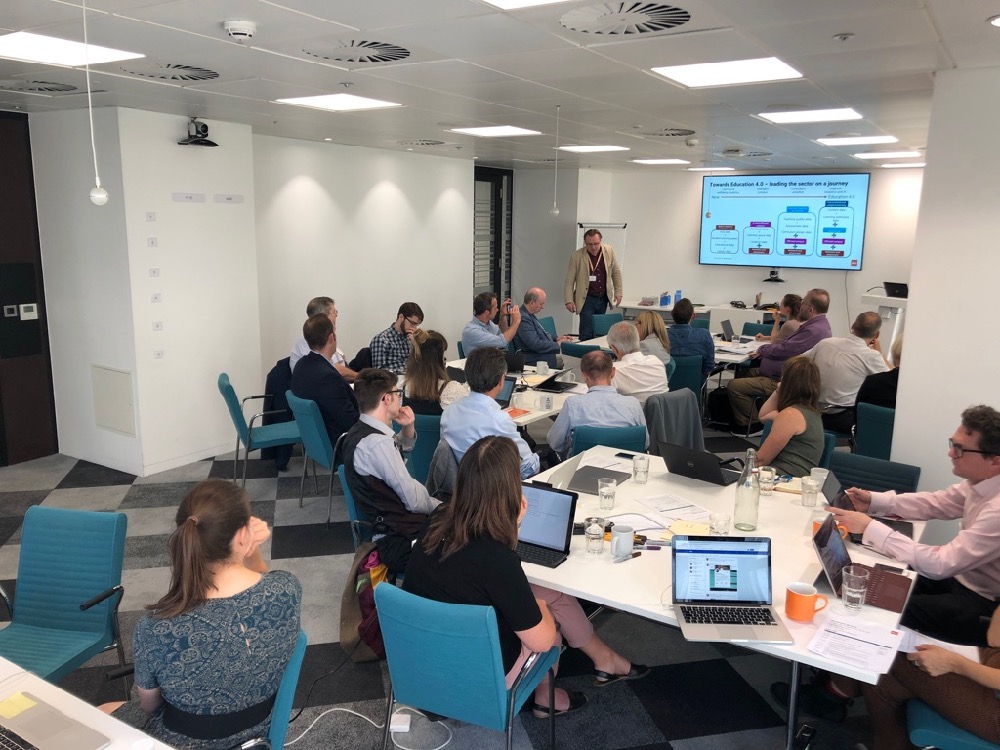
It was an exhausting day, but I do feel that we delved deep into the assessment space and identifying some of the challenges and problems universities and colleges face. We also identified some of the opportunities that are out there as well. What can Jisc do in this space, well we’ll discover that later this year.
I also wrote a blog post reminiscing about the Jisc Pedagogy Experts meeting I had attended back in 2007, twelve years ago.
On Friday I was back to the Bristol office, twice in a week. I had various back to back meetings.
In the afternoon we had the knowledge call on presentation skills. Though attendance was low the format appeared to work well. I used a tweetchat format, but used Teams as the platform.
My top tweet this week was this one.
Just dropping this into the conversation....
— James Clay (@jamesclay) June 26, 2019
Sticky campus roadshow | Jisc https://t.co/zl4XR1OiNB #AdvanceHE_chat #LTHEchat pic.twitter.com/WNo7OdegZ8

It was Monday, so as well as having a few online meetings, responding to e-mails, I was also writing stuff too. There was an interesting discussion on the Twitter about the term blended learning. Started off by this tweet from Peter Bryant.
I am finding the notion of blended learning to be increasingly problematic. Its like saying the drink has to be a milkshake because it blends fruit and milk. So, it must be good. But do you want o need a milkshake? What do you get out of drinking this blended masterpiece? #EDEN19
— Prof Peter Bryant (@PeterBryantHE) June 17, 2019
I do agree with the sentiment of Peter’s tweet that the assumption blended is somehow better than other kinds of learning is flawed.
Reflecting on this more I thought about it, I realised that we’ve always had “blended” learning.
I posted my response to his tweet.
Hasn't learning always been "blended"? In the olden days (well when I was at University) we had blended learning. We had big lectures, small discussions, working in the library, in groups, individually, working remotely, working in coffee places (well it was tea shops and pubs).
— James Clay (@jamesclay) June 17, 2019
There are many ways to deliver learning (is that even a thing, can you even deliver learning) and ways for people to learn. My experience is that people like to learn in different ways and in different contexts depending on what they are learning, how they are learning, with whom they are learning, the topic, the subject and even the outcome of that learning and how it will be assessed. Don’t fall into the trap of learning styles, thinking that each individual has an individual way of learning, as the way in which people learn varies all the time and what works one day, may not work for them the following day. Sometimes your don’t even have a choice about certain aspects, as in I have to attend that compulsory lecture regardless of how I actually feel about it and the subject.
The difference today is that certain technologies can add, enhance and improve on those blended experiences.If I watched a video on a Betamax tape to help my understanding, is watching an online video hugely different?
— James Clay (@jamesclay) June 17, 2019
I think technological advances have allowed people a much wider choice of ways to learn. I expanded this in another tweet.
In my day we used microfilm to research old newspapers, today I can do it better and quicker though an online database of papers.
So blended has always been there, maybe the problem was that learners back then were in control of their learning? Today we want to control it!
— James Clay (@jamesclay) June 17, 2019
Since writing that tweet, I realise that the control aspect is both enhanced and diminished by the advances in technology.
We want to “measure” learning by using tools such as the VLE, whilst students can subvert that control by using tools such as WhatsApp or historically Facebook groups (are Facebook groups still a thing these days?).
So what do you think? Is blended learning new or has it always been here?
Tuesday I was back in London, it was warm and sunny and we had blue skies, alas as the day went on it started to rain. I was in London for an event by London Higher on research they had undertaken on commuting students, and the impact of commuting on student outcomes and wellbeing.
I made a sketch note of the event.

These sketch notes are mainly for my benefit, as they collate and coalesce my thoughts from the event.
The event took place at the BT Tower and I did initially think we would be at the top of the tower, alas it wasn’t meant to be, the event took place in a room on the ground floor. I was close, but not close enough.
In between meetings I went to a new coffee place and enjoyed a flat white as I caught up with my correspondence.

In the afternoon I was off to the RVC for a meeting with an old friend to discuss learning and teaching in higher education and her thoughts about what Jisc can do in this space.
The end of the week saw me once more off to London, this time for a meeting with officials from the DfE. It was really nice and sunny compared to Tuesday.
Oh had more coffee as well…

My top tweet this week was this one.
That @DavidOlusoga brushed past me at Paddington, I hope he managed to catch his train, as he appeared to be in a real rush.
— James Clay (@jamesclay) June 20, 2019

Another Monday and another day back in London. The weather was awful, it’s June, it’s supposed to be dry and sunny, but all I had on Monday was rain and then more rain.
Tuesday was going to see me flying off early to Edinburgh for a meeting on Wednesday, however a last minute cancellation, meant that I changed my travel plans. I was also supposed to be going to our Harwell office on Friday, but that meeting was cancelled as well.
We had a short meeting about place, I mentioned in a previous weeknote about the Bristol One City project.
Having more time this week, enabled me to crack on with some reading and writing, as well as reflection about future events and meetings I am attending. I was reading and reviewing a range of internal documents.
One document I reviewed again was the government’s EdTech Strategy.

For me some key areas need further discussion and development, how does technology support learning and teaching and the importance of digital leadership (which is not quite the same thing as leadership).
Friday saw us discussing the usage of Teams in higher education as a… Well I was going to say replacement for the VLE, but that implies that the VLE is one thing and Teams is another thing, but they are not the same thing.
I have always thought of the VLE as more of a concept rather than a specific product. A virtual learning environment (VLE) can have a range of functions and services. Certain products and fulfil some of these functions, others may plug into the product or live alongside it. So you could have Moodle as your core within your VLE, but have WordPress connected in to provide a blogging platform and Mahara to be the portfolio tool.
Microsoft Teams has many functions that enable it to be used as a core of the VLE, into which other functions could be connected or plugged in. It has all the functions you expect from a VLE or LMS, such as content, communication (individual and group) and assessment.

The Apps ecosystem certainly enables a much wider range of functions, though certainly apps and functions appear to be “missing”.
Microsoft Teams is the digital hub that brings conversations, content, and apps together in one place. Create collaborative classrooms, connect in professional learning communities, and communicate with all staff – all from a single experience in Office 365 Education.
There are already universities and colleges out in the sector using Teams as their VLE, I am interested in not just who is using Teams as their VLE, but also how they are using it, and how embedded it is into practice.
One of the feature of Amazon Photos which I use to back up my digital image archive is it shows what photographs you took on the same date in previous years.
Twelve years ago in 2007 I was drinking coffee at my desk in the old Gloucestershire College Brunswick building in the heart of Gloucester Anyone else remember BBC Jam?

Fifteen years ago this week I was taking photographs of a building site to demonstrate the differences between a range of digital cameras.
This photograph was taken with a Sony Cybershot camera.

This one was taken with the digital photo feature of a digital video camera.\
This was taken with a Canon EOS 300D DSLR.

I also used a proper DSLR lens with optical zoom to show the difference between optical and digital zoom.

This was taken from the same location as the photos above.
My top tweet this week was this one.
Ooh the outside of the WHSmith in Weston-super-Mare looking very nice. Re-opens on Monday, looking inside though, not much has changed they still have the same @WHS_Carpet pic.twitter.com/Gy1UMc2WMx
— James Clay (@jamesclay) June 9, 2019