All posts by James Clay

Looking back – Weeknote #18 – 5th July 2019

The beach at Sand Bay

A busy and confusing week for me with various non-work activities taking place, resulting in a more agile and flexible way of working.

On Monday, that Amazon Photos reminded me that on the 1st July in 2007 I was taking photographs of our brand new library at the new Gloucestershire College campus on the quays.

Gloucestershire College Library

What really impressed me back then was that my library team came in over the weekend to unpack everything and ensure that the library was ready to open. They didn’t tell me they were going to do that, as they wanted to surprise me (and everyone else as it happens). The library was welcomed by staff and students. It would take a little time to embed the use of the library across the student body, but within a year or two we were there.

At Gloucestershire College I was responsible for TEL, the libraries and learning resources from 2006 until 2013. Ofsted at our March 2013 inspection. Ofsted said “Teachers and learners use learning technologies extensively and creatively inside and outside the classroom. Most courses provide a good range of materials for learners through the college’s VLE. Outside lessons, many learners make constructive use of the college’s libraries and resources.” This was achieved by working with curriculum teams and students on show how the library and technology could be used to support learners and enhance the learning experience. I was very proud that all the work myself and my team had put into the use of learning technologies, the VLE and the library was recognised.

I quite enjoyed the tweets this week from Microsoft celebrating the 1985 initial release of Windows.

My first experience of Windows was some time later with Windows 3.0 and remembering the big advance that Windows 3.1 brought to computing. It was probably Windows 3.1 that really made me appreciate the affordances that technology could bring to teaching.

I remember the huge fanfare that was Windows 95 and what a step change it was from 3.1. We even had video now on Windows, though it was quite small.

I never really moved to Windows 98 and moved straight to Windows 2000 when I started a new job in 2001. Well the laptop I was provided with did use Windows Me, but I soon moved over to 2000. I liked Windows XP and thought it was a huge improvement over previous versions of Windows.

After that I was more of a Mac person and rarely used Windows. I did have to use Windows 7 for a while, but found it confusing as I hadn’t used Windows for a long time. Today I have been known to use Windows 10, but my main computing platform these days is still OS X.

David Kernohan of Wonkhe wrote an interesting blog post Visualising the national student survey 2019.

I’ve long argued that NSS by institution only isn’t helpful for prospective students or others – you include so many different student experiences l that an average doesn’t offer much help for understanding how your experience may compare.

He then goes through a range of visualisations including results that allows you to get as close to results for an individual course as the data allows.

I liked the use of Tableau to enable you to interact with the visualisations.

Another news item this week caught my eye. Police face calls to end use of facial recognition software.

…independent analysis found matches were only correct in a fifth of cases and the system was likely to break human rights laws.

Relying on new technology for some stuff can be excused, but using unproven technology that could result in negative impacts on people’s lives is inexcusable.

Actually relying on technology without a human element is also inexcusable. The number of times we hear the phrase “well the computer says…”.

We need to remember that computers and software are designed by people and people can be wrong, biased and will make mistakes.

On Thursday, that Amazon Photos once more gave me a blast from the past and reminded me that thirteen years ago in 2006 I had presented at the EU e-Learning Conference in Espoo in Finland. I was presenting on behalf of Norton Radstock College (now part of Bath College) about a joint European project they had been working on. At the time I was Director of the Western Colleges Consortium of which Norton Radstock was the lead college. I was on holiday when I got the call to see if I could attend, so it was a somewhat mad rush to sort out the travel. I started off in Bristol Airport and then there was a bit of a mad rush at Schiphol where I had to change to a flight to Helsinki. Schiphol is one huge airport…

Schiphol Airport

Having arrived at Helsinki, I needed to get to Espoo and travelled by shared taxi to the hotel. I spent part of the evening walking around the area, before ending up in the hotel restaurant.

Espoo

It was lovely and sunny, and as being so far north, the sun never really set. I also remember trying to access the BBC News website connected to the hotel wifi and being surprised by the advertising all across the BBC site. I then connected to the VPN in my office in Keynsham and all those adverts disappeared…

The conference was opened by a string quartet which I remember been something I hadn’t seen before at an e-learning conference. My presentation went down well, but the humour didn’t!

EU e-Learning Conference 2006

The conference meal was a little disappointing, I had been expecting a meal that would be full of Finnish delicacies and national dishes. What actually happened was we went to an Italian restaurant and had a buffet of Italian food.

It’s quite happenstance that I was reminded of that conference and trip, as in my new role I am now working with NREN colleagues across Europe on different projects,

Helsinki Tram

I had some time the following day before my flight to have a quick look around Helsinki. I caught a bus to the centre and back.

Helsinki

As I didn’t know any Finnish I thought I did quite well to not get lost.

Helsinki

Spent some time reviewing and planning the Data Matters 2020 conference. I presented on the Intelligent Campus at Data Matters 2019 and in my new role the responsibility for planning the next conference falls of my shoulders.

I also spent a fair amount of time working on the Learning and Research Technical Career Pathway I am working on at Jisc.

My top tweet this week was this one.

Presentation Styles – Weeknote #17 – 28th June 2019

Paddington

It was another Monday and another day travelling to London. I was interviewing a candidate for a job. Preparation and post-processing (?) always takes longer than you think it will.

On Tuesday I spent some time preparing for the a knowledge call on presentation skills that I am leading on.

These two blog posts were very influential on my presentation style

Gates, Jobs, & the Zen aesthetic

Learning from Bill Gates & Steve Jobs

Back in 2010 I was invited to deliver a 15 minute keynote, which was then shortened to 12 minutes as other presenters had over run. I always think it’s just selfish of other presenters to run over their time slot, it’s unfair to the other presenters and the audience. A good chair will ensure that this doesn’t happen, and should cut presentations short if needed.

I always plan for the time allocated so I don’t run over. Now the accepted model for powerpoint presentations is 2-5 minutes per slide, so if I was presenting according to the accepted model I would have had no more than six slides.

So how many slides did you have?

I used ninety six slides.

Did you really?

Yes I did.

96 slides in 12 minutes – Presentation Styles

I am also going to use this link about a presentation on presentations at a recent Jisc TEDx event A duck goes quack…

Some final thoughts on presentations

  • When presenting read your slides out.
  • Make sure you fill with slides with as much text as possible, just so you can ask people at the back can they read them.
  • Ensure graphs and diagrams are taken from a document so that the details are unreadable even from the front row.
  • Cover your presentation with organisational branding, so that everyone knows where you are from and can be distracted from the actual content.

Okay…

  • Seriously do think about your presentation. Think of the session as a story.
  • Don’t read your slides out, use the slides to inform and talk to the audience about the stuff you did or are doing. The slides should inform this not be all the talk written down. Despite everyone saying don’t read your slides, people still do it.
  • Less is more, sometimes more is better. So don’t cover your slides in lots of text. One slide with six bullet points has less impact then six slides with a single piece of information. Use less words (or even just a single word) and expand this when you present.
    Images can be very powerful and can replace words.
  • Don’t use clipart though, go somewhere like Pixabay or Unsplash and find some decent photographic images.
  • When using graphs and diagrams, don’t just copy them from your report or Excel spreadsheet, simplify them. Do they add to the story you are telling?

Wednesday I was in the Bristol office. It was nice to meet people, as I haven’t been in the Bristol office for a while now.

Thursday I was back in London for the Jisc Horizons meeting on assessment. The aim of the meeting is to explore the future of assessment in universities and colleges and how technology could be used to help address some of the problems or opportunities we face. My main role for the day is to act as a scribe noting down the comments and ideas from the participants.

It was an exhausting day, but I do feel that we delved deep into the assessment space and identifying some of the challenges and problems universities and colleges face. We also identified some of the opportunities that are out there as well. What can Jisc do in this space, well we’ll discover that later this year.

I also wrote a blog post reminiscing about the Jisc Pedagogy Experts meeting I had attended back in 2007, twelve years ago.

On Friday I was back to the Bristol office, twice in a week. I had various back to back meetings.

In the afternoon we had the knowledge call on presentation skills. Though attendance was low the format appeared to work well. I used a tweetchat format, but used Teams as the platform.

My top tweet this week was this one.

Giving feedback….

Jisc Pedagogy Experts Group meeting in Bristol

I was reminded today by Amazon Photos that twelve years ago in 2007 I had attended a Jisc (or should that be JISC) Pedagogy Experts Group meeting in Bristol.

I did blog about the meeting. This was one of the first blog posts I wrote for this blog, but I had been blogging for a few years on my old Western Colleges Consortium blog.

The meeting brought together people from across the UK.

The aim of the meeting is to inform the group of the current issues and investigations into many of the JISC e-learning Learners’ Experience projects, also to consult the experts own expertise in relation to learners’ experiences.

It was not a meeting, much more a discussion and not a series of presentations with a few questions.I was on a panel in the afternoon looking at how can we help to meet learners’ changing needs and expectations.

I remember one session, where we were split into groups, and we were discussing learner experiences. We were challenged to provide feedback using a single PowerPoint slide. I decided that this didn’t give us much choice, so myself and Alistair McNaught decided to give our feedback as a rap. I used Garageband on the Mac and provided the background drums and music, and Alistair did the rapping. Luckily for everyone it wasn’t recorded, so the rap is now merely a memory….

Blended Learning – Weeknote #16 – 21st June 2019

London

It was Monday, so as well as having a few online meetings, responding to e-mails, I was also writing stuff too. There was an interesting discussion on the Twitter about the term blended learning. Started off by this tweet from Peter Bryant.

I do agree with the sentiment of Peter’s tweet that the assumption blended is somehow better than other kinds of learning is flawed.

Reflecting on this more I thought about it, I realised that we’ve always had “blended” learning.

I posted my response to his tweet.

There are many ways to deliver learning (is that even a thing, can you even deliver learning) and ways for people to learn. My experience is that people like to learn in different ways and in different contexts depending on what they are learning, how they are learning, with whom they are learning, the topic, the subject and even the outcome of that learning and how it will be assessed. Don’t fall into the trap of learning styles, thinking that each individual has an individual way of learning, as the way in which people learn varies all the time and what works one day, may not work for them the following day. Sometimes your don’t even have a choice about certain aspects, as in I have to attend that compulsory lecture regardless of how I actually feel about it and the subject.

I think technological advances have allowed people a much wider choice of ways to learn. I expanded this in another tweet.

Since writing that tweet, I realise that the control aspect is both enhanced and diminished by the advances in technology.

We want to “measure” learning by using tools such as the VLE, whilst students can subvert that control by using tools such as WhatsApp or historically Facebook groups (are Facebook groups still a thing these days?).

So what do you think? Is blended learning new or has it always been here?

Tuesday I was back in London, it was warm and sunny and we had blue skies, alas as the day went on it started to rain. I was in London for an event by London Higher on research they had undertaken on commuting students, and the impact of commuting on student outcomes and wellbeing.

I made a sketch note of the event.

These sketch notes are mainly for my benefit, as they collate and coalesce my thoughts from the event.

The event took place at the BT Tower and I did initially think we would be at the top of the tower, alas it wasn’t meant to be, the event took place in a room on the ground floor. I was close, but not close enough.

In between meetings I went to a new coffee place and enjoyed a flat white as I caught up with my correspondence.

In the afternoon I was off to the RVC for a meeting with an old friend to discuss learning and teaching in higher education and her thoughts about what Jisc can do in this space.

The end of the week saw me once more off to London, this time for a meeting with officials from the DfE. It was really nice and sunny compared to Tuesday.

Oh had more coffee as well…

My top tweet this week was this one.

State of play updated

On this day nine years ago I was presenting and giving an  overview of the current state of play of mobile tech and MoLeNET for the JISC Cetis Mobile Tech Event on the 15th June 2010 in Bolton.

Here are the presentation slides I delivered.

I created the slides in Apple’s Keynote application before saving them as images which I then imported into Powerpoint.

I thought it would be interesting to reflect on what we thought then was the state of play then and what the current state of play is.

June 2010 was just two weeks after the iPad was available in the UK and people were still wondering what to do with it and what it’s potential was, I used the image of iPad boxes to show that this was going to be a “something” and I think we can say it certainly had impact. 

Not just putting the tablet as a mobile device into the heads of consumers and educators, but also the influence it had on smartphones as well. I don’t think we would have the huge large screen smartphones we have today if it wasn’t for devices such as the iPad and notably the iPad mini.

In most of my presentations I usually put a slide like this in.

There was still a culture of presenters asking people to turn off devices, give me your full attention and all that. Today I think we have more idea of if we want to use our device or not at conferences and presentations. I certainly wanted people to think about what I was saying, but also join in the conversation using new tools such as the Twitter!

In the presentation I started to look at the news headlines of the day

Apple had released their iPhone in 2007, now three years later it was having a huge impact on the market for phones.

Today the figures are somewhat different, there is no more sign of Nokia, RIM, HTC or Motorola, but look how Samsung dominates that market along with Huawei and other Chinese manufacturers.

Another headline was the success of the iPad.

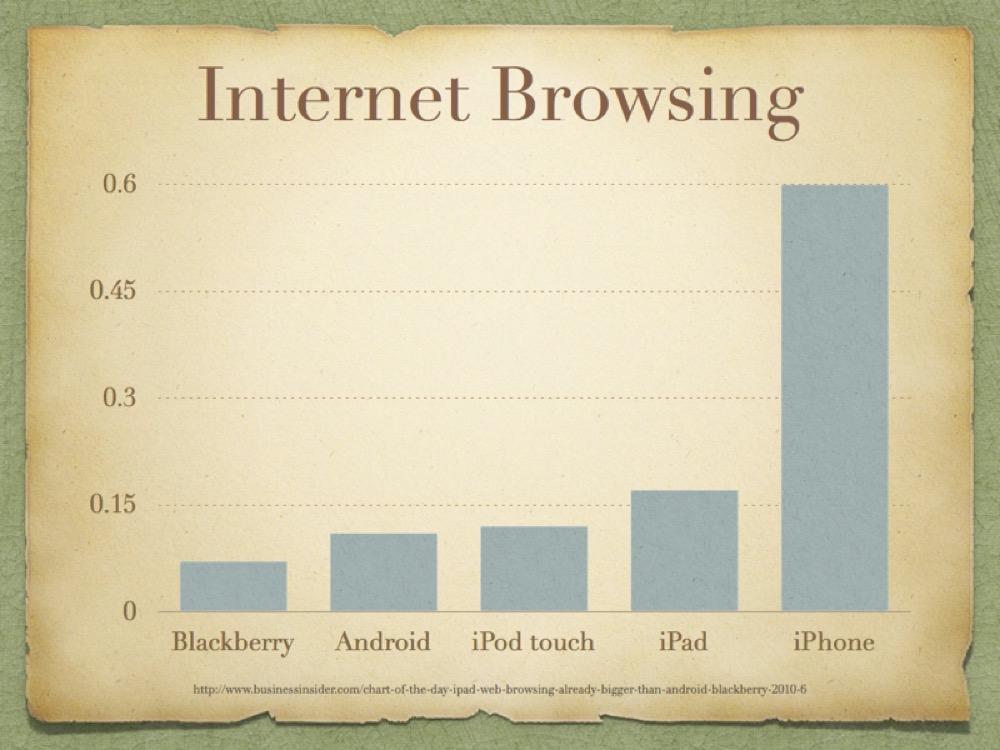
What was interesting was how much the iPhone (and the iPad) were used to browse the mobile internet back in 2010.

Today most smartphones are capable of web browsing, mainly as most websites are now mobile optimised, making it a much easier experience than trying to navigate a desktop enabled site on a mobile browser. The other big change has been the growth of smartphone apps.

Back then the data limits with mobile contracts was really limiting.

Though these limits are still here today, having an unlimited data contract is no longer the realm of business accounts, consumers and students can access contracts with unlimited data more easily and quite cheaply as well. The data landscape has changed as well with 4G speeds being widespread and we are on the edge of the 5G world as well. The other factor that has changed is the widespread availability of wifi.

I really find these data usage patterns for the O2 network for 2010 incredibly low compared to today.

I have been known to use between 50GB and 100GB per month on my mobile contract.

What’s the difference?

Hello Netflix!

I then had a link to a Jisc report published in 2009, on issues in mobile learning.

Identifying Emerging Issues in Mobile Learning in Higher and Further Education: A report to JISC

This report describes the results of a series of discussion workshops where experts and experienced practitioners explored visions of how mobile technologies and devices will influence practice in Higher Education (HE) and Further Education (FE) in the near future. The workshop series was funded by the UK’s Joint Information Systems Committee (JISC) as part of the Emerge Community within JISC’s own Users and Innovation research programme. This exploration focused on identifying emerging issues for the sector arising from the increasingly likely large scale use of Smartphones, PDAs and camera phones by learners in HE and FE, both on campus and in the workplace. 

One of the things that is apparent from the report is how different mobile learning was back then compared to now. The main difference is the increase in bandwidth and connectivity. Then there was quite a bit of reliance on offline mobile learning and SMS texting. Today we see the use of mobile optimised web sites and apps.

However some of the issues in the report, highlighted in my presentation are still relevant today.

Training is still an issue, and not just with the technical side of things, understanding the affordances of mobile devices and mobile learning as well isn’t something that just happens and people instinctively know.

As discussed above, the issue of connectivity. Luckily today we have much better and more reliable wifi and mobile connectivity. This allows for mobile learning without the learner having to worry about being connected. Faster speeds allow for real time video chat, as well as streaming high quality video whilst on the move.

Collaboration back then often meant asynchronous textual conversations, as poor or expensive connectivity meant that real-time chat and conversations were not a possibility. Today collaboration is so much easier and can be done with audio or even video chat.

I also mentioned the Twitter.

As well as issues I also in the presentation talked about the fears that practitioners often felt when it came to mobile learning.

The cultural shift towards the use of mobile devices and learning whilst mobile, was something that hasn’t really gone away. 

There is still resistance to change despite advances and increases in the use of mobile technology. Often though people are happy to discover and use mobile devices for their own stuff, using mobile devices for learner is still a step too far for some.

One reference I think still stands is how as learning technologists we often think we come over as Luke Skywalker, here to “save you”.

We do need to remember that others mainly see us as…

Resistance is futile.

One important aspect that is equally important today was privacy.

With the increase in data gathering, location data gathering and increase in analytics, what was a real issue in 2010 is a much bigger issue today.

Having discussed the state of play back in 2010, I then went into discuss the MoLeNET project.

It’s interesting to see what has changed and what has remained the same.

References 

Clay, J. 2010 ‘Mobile: The State of Play (featuring MoLeNET)’ [PowerPoint presentation] Available at: https://www.slideshare.net/jamesclay/state-of-play . [Accessed 14 June 2019].

e-Learning Stuff. 2010. Mobile: The State of Play (featuring MoLeNET). [ONLINE] Available at: https://elearningstuff.net/2010/06/15/mobile-the-state-of-play-featuring-molenet/. [Accessed 14 June 2019].

Wishart, J & Green, D 2009, Identifying Emerging Issues in Mobile Learning in Higher and Further Education. JISC (Joint Information Systems Committee), Bristol.

Realising the potential…. – Weeknote #15 – 14th June 2019

Senate House

Another Monday and another day back in London. The weather was awful, it’s June, it’s supposed to be dry and sunny, but all I had on Monday was rain and then more rain.

Tuesday was going to see me flying off early to Edinburgh for a meeting on Wednesday, however a last minute cancellation, meant that I changed my travel plans. I was also supposed to be going to our Harwell office on Friday, but that meeting was cancelled as well.

We had a short meeting about place, I mentioned in a previous weeknote about the Bristol One City project.

Student Experience 2030 – Weeknote #09 – 3rd May 2019

Having more time this week, enabled me to crack on with some reading and writing, as well as reflection about future events and meetings I am attending. I was reading and reviewing a range of internal documents.

One document I reviewed again was the government’s EdTech Strategy.

Realising the potential of technology in education: A strategy for education providers and the technology industry

DFE Edtech Strategy

For me some key areas need further discussion and development, how does technology support learning and teaching and the importance of digital leadership (which is not quite the same thing as leadership).

Friday saw us discussing the usage of Teams in higher education as a… Well I was going to say replacement for the VLE, but that implies that the VLE is one thing and Teams is another thing, but they are not the same thing.

I have always thought of the VLE as more of a concept rather than a specific product. A virtual learning environment (VLE) can have a range of functions and services. Certain products and fulfil some of these functions, others may plug into the product or live alongside it. So you could have Moodle as your core within your VLE, but have WordPress connected in to provide a blogging platform and Mahara to be the portfolio tool.

Microsoft Teams has many functions that enable it to be used as a core of the VLE, into which other functions could be connected or plugged in. It has all the functions you expect from a VLE or LMS, such as content, communication (individual and group) and assessment.

Teams Apps

The Apps ecosystem certainly enables a much wider range of functions, though certainly apps and functions appear to be “missing”.

Microsoft Teams is the digital hub that brings conversations, content, and apps together in one place. Create collaborative classrooms, connect in professional learning communities, and communicate with all staff – all from a single experience in Office 365 Education.

There are already universities and colleges out in the sector using Teams as their VLE, I am interested in not just who is using Teams as their VLE, but also how they are using it, and how embedded it is into practice.

One of the feature of Amazon Photos which I use to back up my digital image archive is it shows what photographs you took on the same date in previous years.

Twelve years ago in 2007 I was drinking coffee at my desk in the old Gloucestershire College Brunswick building in the heart of Gloucester Anyone else remember BBC Jam?

BBC Jam mug

Fifteen years ago this week I was taking photographs of a building site to demonstrate the differences between a range of digital cameras.

This photograph was taken with a Sony Cybershot camera.

construction site

This one was taken with the digital photo feature of a digital video camera.\construction site

This was taken with a Canon EOS 300D DSLR.

construction site

I also used a proper DSLR lens with optical zoom to show the difference between optical and digital zoom.

construction site

This was taken from the same location as the photos above.

My top tweet this week was this one.

Avoiding the President – Weeknote #14 – 7th June 2019

Lighthouse at Dungeness

After a lovely week off in Sussex, it was straight back into work with three days in London. I am expecting a few issues as it would appear a certain American President is also visiting London during the same three days!

Though I have been off work for a week (well four days if you exclude the bank holiday) and having cleared my inbox before I went away, I did think 110 new emails wasn’t too bad. I suspect a fair few are automated notifications. There were no direct messages in Slack, but Teams was quite busy as was Yammer.

The big story of the week when I was away was the Augar report, I spent some time reading various articles on the report.

Tuesday was a blast from the past as I attended the Jisc Digital Futures Quarterly meeting in London. This was a regular meeting I participated in when I worked in the Futures directorate. In my new role I am in a different directorate. Myself and Zoe had been invited to speak about the Technical Career Pathways. After our session and a working lunch, we sat down and we spoke about mapping the relevant sections of the SIFA framework to the Learning and Research Technical Career Pathway. Using the SIFA framework is going to enable us to provide consistency across the different Technical Career Pathways within Jisc.

Pasean restaurant

Wednesday another day in London, this time I was speaking to the Jisc e-textbook publisher strategy group meeting about the Jisc HE Learning and Teaching strategy.

It was an interesting conversation about not just the future of learning and teaching, but also some of the current projects Jisc is working on,

I didn’t see much of the Presidential visit except the huge number of helicopters flying overhead, so when I got home I was pleased to see the back of them. So you can guess I wasn’t too amused by the number of Royal Navy helicopters flying over my house on maneuverers on Thursday. Weston-super-Mare is home to the Helicopter Museum and the armed forces often fly their helicopters to that location and then back home.

I spent the end of the week going through the e-mails I had built up over the week (and the week I was off on leave).

My top tweet this week was this one.

Building digital capability three years ago…

Three years ago today I was in Birmingham for the UCISA Spotlight on Digital Capabilities conference, where I was delivering the opening keynote.

As the opening keynote in front of well informed audience on the subject I have been immersed with over the last twelve months was quite a challenge. I didn’t want to repeat the story that Sarah delivered last year, I knew I want to let people know where we are, but also to get them to start thinking about once the service is available, what else needs to happen at an institutional level.

The presentation covered where we are in terms of the Jisc Digital capability service and what it will offer universities and colleges, but also some of the challenges and thinking behind the work we have done.

It also mentioned some stories about the importance and value of digital capabilities including the infamous story of BoatyMcBoatFace.

As well as taking photographs and putting them on Instagram, I blogged about other sessions at the conference as well.

The importance of language – UCISA Spotlight on Digital Capabilities

and

Building ICT Proficiency – UCISA Spotlight on Digital Capabilities

and

Digital diversity – UCISA Spotlight on Digital Capabilities

Following on from the conference I reflected on many of the sessions and wrote the following blog posts.

Do we still need IT training teams?

and

Engaging the invisibles

It wasn’t long after that, that I swapped teams at Jisc and moved into the Further Education and Skills team. Though I would continue to work on the technical side of the Digital Capability project, I was soon immersed into the world of the Intelligent Campus.

Understanding the value more – Weeknote #12 – 24th May 2019

So the week started with a 9am start at the University of Hertfordshire. This meant travelling up the day before on Sunday. This was the second day of the University of Hertfordshire Value Study following the first day on Friday.

I was asked to facilitate various sessions, on Friday I did a session relating to that old chestnut of mine, the Intelligent Campus. Monday saw me supporting sessions on Learning and Teaching and Next Generation Learning Environments.

Whilst preparing for this session a few weeks back, I was reminded of the reports that have been published in this space by Lawrie Phipps.

The first was the report on the Next generation [digital] learning environments: present and future challenge.

The report was a response to the challenge of the following questions

  • What would an environment do for staff and students?
  • What kind of learning experiences would an environment need to support?
  • What learning and teaching practices aren’t currently supported in environments?

The report makes for interesting reading

The second report which was researched as a result of the earlier work, with the aim to gain a detailed understanding of current teaching practices in universities and colleges.

Listening to teachers: A qualitative exploration of teaching practices in higher and further education, and the implications for digital

Listening to teachers: a qualitative exploration of teaching practices in HE and FE and the implications for digital

I would recommend you read the whole report. One comment from an academic in the room was that they preferred to base their practice on academic papers rather than reports. So it nice to be able to say “and here is the link to the full paper.

Overall the day was extremely useful for both Jisc and I think Hertfordshire as well.

Tuesday was another travelling day, this time to Manchester, though I left it till the early evening to travel up.

Before I left I hosted a knowledge call on Digital Ecosystems, delivered by my colleague Lawrie Phipps.

On Wednesday I was in Manchester, I was staying in a hotel close to MediaCity, so caught the Metrolinktram into the centre of the city. I arrived in St Peter’s Square and decided to take a few photographs, including this one of a council building.

I have recently been using Amazon Photos as an online backup service for my photographs. One of the nice features is that in the app it shows you photos from the same date in previous years So I was amused to find that two years ago to the day, not only had I being in Manchester, but I had also taken some photographs including this one the same council building I had taken on Wednesday.

Mentioning this on the Twitter resulted in some amusing comments from people.

https://twitter.com/sheilmcn/status/1131137497310871552

My main reason for coming to Manchester was to discuss with colleagues possible ideas about , what would probably be described as career analytics. Using a wider range of data sources and datasets to help careers staff be informed and better understand how to support students in what they want to do in the future, or even planning what degree to take.

I had a couple of other meetings in Manchester before heading home.

After a fair few days travelling it was nice to not have to do this and work from home, however it was an earlier start than normal as I had a meeting with some European colleagues about a workshop we’re running at TNC in June in Tallinn in Estonia.

This was followed by a meeting about Technical Career Pathways and the progress we are making with these within Jisc. In my new role I am leading on the Learning and Research career pathway and the best way to describe what these are is a mechanism for people to progress their careers from a technical and skills perspective rather than through managing people.

Over the week I have been working on our HE Learning and Teaching strategy which emcompasses the student experience.

Friday I was in our Bristol office with a day packed full of calls and meetings. Some of these were about future events and conferences. The office was busy for a Friday, with a flexible working culture, sometimes the office can feel somewhat quieter than other days of the week.

My top tweet that week was this one.