Noteshelf – iPad App of the Week

Noteshelf Icon

This is a regular feature of the blog looking at various Apps available. Some of the apps will be useful for those involved in learning technologies, others will be useful in improving the way in which you work, whilst a few will be just plain fun! Some will be free, others will cost a little and one or two will be what some will think is quite expensive.

This week’s App is Noteshelf.

The most beautiful note-taking app ever designed for the iPad. Noteshelf is the handwriting note taker that features super natural digital ink, a stunning UI and a comprehensive toolset that will increase the benefits of owning an iPad by leaps and bounds.

£3.99

I am still trying to work out the best way to take notes using the iPad, actually it’s not just about making notes, it’s also about sharing notes, annotating notes and transforming notes into articles, reports and other stuff.

I have already reviewed some note taking apps before, including Microsoft OneNote for iPad and Bamboo Paper however I realised I’ve not covered Evernote in this series, though that is one app I do use a lot, maybe that’s one for another week. I will also be looking at some other note taking apps too.

I do wonder though Noteshelf looks nice and has lots of nice features, if it is too pretty and is form over function.

Noteshelf App

The key with any note taking app, is, is it easy to use, does it allow you to easily make notes, annotate stuff and also share notes. Noteshelf does work better with a stylus.

What I like about Noteshelf is that there are lots of different tools allowing you to be very creative with your note taking. You can make your notes using a variety of paper types and pens.

Noteshelf App

Not a great fan of in-app purchases in many instances, however in this app they are mainly used to add features, rather than add functionality that should be in the app in the first place.

Yes this app is a little pricey to many note taking apps, but you will have the best looking notes on your iPad.

Get Noteshelf in the iTunes App Store.

Loud Prezi

Speaker

One of the reasons I like Prezi is that it allows learners accessing the presentation to see the “whole thing” and then focus on the area of the presentation they want to review or see again. In many ways you could use Prezi presentations as part of a flipped learning approach in terms of collation of resources and links. Prezi have added a new feature that allows you to add audio to the paths in your presentation.

This is quite easy to use, the only downside I found was that I couldn’t record direct to Prezi, I had to make the recordings separately and then upload to Prezi.

I made a copy of my PSP Prezi and started to add audio to it.

You can see the original non-audio version here.

I think it adds another aspect to Prezi making it much more useful for remote and flipped delivery models.

I would prefer though to do what I can do with Apple’s Keynote and record a “soundtrack” as I present the whole presentation. At the moment I need to record individual tracks over a single flowing audio track. The end result for some parts of the presentation means that you don’t get a nice flowing narration, you get an automated railway station announcement.

Should I buy an Apple TV for my classroom?

Apple TV

I noticed the following tweet on the Twitter over the weekend and was inspired to reply.

https://twitter.com/digitalmaverick/status/310515754636279809

This kind of response is just as short-sighted and blinkered as those by people who would say “buy an Apple TV”.

I agree with the sentiment that if we work within education, then we shouldn’t waste public money, but to assume that going down the Apple TV route is a waste of money, makes too many assumptions about the context.

So why all this “fuss” in the first place? What is the significance of AirPlay and as a result the discussion over Air Server and Apple TV.

One of the features that Apple have had for many years is the ability to stream media across your wireless network to a device on that network.

You could stream your iTunes audio to the original Airport Express, which was then connected to speakers (usually better speakers than the ones on the Mac) or speakers in a different room. This was known as AirTunes.

The name was changed to AirPlay in 2010 when it could be used to stream video content from your Mac. In 2011 with the release of the iPad 2 it was now possible to stream (mirror) your screen using AirPlay.

What then excited people in education was the ability to mirror your iPad (and now your Mac desktop) over the wireless network. This meant you didn’t need to worry about cables and you could hand round your device without needing to come up to the screen.

Additionally everyone with a device could use also use the technology could use it, so if all your learners had an iPad they could all stream their screens.

Though initially such a technology was restricted to Apple devices, it wasn’t long before developers came up with solutions for other devices.

Your PC could, through the use of Air Server act as an “Apple TV” and allow devices to Air Play or mirror their screens. Software such as Air Parrot allows older Macs and PCs to stream and mirror their screens to Apple TV.

So what was initially an Apple centric solution now didn’t need a single Apple device.

So what about that tweet?

https://twitter.com/digitalmaverick/status/310515754636279809

Well if you already have a classroom setup, there is a PC, a projector then I agree an Apple TV is probably not the cheapest solution, I would also suspect that the projector doesn’t have an HDMI connection. In this instance and context then Air Server is the cheaper solution.

However this is not the only context and to say the Apple TV is a waste of money is not correct.

When equipping a new room, or replacing equipment, if you consider the cost of a PC, a projector, an IWB or an iPad, then compare that to the cost of an iPad, a TV and an Apple TV then the Apple TV solution would be a much cheaper solution. Add a wheeled stand to the TV and suddenly you have a mobile solution.

The important consideration when purchasing any equipment is not to favour one solution over another, but consider the context, what do you have already, what do you want to do, where are you going to do it.

In my libraries we have large plasma screens with a Mac mini underneath, in this instance we have gone down the Air Server route to allow us to stream through AirPlay. However if I already had the iPad and the screen, to buy a £499 Mac mini would cost a lot more than a £99 Apple TV.

It’s not about the technology, it’s about the context. Be informed and think about solutions.

Short and Sweet

Short and Sweet

So just how long should a training session be? 15 minutes, half an hour, an hour, all day, a week?

It is a challenge to both design training that covers what needs to be covered within a set timeframe, but also to ensure that it is sufficient, robust and effective. Also no one has all the time in the world for development activities, so compromises have to be made, yes a day’s training would be ideal, in reality you have an hour.

There is also no one model that fits all needs, so though this blog post is on “Short and Sweet” sessions lasting fifteen minutes, this is not the only model of development we deliver, there are also sessions lasting an hour, half a day and the odd whole day development.

One of the problems we have faced is that what we want is staff attend a training session, get all excited and inspired, hopefully then embedding the ideas and tool into their practice. However with any training session of an hour or more there is an assumption that the practitioner will find the session useful.

They might not know if it will be or not, and won’t until they attend. As a result they are likely to be cautious and probably won’t book in or attend, they don’t have the time! Of course providing information on the training in advance can help, but there is another assumption that they are aware of the training and read the information; that doesn’t always happen.

Sometimes practitioners don’t actually need training, did you ever get training in using iTunes for example, but need inspiration. They will then think about what they were shown and work on it in their own time.

Time, no one has any time anymore… I could argue for ages about how it isn’t “lack of time” that’s the problem, but “prioritisation” which is key, but you and I don’t have the time!

It was these concepts that made us think about revisiting training that was delivered to teams at a time and place to suit them (okay at team meetings), on demand, from a menu and to be quick and digestible.

I came up with the name, “Short and Sweet”, the idea was that there would be a selection of choices, and teams could pick and mix what they wanted. It also allowed me to theme the training with sweets. Well initially I was going to do just sweets, but I did think about healthy eating and all that, so I also used fruit too.

Each session was to be no longer than 15 minutes. The concept was to provide a taster, to tease and to inspire. Where possible there would be a follow up session available so that if so inspired they could then go to a more in-depth practical session.

I am also going to “digitise” some of the sessions and make them available to view on demand and on a mobile device.

I delivered my first few sessions of “Short and Sweet” and they worked well, and I did get some positive feedback. It will take as little longer to see if they have had any impact. It will also take longer to see if the concept lasts.

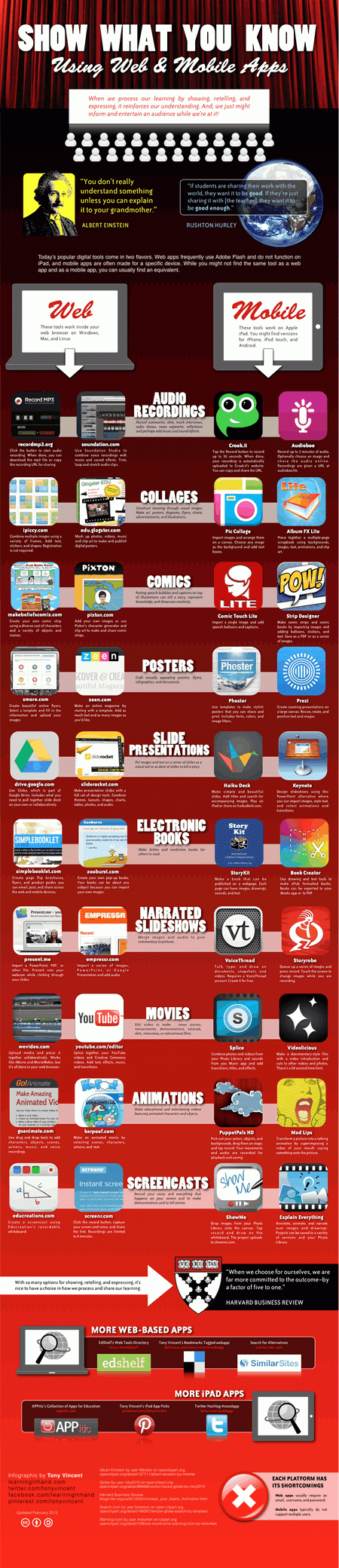
Show what you know [Infographic] – Updated

I liked Tony Vincent’s excellent Infographic on apps that can be used for different activities. He has now updated it. Click image for a larger version.

Show What You Know Infographic by Tony Vincent

This is a really useful visual guide to apps, both mobile, but also importantly similar apps that can be accessed through a browser (not everyone has an iPad).

Nowadays teachers and students have a variety of ways to show what they know and to express themselves. Take a look at some of the hottest online and mobile tools for showing, explaining, and retelling in my infographic, “Show What You Know Using Web & Mobile Apps.” These tools can turn students into teachers and teachers into super-teachers! Furthermore, most of the apps listed in the infographic are free of charge.

Update

Replaced apps that are no longer available.
Updated some app icons.
Added sections for Slide Presentations and Posters.

Via Tony Vincent’s Learning in Hand Blog.

Top Ten Web Tools of 2012

Imaginarium in Bristol

I did mean to post this back at the beginning of January, but missed my own deadline. However I have found my previous top tens from 2008, 2009, 2010 and 2011 useful so decided to get this article done.

This is the fifth time I have done this, it covers the web tools I use on a regular basis and it’s those that make a difference to the way that I work. These are not necessarily tools that I see as important for learning technologies, no these are the tools I use.

This is an e-learning blog and I should really mention Moodle, I use Moodle everyday as part of my day job, however I see this more as an institutional service rather than a web tool. I use it every day, but in a management perspective, rarely if ever, use it myself for the purpose it is intended for. Help lots of people though to use Moodle. Anyway onto my top ten web tools of 2012.

10. Evernote stays at number ten, I do use this very regularly, but certainly not as effectively as I would like. Having said that I do like how I can access my notes on any of my devices. I like how I can make audio notes, and use the camera on the iPad and the iPhone to capture handwritten notes. One feature I didn’t like very much this year was the integration with Skitch, I didn’t really want my Skitch captures in my Evernote notebooks. Another feature I think is missing from Evernote is a clever way of doing “to do” lists. I am using it in a smarter way now and I will usually look at it on a daily basis.

9. Coming in at number nine is Speakerdeck, replacing Slideshare. Slideshare in a slightly foolish in April brought in a 10MB limit on uploaded files. Most of my presentations, which I do in Apple’s Keynote, use a lot of images and are often quite large and often nearer 100MB than 10MB. So I looked for an alternative and was reintroduced to Speakerdeck. I found that I actually preferred Speakedeck (less advertising for example) and the online embedding and interface seemed to work better. I wasn’t actually that bothered about my presentations been on the Slideshare website, as I in the main used the service so I could embed the presentations on my blog and in the college VLE. Speakerdeck to me is now the better option for putting presentations online and for embedding. Should be noted that Slideshare backtracked and changed the limit back to 100MB. I also like how you can add an mp3 file to Slideshare, something that is “missing” from Speakerdeck.

8. Holding at number eight is WordPress, I still use the blogging software for my blogs. I like the flexibility it offers and it certainly works for me. I think the only thing that is missing for me is a decent mobile client or iPad app.

7. Chrome enters at number seven. I do use Chrome on my Macs and (now) my Windows PC at work. Even though I use it a lot, I do use it alongside other browsers such as Firefox, Safari and Internet Explorer. What I do like is that I can now sync my browsers across different computers and different devices. Using the Google Nexus 7 I can now see and open the tabs I was using on the iMac or the laptop. I also like how I can do the same with Chrome on the iPad. Great when you want to refer to a site, but either can’t remember the URL or how you got there. Safari does something similar via iCloud, but you need Mountain Lion and iOS 6, which I don’t have on every device.

6. Flipboard falls two places, this iPad app makes it so easy to read RSS feeds and engage with social networks. It’s not that I use Flipboard any less, more likely I am using it more, but other tools have climbed the list because of changed or extended use. Flipboard is my primary RSS reader and in many ways I also use it to browse Twitter and Facebook. The iPad app has made it so much easier to flick through and browse the news, the social news and even images. I’ve not really used the iPhone version yet, but the iPad is a key way in which I can keep up with what is going on.

5. Google+ drops three places to number five. I do like Google+, it reminds me so much of Jaiku, however as with any social network, the key and the value is the community. Though there is a great community there and I have had some great conversations, it doesn’t have the spread or depth that you find on Twitter. I find it a great place to share ideas, links and stuff; it’s just a pity that not enough people think likewise.

4. Twitter, which was number one for a couple of years, drops a place to number four. There are days when I use Twitter all the time and days when I forget it even exists. It was also the year that Twitter finally allowed you to download your archive of Tweets, which was an interesting experiment. As with all social networks the key is the community and the conversations, they are still there on Twitter, there is certainly a lot less spam then there use to be.

3. Instagram climbs three places to number three. I made a determined effort to use Instagram with my #366photos project, where I took a photo a day using my iPhone and Instagram. I did managed to do that so now have a nice collection of 366 photographs. I do like the social aspect of Instagram and I enjoy seeing the stuff that other people post. There was a little bit of a glitch with the proposed change in terms of use, but I think I will still continue to use Instagram.

2. Flickr, also climbs three places. Even though I was using Instagram more than I was the previous year, I was also posting those photographs to Flickr too. I see Instagram as much more a social network than a photography tool, whereas I use Flickr more as a tool than a network. I did add over 1300 photographs to Flickr in the last twelve months. I also used Flickr extensively for finding photographs for the blog and for many of the presentations I gave this year. For 2013 though I expect to use it a little bit more, in the main with the update to the iOS app which makes it much easier to upload to Flickr from the phone, pity there isn’t an iPad version of the App.

1. Dropbox is again my top web tool, making it two years running. It isn’t social, but I use it every day and in some cases all day. Dropbox is a fantastic tool, in the main because it works! I use to really love the concept of Apple’s iDisk, but it never worked for me, either it was too slow to be a useful cloud storage, or if syncing seemed to sync either really slowly or would forget to sync! Even it’s replacement iCloud hasn’t managed to get anywhere near the usefulness of Dropbox, fine with Apple apps, but it’s less useful when using other applications. What I like about Dropbox is that it is fast and reliable. So much so that if I have to move files from my laptop to my desktop on my home network, I usually use Dropbox as it “appears” to be faster than trying to move a file between shares across the network, and Dropbox moves the file via the internet… Virtually all my working files are now on Dropbox and I have it installed on my home and work machines. I use it for sharing files across my mobile devices and for sharing files with others when e-mail doesn’t cut the mustard. The main reason Dropbox is my number one web tool is that it just works, to the point it is transparent and it never gets in the way of me doing my stuff, which is as it should be.

Educreations – iPad App of the Week

Educations Icon

This is a regular feature of the blog looking at various Apps available. Some of the apps will be useful for those involved in learning technologies, others will be useful in improving the way in which you work, whilst a few will be just plain fun! Some will be free, others will cost a little and one or two will be what some will think is quite expensive.

This week’s App is Educreations.

Educreations turns your iPad into a recordable whiteboard. Creating a great video tutorial is as simple as touching, tapping and talking. Explain a math formula… Create an animated lesson… Add commentary to your photos… Diagram a sports play…

With voice recording, realistic digital ink, photos and text, and simple sharing through email, Facebook or Twitter, now you can broadcast your ideas from anywhere.

Free

Educreations

There are quite a few so called whiteboard apps. These apps have a blank screen onto which you can write or draw. The session is recorded, along with audio, so that you can play it back later. I was introduced to this app by a colleague at work who has been using it for a while, and I think it’s a really useful app, though it is much more useful if you create a free Educreations account. As well as creating presentations, there are also lots available from other people. As you might expect the quality does vary a lot, but they certainly give you ideas on how the app can be used.

Starting the app you are faced with a blank screen with a toolbar at the top. The process is quite simple, press record, start drawing, press stop, upload, share. The app will record your voice and what you do on the whiteboard.

Educreations

There are drawing tools and a text tool. So as well as drawing you can also enter (readable) text. You can also import a picture (or diagram) from your camera roll (or use the camera). You can pause the recording, so as you add text and images as you go along without making the animated drawing (or presentation) too long.

The key with using these apps is not to try and record it all in one go, though obviously that is faster. A little preparation will really enhance your animated drawing. It also makes sense to do some planning in advance.

I like the fact that you can have multiple pages. This means you don’t need to try and do everything on one page, but you can prepare pages in advance too.

Another clever way of using the app, is to bring an image from your camera roll. Wikimedia Commons has some fantastic graphics and images that would work really well with this app. Likewise using something like Keynote you could produce some slides to place within your animated drawing.

Once you have finished, you save your work, and then decide where it is going to go. There are various privacy options, from only you can see it, to allowing the world to share in your creation.

Educreations

You can share the link on your social networks or usefully there is an embed code that allows you to add your drawing to a web page or the VLE.

Educreations

For me one of the downsides of this app is that you can’t go back and edit what you have done, no chance of correcting mistakes or redoing sections where you messed up. You would need to start all over again. As a result I could not recommend this tool for making long drawings or presentations. Much better to do lots of short drawings rather than one long one.

It might appear that a teacher using the app to create lessons is an ideal way of using the app, but one way that it could be used, if the learners had access to iPads would be for them to create lessons and then see if they could learn from each other. It is often said that one of the best ways of learning is by teaching to others; here is an ideal tool to do just that.

Get Educreations for the iPad in the iTunes App Store.

Top Ten Technologies of 2012

I did mean to post this back at the beginning of January, but missed my own deadline. However I have found my previous top tens from 2008, 2009, 2010 and 2011 useful so decided to get this article done.

So what’s in the top ten for 2012 then? Well these are technologies that I actually use, they exclude web tools and services which I do a separate top ten for. They are generally tools that make my life easier, more efficient and more productive.

10. BT Infinity FTTC drops seven places to number ten, not because it wasn’t great and useful, but I moved in June and my new place couldn’t get FTTC so I couldn’t use it anymore. This is a top ten for 2012 and for the first six months of the year it was great and since moving back to ADSL I realise how much I depended on it. It is looking like there is very little chance of our cabinet getting upgraded in 2013, so I expect not to see FTTC in the top ten next year.

9. The Blue Snowball Microphone would probably have been higher this year, if I had used it more. I use it for recording podcasts, for doing online presentations and voiceovers. I love the way it records sound and would certainly recommend it to anyone looking for a decent, but not super expensive microphone. The main downside is that the size of the microphone makes it less than ideal for taking to events and carrying in a bag. However the quality of recordings means that I am more keen to use this then any other microphone.

8. The iMac is my workhorse computer, the one I do big things on such as movie editing, managing my photography collection, writing, large spreadsheets, desk top publishing and so much more. It is very much my truck when it comes to computing, but it isn’t that portable… The main downside with the iMac is the size of the hard disk, and I might replace it with a larger drive, but I am quite intrigued by the newer model, the one with the fusion drive.

7. My Google Nexus One is now three years old and is in terms of phones quite an old phone, almost an antique… however I do use it all the time. Mainly for tethering, I am grandfathered into an unlimited tethering plan from T-Mobile so loathe to get rid of that SIM… However it is also a great phone, and most of my Android apps work just fine on it. The big change for my was Froyo, that turned the Nexus One from an interesting phone to an useful phone. Sadly it is now stuck at Gingerbread, and Google have said that they won’t add any future updates. I think I will be replacing it this year, with what though I am not sure. One of the reasons I haven’t upgraded it was purchasing the Google Nexus 7.

6. iPhone 4 drops to number six, the main reason was iOS 6.0 which thought brought many useful features, also removed some too (looking at you Maps). I kept thinking about upgrading the phone to initially the iPhone 4S and then the iPhone 5, but though there were some nice features, to be honest none were really “outstanding” enough to make me upgrade. The iPhone 4 is still a great smartphone and was what the iPhone should have been from day one. The camera is excellent, and great for taking stills and video. The retina display still astounds me in terms of the visual quality. It’s fast enough and apps open smoothly, for a phone that will be three years old this year and I still think of it as a modern phone! Using the iPad and the Google Nexus 7 a lot this year however has made me appreciate the larger screen space that is severely lacking on the iPhone. If I have a choice then I will not use the iPhone and move to a tablet. The key question is will I upgrade this year to the iPhone 5 or the 5S, it might be time for a change.

5. Google Nexus 7 comes straight in at number five. If I didn’t have an iPad and was ensconced into the iTunes ecosystem of apps, music and films, then I think this would be much higher, possibly even number one. I didn’t think I would like the form factor, but it just works, in the main as it fits in my jacket pocket. As a result when going out I have access to a tablet device and don’t need to carry a bag, which I would need to do if I took the iPad. When the iPad mini came out and was available to play with in the Apple Stores, you would have laughed as I went to have a play and then tried to fit it into the inside pocket of my jacket, so see if it would fit in the same way that the Nexus 7 does. Was challenging as the iPad mini was cabled to the table! The main downside of the Nexus 7, well the version I have, is the lack of 3G, so I need to use wifi; it’s not too bad as I then use the Google Nexus One for tethering or free wifi in coffee shops. The screen is great and movies, books and apps look really good. The main downside for me is writing on the tablet, as the on screen control buttons are at the bottom of the screen, when I type I find that too often I hit the “home” button and drop out from what I was typing.

4. Apple TV wasn’t in my top ten last year, what made a real difference this year was AirPlay. Though I liked using the Apple TV for playing and streaming my iTunes content and showing photographs on my Mac, what I liked more was been able to stream content from my iPad and the MacBook Retina to my television. Having lost FTTC one aspect of the Apple TV I do miss was the ability to stream content I had purchased direct (again) without having to download it again, or move it back into iTunes. I think the Apple TV could do with apps, where is BBC iPlayer for example? Also no 4OD or ITVPlayer. If the Apple TV had these apps then it would be even better than before. There was a new Apple TV released in 2012 which plays 1080p content, mine is the previous model to this which does 720p content. Not sure if I would notice the difference, so didn’t upgrade.

3. The 15” MacBook Retina was almost an impulse buy to utilise the remaining part of a budget. My existing 13” MacBook Air that I use at work was then reallocated to another member of staff. I did miss the thiness and lightness of the MacBook Air, as the 15” MacBook is much bigger and heavier. However though I was expecting the screen to be good (having used retina displays on the iPhone and the iPad) I didn’t realise how good it was going to be. The retina screen is incredible and I was really really impressed with it. In my job I do read a lot of text and often I would print it out, I now read a lot more on the MacBook then i did on the previous model. It’s incredibly fast and very powerful. Part of me thinks maybe I should have waited for the 13” MacBook Retina, but I actually like the larger real estate of the 15” screen.

2. The 11” MacBook Air I have is now a couple of generations behind now, but it is still a really superb piece of kit. It’s fast, well it has an SSD inside, it’s light, the battery still lasts a decent amount of time (the 13” had a much better battery life, but the 11” is a lot more portable). It is the laptop I take with me to events and conferences. I think I probably could survive with the iPad for most events, however on the train and at the events I find I am typing a lot more. I did a fair bit of conference reporting last year and having a reasonably decent keyboard made it much easier. I have used a Bluetooth keyboard with the iPad, but even then the challenge is moving the content back to the desktop computer. If I had all my devices running the latest versions of OS X and iOS then I might be able to take advantage of iCloud, however they’re not, some are running Lion, one is running Snow Leopard! I do use Dropbox, but that doesn’t work in the same way on iOS as it does in OS X, as a result I would get multiple copies of files, something that adds to administration. The other reason for using a “proper” laptop with a “proper browser” is that some websites, including my WordPress blogs, don’t work particularly well on mobile Safari, and I’ve still yet to find an iOS app that works the way I need it to for WordPress. So though I really like the iPad, it doesn’t always do what I need and how I want to do it, for those reasons I use the MacBook Air.

1. For the third year running the iPad is my top technology. Well not quite true. The first iPad was my top technology in 2010 and 2011, even beating the iPad 2. This year’s top technology is the third generation iPad, the one with the better camera, faster chipset and retina screen. I certainly feel silly taking pictures or video with the iPad, it certainly lacks the ergonomics of a camera device. However the quality of the video on the iPad is pretty good. I was quite surprised that Apple released a fourth version of the iPad during 2012, but it’s not an upgrade I think I will make from the third generation iPad I have. I do like the retina screen, but when I first saw it, I wasn’t that impressed with the screen, but once I had one and used it everyday I was totally won over. I’ve always preferred paper for reading, until I started using the iPad retina for reading. Even I am surprised by how I now much prefer the iPad for reading over paper. Combined with the MacBook Retina my use of paper as declined considerably. If you read my reasons for making the MacBook Air number two, you might think why and how did the iPad beat it. It’s true the iPad is not a perfect device, and there are shortcomings when it comes to writing and file management. The file management side of things is awful, in theory that is solved when you use iCloud, but the reality is that, that can’t be a reality for me, well not yet. I have too many legacy items of kit I use for my different workflows. Some applications don’t work on Lion or Mountain Lion, so I need an older operating system, and of course iCloud doesn’t work on them. Also using various web systems such as WordPress and Moodle means that you need a proper browser, also there are various websites that I use that just don’t work as they should in mobile safari. Having said all that there are lots of reasons why I find the iPad such an useful device and has a real positive impact on how I do stuff. For example, I find the iPad one of the best devices I have to deal and process e-mail, it’s fast and very effective. I also like how the Calendar works and integrates with the e-mail; this is all through Exchange by the way. The browser (despite some shortcomings) is perfect for that quick browsing you do on the sofa, in meetings or at conferences. Using Chrome as well means that I can sync across various machines, well I know I can do that too with Safari and iCloud, but I think I have explained why I don’t do that, well not often. I do like the app ecosystem, I use a variety of apps for lots of different things. The apps I use on a regular basis include Flipboard, Evernote, Keynote, Pages, iMovie, iPhoto, Snapseed and then there are the games too. I have found it, using iPhoto and Snapseed a great device to use alongside my Canon DSLR, using the camera adapter I can import the photographs into the iPad and then edit them in iPhoto (or Snapseed) before uploading them to Flickr. I much prefer doing that on the iPad then on my Mac. That’s often the reason I take both the iPad and the MacBook Air to events and conferences.

Overall the iPad has and continues to be a device that changed how I worked and makes my life easier and more efficient. That’s why it’s my number one technology for 2012.

There are a few things that aren’t in the list, in the main as I don’t have them, the iPhone 5 and the iPad mini are two examples. I did seriously consider getting an iPhone 5, but haven’t got around to buying one. I think it’s the thought of having to go into a phone shop. I do like the iPad mini, but would I use one having got both the iPad and the Google Nexus 7, I think not. Also it doesn’t fit in my jacket pocket!

My workhorse of a printer, the Canon MP600R also isn’t in the list, but that does get used an awful lot. I would probably have put the HP B110a in there as initially I was very impressed with it, from both a print our perspective, but also how mobile friendly it was for scanning and printing. However after putting in new print cartridges, which killed it, I had to throw it away. So as you might expect, it’s not in the top ten.

So what were your top technologies for last year?

Flipped Learning

Flipped learning offers many opportunities for improving the learner experience. One of the challenges that is often faced is challenging the assumptions that practitioners have about flipped learning.

I do quite like this video from Aaron Sams, in which he talks about flipped learning and how it works for him and his learners.

Aaron Sams is coming to BETT in a couple of weeks and is talking on the 30th Jan.

news and views on e-learning, TEL and learning stuff in general…