Category Archives: iphone

Top Ten Web Tools of 2009

Here are my top ten web tools of 2009. This is a list of web tools which I have used extensively over the last twelve months. Last year I posted my top ten web tools of 2008, here is my new list from 2009.

There were quite a few tools that I have been using and could have been in my top ten.

I really like Screenr, simply put, it is a free web based screencasting application. It captures what you do on your screen and then converts it a web video format and posts a notification to Twitter. You can then download the video as an MP4 movie file. I like it but haven’t made a huge use of it, so that’s why it’s not in my top ten.

A similar concept is Jing, though this requires you to download an application.

iPadio is a phone based podcasting service which has now been supplemented by an iPhone app. Some of the MoLeNET Mentors have made good use of iPadio, I have really used Audioboo.

I use to have strong reservations about Wikipedia, until I realised I used it on almost daily basis. No it’s not my only source, nor is it really an authoritative source, however it is a useful, quick and easy source of information.

I do like Prezi and have seen some excellent presentations using Prezi, however despite liking it, I have never used it in anger! Therefore it does not make my top ten.

I initially couldn’t see the point of Cloudworks, however ALT-C 2o09 and Ascilite 2009 demonstrated the value of Cloudworks as a repository of information, links and comments on conferences and keynotes. I will see how I use it in 2010 to see if it makes the top ten then.

Probably in at number eleven was Slideshare. I used it much more in 2009 than in 2008. However for me the main issue was that my presentations don’t really work on Slideshare as they are mainly pictures and single words, and that’s probably why it’s not in my top ten.

This is an e-learning blog and I should really mention Moodle, I use Moodle everyday as part of my day job, however I see this more as an institutional service rather than a web tool.

There were others which are very popular and didn’t even come close, the one you probably have heard of is Facebook. I have hardly used Facebook this year and am considering as others are in closing my account down.

In last year’s list, but not in this year’s are Qik, Remember the Milk and Crowdvine. I did use Qik, but nowhere as near as much as I did in 2008. The main reason was that thw quality was good enough for people to go “wow” but that was about it. The “live” bit was okay, but not good enough to use on a regular basis. It was just as easy to record video on the iPhone and then upload to TwitVid or YouTube. I have though just downloaded the version for the iPhone 3GS and that may make a difference to how much I use it now. I still use Remember the Milk, but not as effectively as I would like, so more work needed there from me and them. I also did use Crowdvine at ALT-C 2009 and the scheduling was useful as was the communicating, but there was nothing new there compared to 2008 and therefore it dropped out of the top ten. If the social networking intergration was better I am pretty sure it would have probably creeped in. However it was too slow in picking up Twitter posts, Flickr photos and blog posts; this is very important for a conference networking tool.

Anyway onto the top ten for 2009.

10. Evernote

Now why would you use Evernote when you can use Google Docs? Well What I find Evernote is good for is note taking whereas I use Google Docs for writing documents. With Evernote though, you can use it through apps offline, through a web interface in a browser (useful on shared computers), in an iPhone app (iTunes Store Link). I like how you can add screenclips, screenshots, photographs and audio to your notes too. This blog entry was started on Evernote for example. It has great uses for learning too, learners can use it to store notes and with the ability to have different notebooks and tagging, will make it very easy to find notes when it comes to writing assignments or revision.

9. Etherpad

This is also one of those services which you may think, why not just use Google Docs? Well Google thought it was different enough they bought the company! Etherpad is a simple concept which works really well. Create a pad, share the URL and then everyone can help create a shared document; where it is special is that you can do this simultaneously. So as you type, I can type, you will be able to see what you’re typing and what I am typing too. This is brilliant in meetings and at conferences where you can share links, ideas, notes, comments together. In the past a group in a meeting may have had separate notebooks (real or virtual) now with Etherpad you can share a single electronic notepad. The MoLeNET Mentors have used it with great effect as a shared notebook. Imagine a study group of learners using Etherpad to share lecture notes, links, resources, comments, drafts.

8. Shozu

Shozu was my number five web tool last year, it has dropped a few places, but I still use it on a regular basis. What Shozu does for me is when I ever take a photograph using my Nokia N95 I can immediately upload the image to Flickr. With a little preparation I can add relevant tags (or edit tags on the fly) and it will also add the geo-data using the GPS on the N95. What this means is that when I am at an event I can take lots of photographs and people who want to see what is going on can easily see from my photographs. It also allows me to capture my day in a kind of lifestream giving me a record of what I have done, who I have met and where I have been. I also use Shozu to upload photographs and video to Twitter services such as TwitPic and TwitVid. I have also used it to upload content to my blog.

7. Audioboo

This has been one fun app to use on the iPhone. So what is Audioboo? Well it’s a service I first saw demonstrated at the All Together Now event at Channel 4. To put it simply it is an App (iTunes Store Link) on your iPhone that allows you to record an audio recording, add your location, a picture and upload the lot to a website. This has some real  potential for learning activities. As you have an account on the website (not essential but recommended) your recordings are kept together and also have an RSS feed as well, which people can subscribe to via iTunes or other podcasting applications. I have mainly used Audioboo to show people what Audioboo can do. I hope to in 2010 use Audioboo to do a regular short podcast.

6. Ustream

So you want to create video, live video? You want to share that live video with lots of people? Well yes you can stream from your computer, however if you have limited bandwidth then this can be a problem. Services such as Ustream allow you to easily stream live video across the web to many different users, even if you have limited bandwidth such as over a 3G connection. I used Ustream a few times over 2009 to stream keynotes from the Plymouth e-Learning Conference, the VLE is Dead session live from ALT-C 2009 and also various MoLeNET Live “online conferences”. There is now an iPhone app so you can stream live from your iPhone 3GS. Simple to use, easy for people to interact with, live video streaming from UStream is a great technology with lots of learning potential. Learners in the workplace could stream from their work or access live streams from lecturers in college or in the field (or literally in a field).

5. Google Docs

Last year Google Docs scraped into my top ten at number ten. This year I have put it in at number five. The main way I use Google Docs is to write a document that I know I will be working from on multiple computers. Now I know I could use a USB stick, but it assumes I have the same application on all machines, which is not always the case. For example my work machines have Office 2003, fine, but my Mac has Office 2008 (the newer version), my home Mac only has Pages, my Samsung Q1 only has Open Office as does the Asus EeePC. Sometimes the PC is runing Office 2007. Using Google Docs allows me to have a single copy of a document, share that document and export or print in variety of formats. For example I can download my document as a PDF. I have used Google Docs many times throughout 2009 to work on documents with other people from across the world and that has proved how useful this service is to me. Learners will find that using Google Docs as the service to use in writing their assignments (especially group assignments) will avoid the headaches of different versions of Word, losing USB sticks, inability to access network drives from outside college, etc, etc…

4. Ning

So you want to create your own social networking service? Why not use Ning? Create your own creepy treehouse!!! I used Ning a fair few times in 2009 in the main in supporting events I was running or attending. I used it initially for the ILT Champions Informal Conference and the Fringe for the Plymouth e-Learning Conference. It allowed delegates at both events to communicate, share pictures, video, write blog posts and have discussions. I was surprised by how well they worked. I am currently using Ning to work with various communities, and in 2010 it will be the service used by the Becta Technology Exemplar Network to share and collaborate. I don’t actually see Ning as a “social networking” service as such, more as a web site that I don’t need to build! For learning, it has many uses especially when you want students from multiple institutions to collaborate and work together.

3. Flickr

Last year Flickr was number six, this year it has climbed three places to number three. have nearly 2700 photographs on Flickr up from nearly 1500 last year, that means I have uploaded nearly a hundred photographs a month, or three a day! They cover a range of topics and events. From an events perspective I think Flickr adds so much more to an event. It can capture the event in ways that can’t be caught in any other way. Flickr is not only a great way of storing photographs, also a great place to find photographs, and many images on this blog are from photos from Flickr which are creative commons licensed to allow me to use them on the blog. Flickr is a great way to store photographs and to find images.

2. WordPress

Though it’s all about quality I did publish 232 e-Learning Stuff Blog posts last year… I use WordPress.com and have been very pleased with it. One of the key reasons that I like WordPress is that it has made it very easy to post video to the web. Now YouTube is great and all that and I do use it, however with the ten minute limit, this can be quite constraining. WordPress with the (paid for) Videopress upgrade does a very good job of converting my films into Flash Video. The quality is certainly much better than YouTube, and I can embed the video on other sites as well. It handles the bandwith too, with the VLE is Dead video the blog was delivering 40Gb of video that first week! I use a WordPress.com blog for many reasons, the main is convenience. As it is web based all I need is a browser to write a blog entry, though there are other tools such as Shozu and the WordPress app on the iPod touch which also allow me to write. The stats are useful in finding out how people are finding the blog, likewise comments allow feedback. Blogs can be public like mine, or private, restricted to say a group, or a tutor and a learner.

1. Twitter

Last year Twitter was my number two web tool, beaten there by Jaiku, which took first place. As you can see Jaiku doesn’t even make the list this year. For me 2009 was the year that Twitter became even more useful as a tool to converse, collaborate, share and communicate. The reason that Twitter is my web tool of the year is down to a variety of reasons.

Conversations: This is what Twitter is all about, the conversation, the community, the Water Cooler moment, the coffee break.

Backchannel: At conferences, the Twitter backchannel can be fantastic, but can also be a nightmare! I really find that the Twitter backchannel can enhance and enrich the social and networking side of a conference, improve communication and add to sessions taking place. It allows for the converation to continue after a presentation or keynote and can also widen that conversation to outside the conference.

Links: In many ways for me and others Twitter has almost replaced RSS, I find out much more information and useful links from Twitter now then I do any other source.

Mobile: The mobile element has made Twitter a much more effective and efficient tool. The fact that I can now easily access and contribute to Twitter from my iPhone has increased how much I use, engage and interact with Twitter. It’s so easy, I access it on the train, waiting in line for stuff, at events, when I am away. When I was in New Zealand, the lack of connectivity (and the 13 hour time zone difference) made me aware of how useful and important Twitter was to the way I worked.

Twitter also matured this year with the addition of really useful tools such as TwitPic, TwitVid and TweetMic. TwitPic is a simple tool that allows you to post pictures to Twitter. TwitPic really made the news when an airliner was set down on the Hudson River in New York. TwitVid took TwitPic one stage further and allowed you to post video to Twitter. And if you are camera shy then TweetMic allows you to post audio instead.

Though I know that one day Twitter will die, for me 2009 was the year of Twitter and was my number one web tool of the year.

Top Ten Technologies of 2009

Here are my top ten technologies of 2009. Last year I posted my top ten technologies of 2008, this year I am doing it again.

The technologies that were in last year’s list which didn’t make the grade this year were: The PSP, which though is still a fantastic technology, the original format offered nothing new, the new upgraded version did not cut the mustard as far as I was concerned. Also without the long promised keyboard it is still in the main a content consumption device and therefore dropped out of the top ten. The Asus EeePC which dramtically changed the market for computers is now as a format effectively dead. As I write companies such as Samsung and Lenovo are releasing cheap laptops that they are branding as netbooks, however these are for all intents and purposes just cheap laptops with 10.1′ screens and big keyboards. The small linux based micro-laptop format is no longer wanted by consumers and I didn’t really use mine in 2009, so it also dropped out of the top ten. iMovie ’08 was in my top ten in 2008, iMovie ’09 isn’t in my top ten of 2009. It’s not that I didn’t use it, I did, but like the PSP it didn’t offer anything new. Will be interesting to see what iMovie ’10 has to offer. The Edirol RH-09 was in my top ten last year, I still use it, but newer technologies have replaced it in the top ten. Likewise the iPod touch which was fantastic in 2009 has been replaced this year for me by my iPhone. Similarly the 3G USB Stick/Dongle has been replaced by newer technologies such as the MiFi, built in 3G and JoikuSpot.

Anyway onto the top ten technologies of 2009.

10. Nintendo DSi

Released at the end of March, the Nintendo DSi took the best selling Nintendo DS and added extra functionality. From an e-learning perspective the addition of not one but two cameras made the DSi a tool that learners and practitioners could use to capture evidence; or to review a vocational activity. As the DSi can use standard SD cards, this means it is very simple to move files to and from the DSi to the network, VLE or the internet. It’s not perfect, it’s not that easy to put content on the DSi, the lack of a browser coming as standard and the fact that it is a gaming device first and foremost. However it is in my top ten as it had a real impact in Gloucestershire College on teaching and learning.

9. Sanyo CA9

Though there are cheaper video cameras out there, and there are cameras which have better lenses, the Sanyo CA9 is in my top ten technologies due to the fact that a) it uses SD Cards and b) it is waterproof. Cameras with built in Flash memory are great (as you don’t need an SD Card) however SD Cards allow learners to use the camera and the pass it to another learner, whilst holding onto their content (video and images). The fact that the CA9 is waterproof means as well as taking it out in the rain (or swimming) if it gets dirty in a workshop, salon, kitchen, it can be rinsed under a tap. However the waterproofness gives one main disadvantage in that you have to remove the battery to charge it, making it awkward to charge a class set. Despite that one reservation, the Sanyo CA9 is in my top ten of 2009. Video cameras in general can have a real impact on teaching and learning, and we found by putting over a hundred and fifty of them into the college has had a real positive impact and improved retention and achievement.

8. MiFi

So what’s the MiFi? A battery powered 3G wireless router. Using a 3G SIM it would connect to the internet and then allow  up to five wireless clients to connect and share that 3G connection. With a four hour battery life, could be charged via USB and about the size of a credit card. Using a SIM from a Vodafone 3G USB dongle it was  very simple to set up and configure and I would recommend that you use the details from Ross Barkman’s excellent website on connection settings for GPRS/3G to save having to work out where the information is on your providers’ website. You can configure it wirelessly, and the first things I did was rename the wireless network and add WPA2 security. Once configured it is simply a matter of turning it on, waiting for it to connect and then connect your laptop (or other device) to the wireless network. It works very well and felt faster than using the USB dongle! It’s not perfect, it doesn’t really work on the train, but in a fixed location without wifi it does make life easier. You can now get the MiFi from 3 on a contract or as PAYG. This is much “cheaper” than buying the unlocked MiFi, but of course you get less flexibility as a result

7.  Sony HDR-SR10E HDD Camcorder

Last year in my top ten for 2008 I had in two cameras, the Sony HDR-SR8 and the Panasonic HDC-SD5. This year I have as a result of using the Sony HDR-SR8 camera, bought some more cameras for use by staff and in the main used the new Sony HDR-SR10E HDD Camcorder. This is at the high end of the consumer market, though you do get a lot of features. Key ones for me are, a decent lens, full 1080i resolution, a 250GB on board hard drive, and I also had a selection of microphones as well. I used it a lot for taking video this year and very pleased with the end results. Easy to import the video into iMovie ‘09, edit and export.

6. Tricaster

So you need to shoot video? You need to stream video? You need to record video? You need more then one camera? You want graphics, you want presentation slides, you want to screenshare? Though there are a plethora of tools out there for shooting and recording video, screen captures, presentations; most then require you to edit the footage before sharing. One of the things I wanted to do in 2009 was to do all that, but do it live! You can do that using a TV Studio, but it’s not very portable; the Tricaster is!

The process of creating live, network-style television can be very costly and require massive amounts of expensive equipment and a large crew of people. TriCaster™ changes all of that. In one lightweight, portable system (small enough to fit in a backpack), you have all of the tools, including live virtual sets on select models, required to produce, live stream, broadcast, and project your show.

5. JokiuSpot

A simple idea which just works. Basically it turns my Nokia N95 into a wireless hotspot, allowing me to connect multiple wireless devices to my phone’s 3G internet connection. I start JoikuSpot and once started I can then join the wireless and surf the internet. Usually I am using my iPod touch or my MacBook Pro. The Light version only really does internet, it doesn’t allow e-mail or https for example, whereas the Premium version does; this is the reason I upgraded to the Premium version and very pleased I am with it. The main downside is the impact it has on the battery life on the Nokia N95, down to less than four hours, often less!

4. Elgato Turbo.264 HD

Having shot the video, encoding for the iPod or the web can seen to take an age. I have been using and impressed with the Elgato Turbo.264 HD which is a hardware encoder for encoding MP4 files (with the H.264 Codec). It speeds up the process dramtically, encoding is now faster than real time, often twice as fast; and doesn’t tie up the processor allowing you to continue to do other things on your computer. Elgato make some fantastic hardware, the EyeTV is a great device, the Turbo.264 HD allows you to take those recordings and other movie files and convert them easily and fast.

3. Nokia N95

The N95 was my top technology from 2008, it is still here in the top ten for 2009 as it is a device which I still use on a regular basis. The Nokia N95 for me is much more than a phone, it is a device which allows me to create upload and connect. Like the iPod touch I use it on a daily basis, though to be honest rarely as a phone or for SMS. The 5MP camera has an excellent lens and can be used to take some nice photographs. I use Shozu to automatically upload my photographs to Flickr or Facebook over the phone’s 3G connection or if in the right place over wifi. The phone also takes some nice video as well and I can use Shozu to upload that as well automatically. The Nokia N95 does come with a web browser, which is usable, but nowhere near as nice as Safari on the iPod touch. However all is not lost, using JokiuSpot (see above) I can turn the N95 into a wifi hotspot and use the N95’s 3G connection and the iPod touch for browsing, job done. Video works well on the N95 and simple MP4 files work well, though the screen is small, the phone comes with a composite video cable which allows you to show what is on the phone on a video screen or through a projector. I also use the phone to read QR codes which it does quite well. The N95 also has built in GPS and though routing software is extra, for checking where you are using Nokia Maps the phone works great. I also like how Shozu geo-tags the photographs I upload to Flickr too. It’s not all perfect, the device is very chunky and very thick, if you like thin phones, then you won’t like the N95. I am not a great fan of the keypad, but it’s better than some I have used, and to be honest I don’t like phone keypads anyhow!

2. 27″ i7 iMac

Though I have had this computer for just over a month, it is a fantastic piece of kit and as a result is not only in my top ten for 2009, but also my number two technology. This is one mean fast computer. For the first time I can be recording video, encoding video, using the web, CS4 and other stuff without it impacting on my workflow. It replaced a three year old Intel iMac which was (and still is) fantastically fast, but was starting to feel its age when handling multiple processor intensive tasks. With four cores and 8GB of RAM, this new iMac is the business and has made my life a lot less frustrating.

1. iPhone 3GS

Last year my top technology was a phone, the Nokia N95, this year it is also a phone, the iPhone 3GS. Though the iPhone came to the UK in 2007, I did not buy one, as when it came out it did not meet my needs, no tethering, no 3G, no applications. Even the 3G model has some limitations, in the main the poor quality camera, at the time no videe and lack of tethering. The iPod touch did make my top ten last year as that was certainly the device to use if you wanted to use applications. With its Wifi connection and JoikuSpot and the MiFi  I didn’t need the 3G connection that the iPhone provided. However… in March of this year I got an iPhone 3G through work, partly to support my MoLeNET work and partly as everyone was recommending the iPhone to me (and my work Nokia N73 was getting a little long in the tooth). I have to admit that the iPhone 3G was a great device and changed the way I communicated, collaborated and used the web. I started to use SMS as I did like the iPhone keyboard though I know others don’t like it. With the release of the iPhone 3GS and my home phone contract ended, I decided to switch to O2 and get the iPhone 3GS. I got the 32GB model (you can never have enough storage) and was blown away. This was almost the perfect device. With a great camera that shot good (enough) images and video, a great internet experience, the best on any mobile device I have used. However the biggest impact was the applications, the iPhone was starting to become the computer I travel with, communicate with, collaborate with, share with; and that is the main reason why I have put the iPhone 3GS as my top technology of 2009.

The Netbook is Dead

Back in the autumn of 2007, Asus launched their Asus EeePC. I managed to get my hands on one in February; a small form factor PC running Xandros (Linux) with a 7″ screen.

There had been small laptops before, but they were usually around £2000, the Asus EeePC was less than £200!

What do you use your computer for?

Photo source.

Before long, lots of other companies had jumped on the bandwagon, Dell, HP, even Sony started offering a cheap netbook. Notably Apple didn’t!

In November 2008 we recorded a podcast on the impact of the Asus EeePC and other netbooks; this was at the height of their popularity.

However it wasn’t long before the honeymoon was over. Only in March I was writing about some of the issues I had had with the very small netbooks.

Though I liked the Asus EeePC the keyboard was rather too small for me and I know others found it difficult to type large amounts of text on it. The HP 2133 was well suited to those who found the smaller micro-laptops too much of a microscopic size.

It was also back then we started to see the feature creep and added functionality with newer netbooks, in the same blog post I wrote.

However no point in recommending the HP 2133 as HP have decided to withdraw that model. Their replacement, the HP 2140 has a similar form factor to the 2133, included the nice keyboard, but now has a10.1″ screen. You have to ask is it a micro-laptop or is really no longer that form factor and more a subnotebook now?

We also started to see rising prices too. But the devices were popular with learners and practitioners. At most e-learning events too they were awash with netbooks.

However here we are two years after the launch of the Asus EeePC and the netbook is effectively dead, or will be dead soon!

The BBC reports that:

Rising prices and better alternatives may mean curtains for netbooks.

The small portable computers were popular in 2009, but some industry watchers are convinced that their popularity is already waning.

“The days of the netbook are over,” said Stuart Miles, founder and editor of technology blog Pocket Lint.

There are now no netbooks with 7″ screens, very few with 8.9″ screens, most are now coming with bigger screens, at least 10.1″ and sometimes larger. The original netbooks came with small flash based drives, often 2, 4 or 8 GB. This was fine for browsing or word processing, but not sufficient for video or audio. So manufacturers started putting in large traditional hard drives. HP pulled Linux from their netbooks back in February, and that was down to consumer demand, consumers wanted Windows and couldn’t handle or like the Linux OS. In my experience, though I did like Xandros, I found the SUSE on the HP netbooks difficult to use and (bizarrely) unreliable. One of the big issues with the netbook was that it was underpowered which meant it was unsuitable for internet video; as a result manufacturers started putting in more memory and more powerful chips.

The netbook as envisgaed by Asus and imitated by others, is now effectively dead. Most netbooks you buy now are effectively normal laptops, maybe a little smaller…

So what does this mean for learners and learning?

A fair few learners did buy netbooks, but many more bought traditional laptops, as they preferred the “better” user experience over the netbook. Netbooks for most users were as a second computer; learners were more likely to have a single computer and needed something more powerful. Netbooks often did not have the power to deal with media-rich learning content. However the death of the netbook means that there is not the choice that learners did have.

Or is there?

Newer technologies can result in more choice. For a lot of people I know the iPhone has replaced their netbook, and with the introduction of a large iPhone-esque Tablet device by both Apple and Microsoft in 2010 we may have a new style of netbook, a tabletnetbook!

Mobile e-Learning Stuff

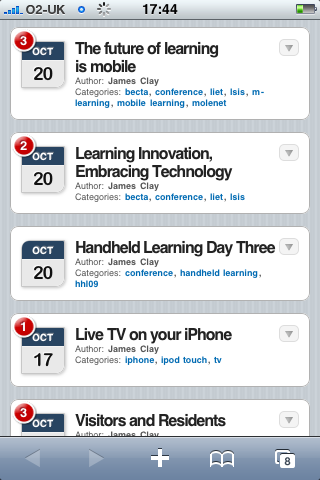
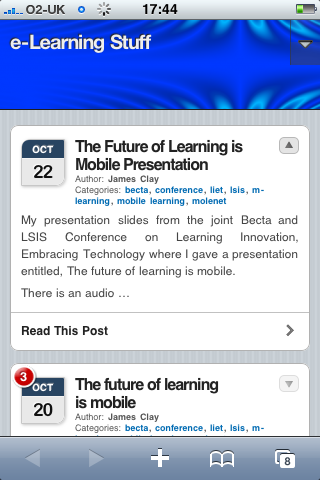
WordPress have upgraded their CSS so that when this blog is viewed on a mobile device, it renders in a format which is much more readable.

IMG_0236

This is an excellent move and makes reading blogs (well this one) whilst mobile so much easier.

So what are the red numbers?

IMG_0235

The number of comments on each post.

There is of course a WordPress App for the iPhone which means that mobile blogging is much easier and faster.

From a learning perspective what this does mean is that reflective blogs are much easier to access, you can read and blog when and where you have the time and the motivation and not just when you are on a computer.

Live TV on your iPhone

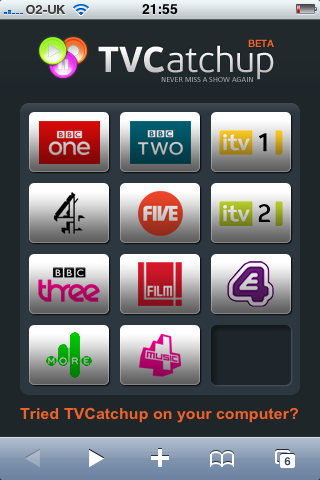
TV CatchUpSo you want to watch live TV?

I know get a television…

But sometimes that isn’t possible or convenient. For example when you are in a hotel room, waiting for a train, etc…

It is now quite easy to do with a computer and a browser, however until now it was not really possible on your iPhone (or iPod touch).

Simply go to http://iphone.tvcatchup.com/ on your iPhone and you can now watch live TV (well there is a lag of a few minutes) when you want to.

IMG_0194

I added it to my homescreen and they (as you can see above) they have a nice icon for your iPhone.

The quality is quite good and certainly watchable.

IMG_0195

The service also has a browser version, however you need to sign up to that!

Regardless of which way you go, as this is live TV you do need to have a TV licence.

Flash coming to iPhone, well not really

One of the things that many people don’t like about the internet experience on the iPhone was the lack of Flash.

So is Flash coming to the iPhone?

Well, no…

There will not be a flash player for the iPhone.

What there will be is the opportunity to create applications for the iPhone using Flash CS5. You create the Flash based activity or application and then export as an iPhone .ipa application.

The new support for iPhone applications in the Flash Platform tooling will not allow iPhone users to browse web content built with Flash technology on iPhone, but it may allow developers to repackage existing web content as applications for iPhone if they choose to do so.

Flash Player uses a just-in-time compiler and virtual machine within a browser plug-in to play back content on websites. Those technologies are not allowed on the iPhone at this time, so a Flash Player for iPhone is not being made available today.

Flash Professional CS5 will enable developers to build applications for iPhone that are installed as native applications. Users will be able to access the apps after downloading them from Apple’s App Store and installing them on iPhone or iPod touch.

So if you can create Flash activities and games, well now you can create iPhone Apps.

Handheld Learning 2009 Day 3

Here I am at day three of Handheld Learning 2009.

I am presenting this afternoon in the MoLeNET session.

Yesterday’s Twitter session went well with some good feedback.

So much to talk about from this conference and also so much I want to talk about from outside the conference, Adobe’s Flash for the iPhone announcement, the worldwide release of the Kindle… so much to say and so little time.

Hoping to write a fair few words this evening on the train.

Expect to see a few reflections over the next few days.

iPhone gets it about a bit

O2 have had an exclusive deal with Apple over the iPhone in the UK, that is all about to change with the news that both Orange and Vodafone have secured a deal with Apple to provider their customers with the iPhone in the next few months.

This may cause extra competition and bring down the price of both the phone and the tariffs and then again maybe not if the demand for the iPhone remains high.

Making the iPhone available on other mobile phone networks will mean that customers (and therefore learners) will be able to get the iPhone (say as an upgrade) and don’t need to change networks or their number. Yes I know you can move your number, sometimes easy and sometimes not.

Over one million iPhones were sold by O2 and it wouldn’t surprise me to see this figure rise faster with the iPhone on the Orange and Vodafone networks.

With the iPhone going to Vodafone and Orange (and thus T-Mobile eventually) it will be available on most networks.

The iPhone is getting cheaper, with more competition it may get cheaper still.

The iPhone is getting competitors edgy and therefore will start to look at how they can improve their products.

The iPhone will get better, the 3GS is significantly better than the 3G in my opinion (and I have used both).

The iPhone may get bigger (ie the Apple Tablet) we need to be prepared for that. Both Apple and Microsoft appear to be edging into the e-book (and e-journal) market after the success of Amazon’s Kindle.

The iPod touch is not a phone, as a result has huge potential in schools who may be concerned about contract costs, etc…

It will be easier more than ever to get the iPhone.

Will it change learning?

No.

Not on its own.

Mobile Learning Thoughts

Often when people mention mobile learning they automatically think about mobile technology, notably mobile computers, specifically Windows Mobile PDAs and iPhones.

For me it is a different philosophy, much more about learning when mobile.

It was walking around different colleges which made me realise that when it came to mobile learning, it wasn’t about getting PDAs running learning content (though I am sure there are scenarios which they would enhance and support learning), but was much more about using the devices our students already have.

These could include

One end result of this was a presentation I gave at the 2006 JISC Online Conference, available here, which looked at how to use a range of consumer mobile devices for learning. I also made a video of the presentation which was made available to delegates at the conference for their mobile devices.

Since then, three years later, the market has moved forward quite dramatically, it is now even easier for learners to access audio, video and web content on their mobile devices. Devices such as the PSP, the iPhone, the Nintendo DSi are more widespread and are also much more connected and can play a lot more content.

One of the key factors has to be how easy is it for the learner to access that content?

Another barrier to overcome is to realise that the mobile device is only one tool that a learner may use for learning. So though a learner may listen to audio, or view video on a mobile device, assessing their learning may take place using a traditional computer or a pen and paper. For me mobile learning is not about learning on a mobile, but learning when mobile.

A (paper) notepad can be used when mobile, though mobile devices do allow for a more interactive, collaborative, engaging learning experience.

Certainly this model is how my institution is moving forward in terms of mobile learning.