Jim Dickinson and Rosie Hunnam interrogate the student opportunities lost to the pandemic, and gather intel on what it would take to build them, and the student community they support, back higher.
This reflects a lot of conversations I have been having over the last few weeks on the importance of building student communities across the current covid-19 restrictions in place. Too often universities assume students can build their own online communities, but discussions with students reflect that this more than not doesn’t happen. Even where it does, it is often based on previous in-person communities. Going forward with potentially restrictions still in place in September, the importance of community building is there and how you do this online is still a real challenge.
After a range of virtual events, meetings, lectures, etc, often the last thing we need is more screen time on a virtual coffee break.
On Tuesday I was along with Doug Parkin and Lawrie Phipps presenting a a session on digital for a Spotlight Series for Senior Strategic Leaders. I was mainly talking about how to look at and embed digital into strategy. It was a good session.
On Wednesday I presented to the DigiLearn community about Learning and Teaching Reimagined.
This seemed to go down well with the attendees.
The Quality Assurance Agency (QAA) has shared outcomes of their work to explore the links between good practice in digital pedagogy and improved student engagement, progression and achievement.
I realised that I have been walking and exercising less during the last few weeks, now the children are back in school, so this week I made a determined effort to increase the amount of walking I do.
Like last week, I have spent a lot of the week interviewing staff and students as part of a project we’re doing at Jisc. We have been talking to them about their thoughts and perspectives on digital learning. As with a lot of these kinds of interviews there are some interesting individual insights, however the real insight comes from analysing all the interviews and seeing what trends are in there. I also spent time planning a similar, but different project.
I attended a roundtable on a digital vision for Scotland and facilitated a breakout room reflecting on the vision.
If you have watched a 60 minute TV programme, you will realise few if any have a talking head for 60 minutes. Few of us have the time or the skills to create a 60 minute documentary style programme to replace the lecture, and where would you go to film it? So if you change the monologue to a conversation then you can create something which is more engaging for the viewer (the student) and hopefully a better learning experience.
In a meeting this week with staff from a university I was discussing this issue and their response was, what about comedy stand-up? That’s a monologue. That got me thinking and reflecting, so I wrote a blog post about needing a tray.
So sometimes you have to backtrack and change your mind.
I have been working on a variety of blog posts about transformation over translation. When discussing the lecture and video I did say:
If you have watched a 60 minute TV programme, you will realise few if any have a talking head for 60 minutes. Few of us have the time or the skills to create a 60 minute documentary style programme to replace the lecture, and where would you go to film it? So if you change the monologue to a conversation then you can create something which is more engaging for the viewer (the student) and hopefully a better learning experience.
In a recent meeting with staff from a university I was discussing this issue and their response was, what about comedy stand-up? That’s a monologue.
I had to concede that they were indeed right, the comedic monologue is something that people to watch and is usually a talking head.
I will defend that I did say “few if any” and not none.
However I don’t think we can class the lecture in the same vein as a comedic monologue, well not all the time. Is a lecture as entertaining as Eddie Izzard discussing the canteen on the Death Star, probably not.
If you are transforming all your lectures into video recordings, some (or a few) will work well as monologues, however some will probably work better as shorter recordings, or as conversations or discussions.
I was recently part of a panel session looking at Challenges for quality assurance in the wake of the pandemic – ensuring quality in digital learning, academic integrity in remote assessment, and emerging best practice
I gave a five minute presentation from my personal perspective.
We knew what we were doing.
We knew how to assure quality and academic integrity.
We thought everything was going to be fine….
There were early signs of the impact of Covid-19 back in December 2019 and January 2020.
Well that didn’t go as planned and was challenging to move online.
Moving assessment online is a journey and one for which we had no map and no real idea of where we wanted to get to.
We thought we could do it?
We thought technology was the solution.
It wasn’t.
The thing is translating practice online doesn’t really work. You lose the nuances of what made the in-person experience so great and you don’t take the advantage of the affordances of what digital can bring.
Can we be surprised when the quality of the experience suffers
Moving assessment online is not only possible, but can be done in a way which maintains quality and integrity.
How can you do this when the requirements in place from university exam board, PSRBs and professional accreditation are based on an model which expects a physical in-person assessment.
You need to transform and reimagine assessment.
You can not transform assessment on your own.
However this takes time.
It takes a certain level of digital capability.
It requires an insight into what we mean by assessment and what we are trying to assess.
At Jisc we are here to help the higher education sector through the use of digital to reimagine teaching, learning and assessment and to reframe the student experience.
I have spent a lot of the week interviewing staff and students as part of a project we’re doing at Jisc. We have been talking to them about their thoughts and perspectives on digital learning. As with a lot of these kinds of interviews there are some interesting individual insights, however the real insight comes from analysing all the interviews and seeing what trends are in there.
Institutional strategies and the delivery of research and teaching are underpinned by digital, never more so than during the Covid-19 emergency. This workshop will engage leaders in understanding the ramifications for leading in this increasingly digital world, reflecting on some of the lessons learned during 2020, and looking forward through a digital lens at what might be possible and what might be needed in higher education over the next five years.
Quite intrigued by the term social loafing which I heard about this week.
In social psychology, social loafing is the phenomenon of a person exerting less effort to achieve a goal when they work in a group than when working alone.
This resonated some of my experiences in doing individual and group work.
Have been talking about our strategy document with colleagues as well and how we expect the document to be used by them with universities.
BT’s Openreach to build full-fibre internet ‘like fury’ after Ofcom move was reported by the BBC. This should result in better broadband, but could also mean more expensive internet connections for some. The pandemic has demonstrated the need and dependency on good and fast connections for remote teaching and learning, as well as for working from home. Personally upgrading to FTTP has resulted in not just more bandwidth, but also more reliability as well.
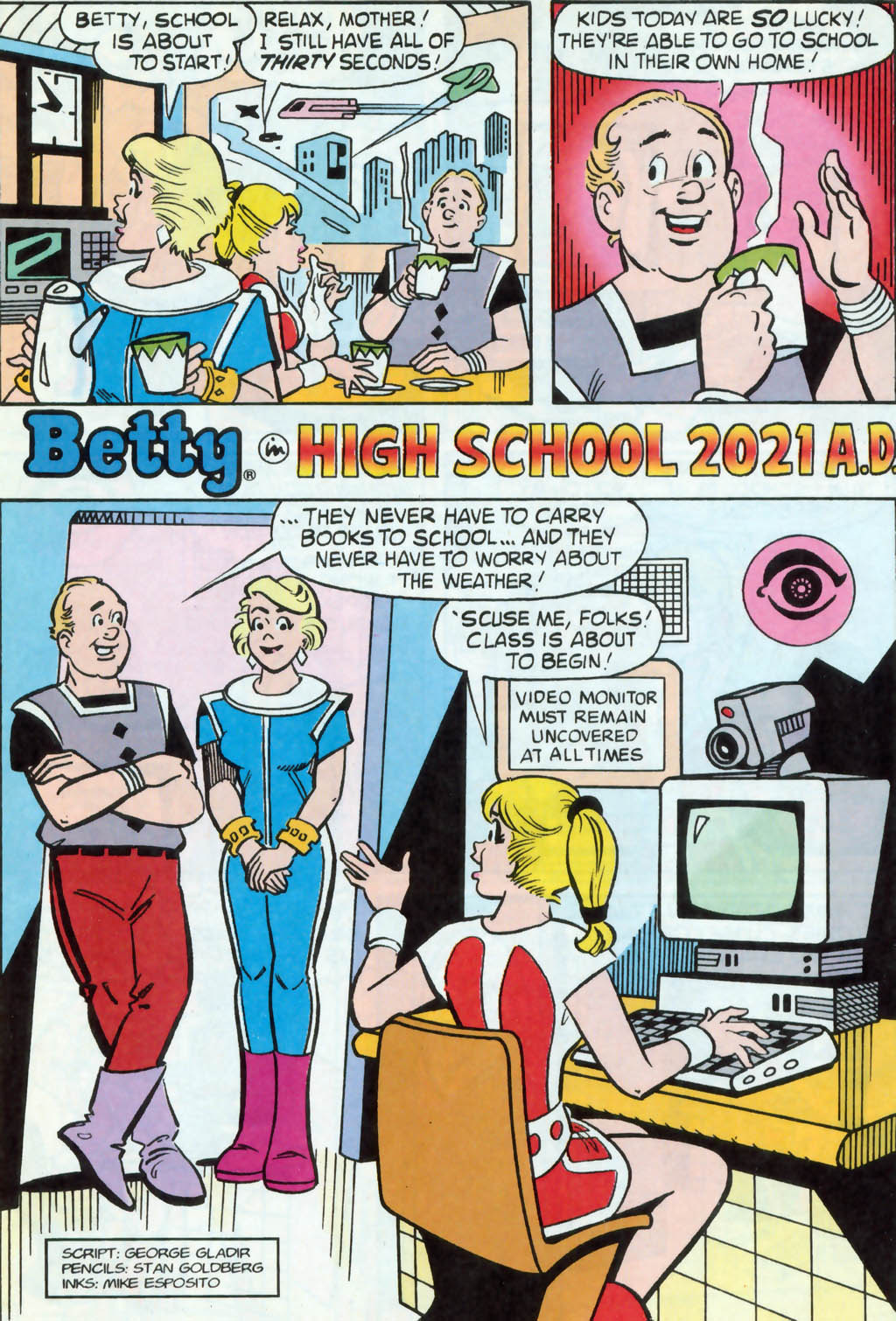
I enjoyed this comic strip from 1997 and how it eerily predicted education in 2021 including always on camera surveillance.
Archie Comics originally published this comic strip in Betty #46, back in February 1997 showing how education would be in 2021….
Scarily accurate prediction, which is of course down to the current covid-19 restrictions. However ensuring your video monitor must be on at all times, seems too familiar to those attending Zoom calls today.
I like how the student, Ronnie, fools the system with her dummy.
In other years I would have been in Birmingham this week as it was Digifest, as it happens and not entirely unexpectedly, I find myself at home staring into a webcam instead of standing on a stage and siting down in my chair to watch presentations on a screen. Not quite the same experience, but the coffee was so much better….
I was chairing a series of sessions on the Monday, which was interesting and I had to chair the Q&A, which was challenging in an online environment, as questions were often posted without the context or needed clarification, which resulted in some confusion on the part of the speakers.
Wednesday I was delivering a 30 minute session on the future of digital leadership, in which I stared at my webcam. I have no idea how many people were watching the session, was it a thousand people, or was it just three people.
I have blogged many times in the past about the advantages of an online conference, and of course the main one is that the coffee is so much better.
I do think that this conference missed a trick by not having either a chat function, or a space to discuss the presentations. Yes some of us uses the Twitter, but it’s not quite the same (and it’s public as well).
Now we've hearing about the future of leadership according to @jamesclay. Great that he appears to be presenting without any slides at all. And he's on a pier. #digifest21
It appeared to go down well with a few comments on the Twitter.
Fantastic talk and answers @jamesclay I am really inspired and motivated about what you have spoke about I need to get more involved I think – thank you for helping me realise this.#Digifest2021#Digifest21
I started as Head of Higher Education at Jisc on the 1st March 2019. So I have done two years (and a bit), had three line managers, a changing role and, oh yes, a global pandemic.
On Monday I had an excellent conversation with Isabel Lucas from Cumbria about the HEDG meeting I was presenting at, at the end of the week.
I have been sharing internally (and externally) the draft of the Jisc HE Strategy.
As higher education institutions plan for what will happen as we move slowly towards more students being on campus, there is continuing chatter about the form that teaching and learning will take. This includes how best to deliver it and how to communicate what this might look like. In all of this discussion, there has been a proliferation of words like “remote learning”, “digital learning”, and “hybrid learning” – and these terms have largely been taken for granted in respect to their pedagogical nuance. But if the preferred solution to the problems created by the pandemic in the first semester was “blended learning”, as we tumble through a second semester it would appear that the HE sector is beginning to settle on its next term of preference – “online learning”.
We do seem to spend a lot of time discussing what we should call what we do. The article makes the point that this does matter. I disagree slightly what matters is not what it is called, but whatever it is called, we have an agreed and shared understanding of what is means for you, for me and the students. We change the term, but this doesn’t necessarily mean that we change our understanding. I recall having this discussion about the use of the term hybridthat I used in an article to mean responsive and agile, whilst someone else was using the term to describe a mixed approach. Words are important, but shared understanding actually allows us to move forward.
Wednesday I joined a panel at the Westminster Education Forum to deliver a session on the future use of technology in assessment.
“The future for England’s exam system – building on best practice from the 2020 series, the role of technology and ensuring qualifications equip young people with the skills to succeed post-18”
I only had five minutes, so not a huge amount of time to reflect on the challenges and possibilities. To think a year ago I would have had to travel to London by train, find the venue and then join the panel in-person. Today, I just switched on the webcam and there I was, did my presentation and then answered a few questions. I didn’t use slides, as there wasn’t always a need to use slides in these kinds of panel sessions and at an in-person event I wouldn’t have used slides.
Of course at a physical in-person event they would have provided lunch, which would then give delegates an opportunity to come and chat about what I had been talking about. That didn’t happen this time. I would say that though using Twitter as a digital back channel at physical in-person events does sometimes work, but people have to be using the Twitter. At edtech events I find a fair few people are , at other kinds of events, not so much.
Lecturers are doing all they can during the pandemic to support the myriad different ways in which students learn
It’s not as though the physical campuses are closed, they are open for those courses which require a practical element.
Then again schools are not closed, they are open for the children of key workers, as well as vulnerable children, and staff are working with them and delivering remote teaching to the children at home.
Yes the experience is variable across the country, even across a school, but to keep saying they are closed, doesn’t really tell the whole story.
On Thursday I had a really good discussion with a university about digital strategy. How important it is aligned to the main university strategy, but also how it enables that strategy and other strategies as well. If you are in charge of a strategy, how does it enable others, and how do others enable yours?
At the end of the week I was involved in the HEDG meeting and did a presentation on Jisc’s Learning and Teaching Reimagined programme and where Jisc is going next. It was good meeting and the presentation seemed to hit the spot.
I had a planning meeting about a session we’re doing with Advance HE on digital leadership which looks like it will be a really good session.
Looked at the presentation I am doing next week at Digifest on the future of digital leadership, what it is and where we are potentially going.
Strange things sometimes happen in universities and we’ve reported plenty of them here over the years. From hauntings and strange happenings to animal action and of course true crime events on campus. But this event which recently caught my eye is one of the oddest I’ve noticed lately. It all happened just over half a century ago at Keele University. Those were turbulent times as the world transitioned out of the end of the heady 60s era into a very different decade.
My top tweet this week was this one.
I’m tired of hearing that universities are closed – it simply isn’t true | The Independent https://t.co/Z5h0QU98Ji
The end of this week marks my second year as Jisc’s Head of Higher Education. I have spent nearly 50% of this job in lockdown. I have also been writing weekly weeknotes for all that time as well.
Had a fair few meetings this week with universities talking about strategy, leadership as well as teaching and learning.
I had a Diversity and Inclusion workshop with the team. We were asked a few questions, but this was my response to: What do you think is the top priority for us that we need to work on?
Recognition that excluded groups don’t have the same advantages and privileges that others have. This has an impact on background, qualifications, experience and needs as an employee. We need to be creative and supportive in bringing excluded groups into the talent pool, but also recognise that recruitment is only part of the issue. Working practices, culture and expectations are there too. Society isn’t fair, we need to be not just equitable but also positive in what we will do.
I ran an online workshop for the current teaching and learning discovery project I am working on. I asked the question, what do we mean by blended learning, well that led to a really interesting discussion.
I do find online workshops quite challenging, and though there are tools out there, such as Miro, that can help, when you don’t know what expertise people have with those kinds of tools, I usually try and avoid using them. Simply put, as a result you spend more time trying to help people to use the tool, and those that can’t get into it, don’t have the opportunity to engage with the actual exercise.
Thursday saw the publication of the Office for Students’ report Gravity assist: propelling higher education towards a brighter future. It is their review of the shift toward digital teaching and learning in English higher education since the start of the coronavirus (COVID-19) pandemic.
It is a 159 page report that attempts to capture the lessons from an extraordinary phase of change.
I was slighty amused by the opening gambit that Digital teaching must start with appropriately designed pedagogy, curriculum and assessment.
Of course with the first and subsequent lockdowns, the technology needed to come first as people quickly switched to remote teaching and needed some kind of tool to do this. What did happen was people merely translated their in-person pedagogy to the online platforms and then wondered why it didn’t work very well… or didn’t work at all. I’ve always found that teachers and academics always put the pedagogy first, it’s a no-brainer. However though it may be pedagogy first, this doesn’t mean pedagogy only. You really need to understand that if you are to take advantage of the affordances that technology can bring to the learning experience.
I also enjoyed reading David Kernohan’s thoughts on the report.
I did another post about the report on the definition of high quality teaching and how it relates to the use of video.
I have been reading the document and overall yes I do welcome the report, I think it has covered the background and situation on the response to the pandemic well.
Friday afternoon I attended the Intelligent Campus Community Event. Since I left the project two years ago, a RUGIT sub-group have taken over the organisation of the event, which is great. It was quite interesting to re-immerse myself into that space.
My top tweet this week was this one.
Goldman Sachs: Bank boss rejects work from home as the 'new normal' – BBC News https://t.co/OQIJze1Mjo
Just a thought, a one hour lecture paused six times, isn’t this the same as six ten minute lectures?
Yesterday saw the publication of the Office for Students’ report Gravity assist: propelling higher education towards a brighter future. It is their review of the shift toward digital teaching and learning in English higher education since the start of the coronavirus (COVID-19) pandemic.
It is a 159 page report that attempts to capture the lessons from an extraordinary phase of change.
I have been reading the document and overall yes I do welcome the report, I think it has covered the background and situation on the response to the pandemic well.
However moving forward, it misses many opportunities to fully exploit the affordances of digital.
An example on page 42
We heard that to create high-quality digital teaching and learning, it is important not simply to replicate what happens in an in-person setting or transpose materials designed for in-person delivery to a digital environment. For example, an hour-long in-person lecture should not simply be recorded; rather, it needs to be broken down into more manageable chunks. In other words, teachers need to reconsider how they approach teaching in a digital environment.
Why does it need to be broken down? Has no one heard of the pause button?
A one hour lecture paused six times, is the same as six ten minute lectures.
How is six ten minute lectures better quality than a one hour lecture paused six times?
I wrote this back in September following a conversation with a lecturer about this very issue, who like me couldn’t work out why they needed to chunk their lectures.
Doing a 60 minute (physical) face to face lecture is one thing, generally most people will pause through their lecture to ask questions, respond to questions, show a video clip, take a poll, etc…
Doing a 60 minute live online lecture, using a tool like Zoom or Teams, is another thing. Along with pauses and polls as with a physical face to face lecture you can also have live chat alongside the lecture, though it can help to have someone else to review the chat and help with responses.
Doing a 60 minute recording of a lecture is not quite the same thing as a physical face to face lecture, nor is it a live online lecture.
There is a school of thought which says that listening to a live lecture is not the same thing as watching a recording of a lecture and as a result that rather than record a 60 minute lecture, you should break it down into three 20 minute or four 15 minute recordings. This will make it better for the students.
For me this assumes that students are all similar in their attention span and motivation, and as a result would not sit through a 60 minute lecture recording. Some will relish sitting down for an hour and watching the lecture, making notes, etc… For those that don’t, well there is something called the pause button.
With a recording you don’t need to break it down into shorter recordings, as students can press the pause button.
Though I think a 60 minute monologue is actually something you can do, why do it all the time? You could, for other sessions do different things, such as a record a lecture in the style of a television broadcast or a radio programme.
If you were starting afresh, there is something about breaking an online lecture down into more sections and intersperse them with questions, chat and polls, just as you would with a 60 minute physical face to face lecture. If you have the lecture recordings already, or have the lecture materials prepared, then I would record the 60 minutes and let the students choose when to use the pause button.
The reality is that if you want to create high quality digital teaching and learning, you need to start from the beginning with what the learning outcomes will. Chunking your existing processes doesn’t result in a higher quality experience, it merely translates what you did before, but in a way which is not as good but in a digital format. It loses all the nuances of what made that physical in-person session so good and has none of the affordances that digital could bring to the student experience.
Probably the best way of thinking about this, is this is a first stage, the next stage is making it happen.
news and views on e-learning, TEL and learning stuff in general…