Learning Innovation, Embracing Technology

It’s a busy week this week, though in the main because I am getting asked to do lots of things.

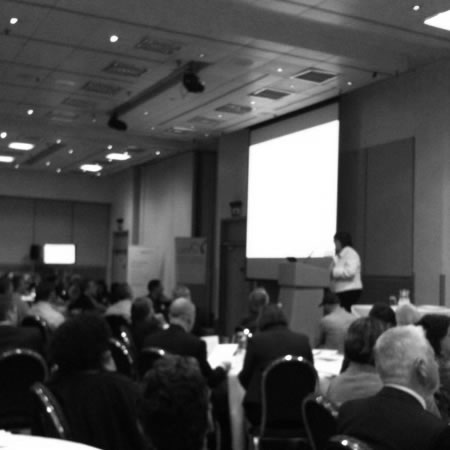
Today I was giving a keynote (and running an exhibition stand) at the joint Becta and LSIS Conference on Learning Innovation, Embracing Technology. My presentation was on mobile learning, though (as you might guess) I covered a fair bit more than just “what is mobile learning”.

I was on just before lunch, prior to my bit we had had LSIS and Becta give their views on embracing technology and a workshop.

liet

Alas (or luckily) I only had ten minutes to do my presentation and using the digital clock on my iPhone I did keep to time.

I would loved to have more time and engaged the conference delegates in conversation and discussion. Well to be honest I did over lunch, where for an hour I chatted and engaged with the delegates on my stand.

As well as showing off a lot of mobile kit (from my bag of crap) I also had bundles of LSN publications about MoLeNET which were taken in their droves.

Went very well, so much so, I never got a chance to eat my lunch!

After lunch I went to Becky Barrington’s workshop on tools that she uses with her staff. Though I know practitioners love to create content, and the tools Becky showed demonstrate how much easier that it is to now, I do question the sustainability of a that model across the FE sector. How can we share all that wonderful content that is being created in various colleges across the country? How can we ensure that the shared content is being utilised effectively and for the benefit of learnings.

We can’t be the only institution who once more will create a series of slides or quizzes on customer service?

I enjoyed Stuart Edwards’ presentation and nice use of this video to prove how social media is having a huge impact on the way we communicate. Glad I didn’t show my video in my presentation as we used the same audio track!

Overall it was a very interesting conference.

Handheld Learning Day Three

After two excellent days, we were on day three of the Handheld Learning conference.

I was presenting again (in the afternoon) in the MoLeNET session on how MoLeNET had an impact on Gloucestershire College.

Again way too much choice and some excellent speakers out there. In the end I chose the inclusion session in the main conference hall. Inclusion is something I keep getting confused about and decided that this would be a good way of updating and getting myself back up to speed.

I enjoyed the session and particularly Sal Cooke’s presentation.

In the afternoon I was presenting in the MoLeNET strand about the impact of MoLeNET no Gloucestershire College.

I found Ray Kurzweil’s final keynote stimulating and though quite a few stats and graphs, it was interesting to see how his predictions have come true and what he is now predicting.

I didn’t win any prizes in the final draw.

I really enjoyed Handheld Learning and even if you are not into mobile learning, there is more than enough in the conference to justify going. The conference is much more about learning and unlike many other conferences brings people from a range of sectors together.

Live TV on your iPhone

TV CatchUpSo you want to watch live TV?

I know get a television…

But sometimes that isn’t possible or convenient. For example when you are in a hotel room, waiting for a train, etc…

It is now quite easy to do with a computer and a browser, however until now it was not really possible on your iPhone (or iPod touch).

Simply go to http://iphone.tvcatchup.com/ on your iPhone and you can now watch live TV (well there is a lag of a few minutes) when you want to.

IMG_0194

I added it to my homescreen and they (as you can see above) they have a nice icon for your iPhone.

The quality is quite good and certainly watchable.

IMG_0195

The service also has a browser version, however you need to sign up to that!

Regardless of which way you go, as this is live TV you do need to have a TV licence.

Visitors and Residents

When I was at FOTE 09 a few weeks ago I stayed overnight and went out for a meal at a terrible Italian restaurant; one of the problems I have visiting different parts of London is that I am merely a visitor and unlike the local residents do not know the best places to eat. I remember visiting London a few years ago and my sister-in-law who lived in London at the time (a resident) took me to a wonderful local pub with fantastic food. The more I visit London the more confident I get with getting about (on foot and on the tube) and knowing which places to avoid and when and which places to seek out and try. First time visitors to London know it differently to those that visit more often and likewise people who live in London will know some places better than others. Visitors and residents know London in different ways and the same can be said for those who use digital and online tools and services. I really don’t want to use the term digital world as I don’t think it is a useful term.

Last year we discussed the concept coined by Dave White of Visitors and Residents and how this relates to how people interact and use the online and digital tools and services out there.

Dave has made a video of the presentation he gave at ALT-C 2009 and it makes for interesting viewing.

You can read more on his blog.

Most people should by now realise that the age demarcation of the digital native and digital immigrant is a flawed concept and should not be relied upon. Projects and research have again shown that young learners are not digital natives and often have issues with digital and online technologies.

From the MoLeNET programme for example.

The experiences of several MoLeNET projects suggests that not all young people are the “digital natives”…

“We came to this project with an unspoken belief that young learners would innately understand how these devices worked, we quickly came to understand that, while they can use them well on a superficial level, more demanding tasks stretched their knowledge of the technology”.

The key lessons to remember is that you can’t assume that younger learners will be confident in how to use new technologies, likewise also don’t assume that older learners will not know how to use technologies.

If you are an online resident it can sometimes be difficult to remember that a lot of people are merely visitors and that they may not fully undertstand the local customs, practices or best places to go.

Facebook ‘cuts student drop-outs’

facebookbbcnews

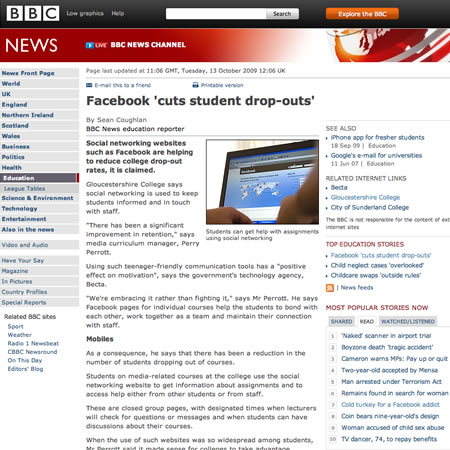
Gloucestershire College makes the news on its use of social networking websites to support teaching and learning.

Social networking websites such as Facebook are helping to reduce college drop-out rates, it is claimed.

Gloucestershire College says social networking is used to keep students informed and in touch with staff.

“There has been a significant improvement in retention,” says media curriculum manager, Perry Perrott.

This is not about encouraging use of Facebook, but taking advantage of the fact that our learners are using Facebook. There are issues that need to be thought about and we hope to cover that in a session as part of the Becta Technology Exemplar Network.

Handheld Reflections Day Two

I do enjoy Handheld Learning and 2009 was no exception. Three days of mobile learning stuff, presentations, discussions, networking and people.

Day two, Tuesday, sees a slightly different and more traditional feel to the conference. We have opening keynotes, parallel sessions and free coffee!

With a 9.30 start I arrived an hour early, time to have a look around the exhibition hall and see what is new and exciting. It was very apparent how the credit crunch is impacting on the mobile learning business with what looked like a 30% drop in exhibitors compared to 2008. It was nice though to see the LSN there with their stand as they have through the MoLeNET programme made a major contribution to mobile learning in the FE sector and it would be interesting to see what both the schools and HE sector thought of the work.

Graham Brown Martin as usual opened the event, and unlike other conference organisers takes the opportunity to discuss and reflect on the issues of the day.

hhl09-002

He certainly did not hold back and told the audience what he thought and what the government of the day should be doing to support and improve education. I got the impression from Twitter and from the (physical) audience that they agreed with him. It was time for change and that change is now, it’s not just up to us (the audience) anymore; government, departments need to make that change.

Up next was Zenna Atkins who was talking in a personal capacity and not as head of Ofsted. She was quite clear about this and actually I think as a result we had a more personal view of education. She felt she had been failed by the formal education system and despite this had a made a success of her life. She recounted tales about her children and their experiences in the education system. I am sure she knows more about the UK education system then someone like me, but you have to ask this question, if the education system is so wrong in the UK, despite the best efforts of organisations like Ofsted which are there to check the quality of the education system, then maybe we need to rethink the whole education system and the quality checking that takes place. I did feel that alienating your audience who are generally all from the formal education system and indicating that they are the problem was an interesting way to present the issues. You have to ask what is the point of a keynote though? Is it there to echo the feelings of the audience or is it to make them stop, think and reflect on their practice? If a keynote makes you think and even if you disagree with the thoughts, is that not better than one that makes you just nod your head in agreement.

With Malcolm McLaren up next it was certainly going to be an interesting keynote and he isn’t someone who has by his own admission not done much handheld learning. I felt he rambled on a bit (and over his alloted time) and didn’t really make me sit up and think as Zenna had done. I didn’t really see the point of him recounting his wine tasting days as that interesting, even if it was sometimes amusing. He was also failed by the formal education system but found success, notice a pattern here? Malcolm certainly polarised the audience and on Twitter half seemed to see him as a rambling old man and the other half were entranced by his life and stories.

Yvonne Roberts was the third keynote and having alienated the audience with a throwaway remark about dyslexia once more recounted how the formal education system had failed her and here she was speaking as a keynote presenter.

It was about now that I realised very little had been said about handheld learning. Many of the speakers were talking about how the formal education system was rubbish and needed a revolution; did they forget who their audience was and what they were doing? Most of the audience (like me) work in formal education, we are doing innovative stuff to enhance and enrich learning, we are changing systems and structures, we are meeting the needs of learners, we are personalising and differentiating the learning experience, we are using technologies to make things better and not just because it is shiny. There are issues and problems with the formal education system, however those issues are institutional, cultural, societal and governmental. Changes need to be made at all levels, in government, in government departments, officiating quangos such as Ofsted, examining boards, local authorities, funding bodies as well as schools and colleges.

I almost felt sorry for James Paul Gee, who hadn’t been failed by the formal education system and had some interesting things to say.

Maybe Graham’s plan was to make us think and reflect, if that was the case he certainly has succeeded in my case. Of course if we had read the programme we would have read that the session was called “Reflections on Learning” and it did what it said on the tin.

Lunch was ninety minutes long which gave plenty of time for networking, talking and sharing.

As with all conferences which run parallel sessions I had wanted to go to the Conference Session Two – “Creativity & Innovation” however due to timing issues and wanting to hear Ollie Bray I went to the Social Media for Learning. I also was interested in the Gaming stream. I enjoyed Ollie’s session which looked at using social media in schools.

hhl09-003

My own Twitter session seemed to go down well and was very full.

Overall a full and enjoyable day with way too much going on. Hoping to catch some of what I missed once videos of those sessions hit the Handheld Learning website.

Handheld Reflections Day One

I do enjoy Handheld Learning and 2009 was no exception. Three days of mobile learning stuff, presentations, discussions, networking and people.

Day one, Monday, is the free day. Anyone can go and they don’t need to pay any conference fee. This is a great idea if you’re interested in going to Handheld Learning and want to try it without spending lots on a conference fee, hotel accommodation etc…

I arrived with only a little time to spare before the HHECKL session started. The session was a variation on the Top Gear Cool Wall, but using gadgets and phones rather than cars.

coolwall01

With four of us presenting, we did initially outnumber the audience. After a slow start once we got going the process did start to work and the discussion was fast and furious.

I was surprised that some delegates weren’t willing to make a judgement on a device they hadn’t used. It wasn’t as though we were asking whether the devices were good for learing, whether they were cool or uncool. We did cover learning, but the focus was the device and the technology – which makes a change.

At the end we had split devices between those we and the audience considered cool and those we considered uncool. We allowed some selected members of the audience to move a device; the most amusing part was when a rather young member of the audience was asked to move a device, moved the Sony VAIO P Series from the Cool to the Uncool section. Asked why, he replied “because James owns it”.

After HHECKL it was time for lunch. As day one is the free day, there is no free lunch. With very few places to actually sit down in the venue, we decided that we would give the sandwiches a miss and pop out for something to eat. Were we in for a lucky time, up Whitecross Street (a few minutes from the Brewery venue) there was a bundle of street vendors selling all kinds of different types of food, a real multi-cultural treat for everyone. With the local pub allowing us to bring in food, we had somewhere to sit, eat (and grab a beer).

One thing that many conferences, and Handheld Learning is not alone in this, is providing social spaces for conference delegates. Though I guess a lot of delegates love attending a packed programme, many who attend want  to talk and discuss issues relating to them and their institutions. Providing a place (with coffee obviously) would allow for more networking and discussion. It’s not that I don’t think the programme is not useful or relevant, sometimes you gain by discussion and talking. Actually that is something that presenters may want to think about when running their presentations and workshops. Bizarrely enough the few tables and chairs available were more often then not taken up with people working and checking e-mail!!! It’s a conference, watch the presentations, network, chat, but if you need to work, go back to work!

The afternoon saw the Pecha Kucha. Simply put you show twenty slides with only twenty seconds for each slide. Sounds simple, but surprising how some people don’t understand this simple concept or don’t know how to use Powerpoint transitions.

One of the good things about the Pecha Kucha is that if one of the presenters is really boring or on a subject you don’t like you only need to wait six minutes for the next one. Though it’s surprising how six minutes can appear like thirty! I hope I didn’t bore the audience with my two Pecha Kuchas, my first was on the Future of Learning, whilst my second (and the last one of the day) was on Twenty Web 2.0 Apps for Learning.
I really enjoyed Tony Vincent’s presentation, his style of presentation and slides are superb. Alas I was going to miss his session the following day as I was presenting at the same time. If you have never done a Pecha Kucha before I would suggest that next year if it is on you give it a try. Choose something you are passionate about. Don’t worry too much about the slides, sometimes pictures work better than words.

Reflecting on both HHECKL and the Pecha Kucha has given me an idea for next year’s conference with a Britain has Handheld Talent type session. Start talking about your project, concept, ideas and see if you can last before you get the big X from one of a panel of judges.

Being involved in both HHECKL and Pecha Kucha was really enjoyable and one of the many highlights for me of the Handheld Learning Conference.

That night after an (okay) meal at a local Italian restaurant it was the Awards Evening. I was up for two awards and alas I was going to go away with nothing… ah well maybe next year! Thanks to everyone who voted for me.

A lot has been written about the awards party my view is that I believe that the awards event is an important event, yes I was up for two awards this year which was a real honour and recognition from the community about the work I do. I also went to last year’s awards ceremony and supported colleagues (even if I wasn’t up for anything last year). I also supported this year’s awards by “buying” a table. There aren’t many awards for mobile learning and it is important to the community that we recognise the innovative work that they are doing. As a result it’s important that we also support these awards.  I agree with Graham Brown Martin, it is sad that we lose this focus when we discuss coffee and the price of drinks.

After a good night out at the awards it was back to the hotel and bed…

More later…

e-Learning Stuff Podcast #029: Handheld Reflections

hhl09-001

Recorded live at Handheld Learning 2009 (hence the background noise) James is joined by David Sugden, Lilian Soon, Ron Mitchell and Nick Jeans.

We reflect on the keynotes, presentations, sessions, the conference, hheckl and stuff.

This is the twenty ninth e-Learning Stuff Podcast, Handheld Reflections.

Download the podcast in mp3 format: Handheld Reflections

Subscribe to the podcast in iTunes.

Shownotes

news and views on e-learning, TEL and learning stuff in general…