TuneIn Radio – iPhone App of the Week

TuneIn Radio – iPhone App of the Week

This is a regular feature of the blog looking at the various iPhone Apps available. Some of the apps will be useful for those involved in learning technologies, others will be useful in improving the way in which you work, whilst a few will be just plain fun! Some will be free, others will cost a little and one or two will be what some will think is quite expensive. Though called iPhone App of the Week, most of these apps will also work on the iPod touch.

This week’s App is TuneIn Radio.

Listen to and record over 30,000 radio stations including thousands of AM/FM local stations on your iPhone or iPod touch with TuneIn Radio!

£1.19

Despite all the wonder, images and content that television and the internet brings to people’s lives, radio is still very much alive and listened to.

I suspect that the main reason for that is radio is something that can be combined with other activities. Whilst driving your car you can listen to the radio. Likewise when cooking, cleaning or gardening you can also listen to the radio. I am sure many learners will listen to the radio whilst studying, and I guess many staff have the radio on when marking.

The iPhone for all its features and functionality does not have a radio function. Some mobile phones do, but the iPhone does not.

So what does this all mean in the context of this series on iPhone Apps?

Well I was recommended to have a look at TuneIn Radio. This App allows you to stream various radio stations from the web.

As well as radio stations you have never heard of, it also allows you to listen to stations like Radio 4 or Five Live.

The App allows you to pause and rewind the stream, making it great when you want to not miss anything, but something more important comes up than the radio.

The App also allows you to record from the radio and listen later.

Now without multitasking on the iPhone, there are limitations in how you can do other stuff on the iPhone as you listen to the radio. Having said that the App has a built in web browser, allowing you to do web stuff whilst listening to the radio.

I have only really just started using this App, but even at this early stage I really like the ease of use, the way it works and what it allows me to do.

If you like listening to radio then this App is certainly one you should be looking at.

Get TuneIn Radion in the App Store.

Photo source.

Will Twitter still eventually wither and die?

A year ago I wrote a blog post, Ten reasons why Twitter will eventually wither and die… in which I covered that I saw at the time as ten valid reasons why one day Twitter would “wither and die”.

It is a fact known to all that use Web 2.0 tools and services that one day they will no longer be flavour of the month, or will be swamped by spam, cons and hustlers. One day we will no longer be using Twitter and when that is, no one really knows, but if it continues along it’s current roadmap it will be sooner than we think.

So do I still think, a year later, Twitter more popular than ever, that Twitter will no longer be the popular site it is now?

So what of the ten reasons I discussed back then.

1. Spam

Spam is still an issue on Twitter.Last year I said “though it doesn’t generally affect the majority of Twitter users” however this year I would suggest that it does impact on many users. We still have hashtag and searching spam, click on any Trending Topic and you will see spam postings amongst all the other tweets in the trending stream. Twitter’s own @spam account is certainly helping in reducing spam and warning people about possible spamming. There is also the report spam button which also helps to reduce spam.

What I am seeing more of is people RTing adverts and promotions, the RT to win an iPad for example.

For some reason people think they might actually win an iPad doing this! Duh! Well there may be some valid Twitter competitions and there are some which are not so valid… Of course the real issue is that if your Twitter stream is consistently full of people just RTing competitions is this not spam?

Another form of spamming is continually posting links to your blog.

But James you do this I hear you say…

Now I know I post links and I do worry about doing so. Spam by definition is unwanted communication, and spam is also quite personal. What I consider to be useful blog links, you may consider to be unwanted spam. However in terms of Twitter I think the issue is much more about the quantity of tweets about blog posts as a proportion of total tweets. This is where I do get concerned, if I post lots of tweets about my blog posts and in addition most of my other tweets are @ replies then unless you follow everyone I do, all you will see from me are tweets linking to my blog posts. As a result you may consider me more of a spammer, as though I am using Twitter to converse and chat, you are not seeing that, as you don’t follow the people I do. As a result I generally only post a link to my blog posting once. I know this means that some people will miss it, if I post in the morning, then people in the evening may miss it… However if it is a good blog post (as considered by others) than what can happen is that other people will post the link or RT my link.

2. Terrible Jokes

Last year I mentioned humour as an issue.

We all like to have a laugh and one of the attractions of Twitter can be the humour that you find there. However some people takes jokes a little too far and this can annoy people, especially conference organisers who don’t want their Twitter stream “corrupted” by inappropriate humour.

I think this is now less important, though a similar issue is inappropriate language. The main issue with this is if you are like me and show other people how Twitter works, to have a stream full of people using inappropriate language can reinforce people’s perceptions of what “social networking” is all about.

3. Fake RTs

Last year I said

Hasn’t happened to me, but did happen to @billt (the real Bill Thompson). To RT or to re-tweet means to completely copy and post what someone else has posted before. Generally a way of getting information around Twitter quite fast and for highlighting important information or sites. So how does the Fake RT work, basically someone posts a tweet like this RT @jamesclay Found this really interesting site http://youknowit.is/spam others who respect @jamesclay then follow the link or even worse retweet (RT) the spam tweet.

This does now happen to me on a regular basis. People copy what I am tweeting and posting it on, sometimes with links that I don’t endorse!

4. The Hustle

Last year I said:

However there is a problem with shortened URLs and that is you don’t know where you are going as the URL gives no indication. This unknown factor will allowunscrupulous Twitter users to send other users to spam sites, or more worryingly phishing sites or sites with a virus or trojan download.

Still happens, and people still get caught out and hand over their Twitter credentials. This then leads into…

5. Identity Theft

Still happens way too often, sometimes accidently as people fall foul to phishing scams, but sometimes as people authorise third party apps to post tweets using their account.

6. Cons and Scams

We still get cons and scams. With the recent Haiti earthquake there were a few cons going around Twitter about making donations, which didn’t get to Haiti but went into the pockets of con artists.

7. Trojans and Worms

I said back then

As Twitter becomes more and more popular, it won’t be long before it gets swamped by worms and trojans. Once we’ve been infected we probably won’t go back and one day it might be too much for us all and we’re all go and leave and move onto the next thing.

It’s still an issue and if people keep clicking on unknown links then it will keep happening.

8. Fashion

Only time will tell if Twitter will remain fashionable. However the tech sites are already looking for the next thing after Twitter. Yesterday the Guardian published an article Will Foursquare be the new Twitter? in which Tim Adams says:

An application that allows friends to track one another’s movements when they’re out and about could be the next big thing in social networking.

Mashable last July in Foursquare: Why It May Be the Next Twitter said:

While no service is likely to achieve the same scale as Twitter in the coming months, Foursquare has all the right ingredients to be one of this year’s big hits.

I am seeing more and more of my Twitter community using Foursquare. Once that service starts to add Twitter’esque functionality, will people move on from Twitter? Don’t know for sure, but it does mean that if other things in this list annoy you, you now have somewhere to go…

9. Feature Creep

There are already lots of third party tools that add additional features to Twitter. Last year I said:

Once too many people start using these tools, you may find that your Twitter stream becomes just a stream of announcements from people using these tools, and as a result you may well stop using Twitter as it will have outlived its usefulness.

I still think that added features can enhance a service, but in addition can spoil what makes Twitter unique, relevant and useful.

10. Spam Followers

I still get them, I bet you do too.

Conclusions

There are now other reasons why Twitter will fall by the wayside and I will discuss these in a future blog post. So will Twitter fail and disappear completely as I predicted last year? Eventually, yes Twitter will go the same way as other services have in the past, some diehard users will continue to use the service.

e-Learning Stuff Podcast #044: It’s not James Clay

This podcast does not discuss James Clay, nor does it look at his Twitter feed, nor is he mentioned at all…possibly…

With Lilian Soon, David Sugden, Ron Mitchell and without James Clay.

This is the forty-fourth e-Learning Stuff Podcast, It’s not James Clay

Download the podcast in mp3 format: It’s not James Clay

Subscribe to the podcast in iTunes

Shownotes

iTunes U

I have been thinking about iTunes U for a while now.

My main issue at the moment is why?

I am not concerned about the application process, as other colleges have undertaken the process.

Nor am I concerened about doing all the design work for the front end. Apple has useful guides and we have the resources to do this too.

I am slightly concerned about the following line from Apple’s website:

At a minimum, your institution should have 150 audio and video files of acceptable quality ready to go on day one, with a plan for posting updated content on a regular basis.

It’s not that we don’t have this level of content, nor am I concerned about whether it is to an acceptable quality, my slight concern is whether any of the content contains third party content that we may be licensed to use within college or on the VLE, but won’t have the rights to re-distribute those third party materials.

My main concern or worry is why!

Why would we use iTunes U?

We still need to host the materials.

We need to apply.

We need to sort out RSS.

We need to plan for regular content.

But why would we use iTunes U?

Apple say:

With an open iTunes U presence, your school can gain recognition — not to mention a competitive edge — as you reach out and share your knowledge.

I think I can see this from a University perspective competing for learners who may look at things like iTunes U. I am not so sure that our learners will be looking at or persuaded by us being on iTunes U.

I like the concept of iTunes U, but I can’t see why I should be using it.

100 ways to use a VLE – #62 Jorum

Now Jorum has lots of useful and wonderful materials in it.

Jorum hosts a wide variety of learning and teaching resources from any subject area within UK Further and Higher Education learning and teaching, ranging from simple one-file assets and links to external resources, to more complex learning objects, including content packages and open courseware. These resources are free to use, and are available for all educational purposes, for download, reuse and repurpose.

The downside is that in order to access the JorumUK materials on Jorum you need to register an account and be a member of staff at an institution in the UK. This means you can’t simply pass the URL onto your learners.

So if you are a member of staff and want your learners to be able to access the materials then where are you going to put them?

Well you can’t just place them on a website, the licensing agreement doesn’t allow for that. Nor are they designed to be e-mailed to learners.

The obvious place to put them is on the VLE.

So what about JorumOpen then?

Though these resources are open and made available under a creative commons licence.

However though freely available, JorumOpen is not a delivery platform, it’s a repository, a place to store materials.

The obvious place to put these materials is again the VLE.

It’s not always best practice to provide a bundle of resources to a learner, context is really important. Placing resources from Jorum on the VLE is only part of the process, you also need to consider how the object relates to the learning activity. What do the learners need to do prior to using the object, whilst using the object and what to do after accessing the object. There are many other tools on the VLE that can be used to support the learning activity based on any learning object downloaded from Jorum. You could for example, use a discussion forum to discuss what the learners have learnt. Using a quiz to assess what the learners now understand.

Jorum has a wealth of content from which to take and use with learners on the VLE.

Photo source.

How to use Screenr

I created the following screencast on how to use the screencasting service Screenr.

So what is Screenr?

It’s a web service that allows you to make screencasts quickly and easily, then have them posted to the web.

Once on the web, you can either share the URL, put it in an e-mail for example, or on Twitter.

You can embed the video into a webpage on a website or on a VLE. This is in the Flash format. What about if you have a smartphone or an iPhone, well Screenr ensures that the video is available in an MP4 format which will play on the iPhone, other smartphones and internet capable video devices.

Screenr also allows you to share your video on YouTube.

Finally one useful aspect is that you can download the video as an MP4 file. This can then be embedded into a PowerPoint presentation. You can also import this video file into iMovie and edit it, add titles, other video, to create a new video. If you have the appropriate MP4 codec on your Windows PC you can import it into Windows Movie Maker and do something similar.

What I like about Screenr over other similar tools (like Jing) is that it doesn’t require you to download an application or install anything. Go to the website, click create screencast and then everything is simple after that.

Ashen

Was it only a couple of weeks ago I wrote a blog post entitled “million-to-one chances happen nine times out of ten” in that I wrote about the impact of snow closures on educational institutions. I did write…

Even if it doesn’t snow really badly next year, other things may happen that result in the physical closure of the educational institution. It could be floods, high winds (remember 1987), flu or similar viral infections, transport strikes, fuel crisis, anything…

Over the last week we have seen not so much closures, but certainly some disruption due to the volcanic ash from Iceland and its impact on air travel.

Hitting the UK as it did at the end of the Easter break, many learners and staff were stranded overseas with no way of getting home.

As with the snow, little mention has been made of using technology to mediate the impact of the closure of UK airspace. One exception, BBC News reports on one teacher who is using a webcam to continue teaching despite been stranded in Spain.

A teacher from Oxfordshire stranded in Spain because of air restrictions is using an internet cafe to take lessons. He is using a webcam to make sure that his business studies A-Level students do not miss out on lessons.

Interestingly in the same article…

Meanwhile, 16 teaching staff from King Alfred’s School in Wantage have been left stranded because of the ban on flights. The school said it on its website that it would face “severe staffing shortages” and would only open for certain year groups during the week.

So it would appear that not everyone is coping with the disruption.

In the comments on the recording of our debate on this issue at the Plymouth e-Learning Conference was the following comment:

Irony time: In my mailbox this morning “Technology Enhanced Learning Workshop cancelled due to speaker unable to get a flight”. Missed opportunity for some “Technology Enhanced Learning” me thinks? The Sky is broken so use Skype?

I am aware of a few people who are stranded overseas, but are in fact continuing to work using e-mail and VPN to maintain contact and communication with colleagues back home. Time zone differences are causing a few issues, and I also know that many people rather than stay and work are travelling and trying to get home.

As far as I am aware no schools or colleges have closed because of the ash, but certainly some classes have been cancelled or disrupted due to the ongoing ash cloud issue.

Learning technologists have to be careful to ensure that they don’t appear smug about the role technology can play when we have issues such as snow and ash, but we as a community need to work with colleagues to ensure that when disruption happens we don’t worry so much, we keep calm and carry on…

Picture sources here and here.

Scrabble – iPhone App of the Week

Scrabble – iPhone App of the Week

This is a regular feature of the blog looking at the various iPhone Apps available. Some of the apps will be useful for those involved in learning technologies, others will be useful in improving the way in which you work, whilst a few will be just plain fun! Some will be free, others will cost a little and one or two will be what some will think is quite expensive. Though called iPhone App of the Week, most of these apps will also work on the iPod touch.

This week’s App is Scrabble.

Scrabble spells major F-U-N on your iPhone! Experience the realistic look and feel of Europe’s favorite board game.

£2.99

I recently discussed gaming and learning with Ron Mitchell and Kev Hickey in one of our podcasts.

Last week saw the Game Based Learning Conference, we didn’t go, but that didn’t stop us from talking about using games for learning and using gaming devices to enhance and enrich the learning process.

At the end of the recording we asked what was our favourite games, Scrabble came up twice!

Scrabble is a word game in which players get points for playing words on a board in a similar manner to a crossword.

Research from various universities has demonstrated that if learners play word and number games this can improve their literacy and numeracy skills. AS reported by The Telegraph:

Scrabble is just as good at improving mental sharpness as a Nintendo DS video games console and a copy of Dr Kawashima’s Brain Training, say researchers from the University of Rennes, Brittany.

Just on that article and research I have to admit I have always found it much easier to get 17 year olds to play games on the Nintendo DSi than I have getting them to play Scrabble!

Having said that I have “caught” learners in our Library playing Scrabble on the computers. I didn’t know if I should throw them off or congratulate them.

Scrabble requires players to use both word and number skills to maximise the points they earn, so has as demonstrated by the research to improve literacy and numeracy.

Scrabble on the iPhone can be played solo or with other players over wifi.

I quite like playing the game, even if the iPhone cheats and uses words that a) no one has ever heard of and b) no one would ever use!

When waiting for a train, or on a train, or to pass a few minutes away, Scrabble is a nicely executed iPhone game.

Promoting e-resources

In the past we had books, journals, magazines and newspapers in our institutional libraries. Places full of print media. We had individual desks and small tables.

Then computers arrived. In the main so that learners could use them to type up stuff or use “educational” software.

Then the internet arrived and lots of things changed.

Today the learner not only has access to all the traditional print media, they also have access to all the resources available online.

The Excellence Gateway has another useful case study on how promoting resources can increase usage of the library.

Hull College has increased library usage through the promotion of e-resources. The College is now able to cater to an increased number of learners and also tailor services to different types of learner, such as distance or part-time students, or learners with disabilities. e-Resources have made the library service more responsive to the needs of both learners and staff within College.

We have undertaken a recent review of our own promotion of e-books and have started to undertake new and exciting promotional activties to increase usage of e-books by learners and staff.

Key things we are doing include:

  • Letting staff know what new resources and e-books there are. We are using different channels, print publications, e-mail, VLE and importantly face to face conversations.
  • As well as letting them know what is available, we are also promoting how they can use the resources to support teaching and learning.
  • We are using similar methods with learners, using print, e-mail, SMS, VLE and social networking.
  • In the libraries themselves staff are ensuring that when learners ask for particular resources that as well as showing them the print publications they are also showing the learners relevant e-books and online resources.
  • We have also ensured that all the e-books we have are in our catalogue.

Having digital and online resources is not just about getting them or getting access to them, but also ensuring that learners and staff know about them.

How do you promote e-resources to your staff and learners?

In at number one!

Those of you who read the blog of a regular basis will know that as well as the blog I also (with a group of e-learning friends) record a podcast.

You can listen to the podcast on the blog, there is a simple Flash based player, so you don’t need to download it to listen to it.

You can download the mp3 file from the blog which then allows you to transfer it to a mp3 player, an iPod, burn it to CD, listen to it on your computer, or on your phone.

You can also subscribe to the podcast, either through the blog RSS feed (which incorporates all the blog postings and media files uploaded) or through the podcast RSS feed. You can subscribe via applications such as iTunes, Juice or your browser.

Finally you can subscribe to the podcast through the Apple iTunes Store. I submitted the podcast to the iTunes Store in October 2008 to the Educational Technology Podcasts section of the store.

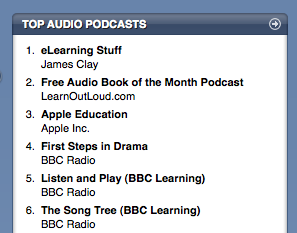
It is proving reasonably popular and the podcast is generally always in the top twenty, quite pleased though today to see it is in at number one!

Now if you go and look I suspect we may have dropped a fair few places, the top podcasts list does change on a daily basis dependent on how many subscribers you have and how many new people subscribe.

I am working on a workflow document which describes the process I use for recording the podcast, it is currently a work in progress but you can view it here.

Since Christmas I have been putting an episode out every week, which is a lot more challenging than you would think

Always interested to hear about topics people would like us to talk about or even those who would be interested in taking part.

news and views on e-learning, TEL and learning stuff in general…