
Happy New Year
No weeknote this week as I am on leave.


Merry Christmas.
No weeknote this week as I am on leave.

An interesting blog post from WonKHE about the challenges that exist with restructuring higher education. It’s not as simple as we think it is. There is a lot of resistance and scepticism about merger that we have seen elsewhere as well.
Connect more: creating the conditions for a more resilient and sustainable HE sector in England
There is a startling dearth of law and policy around structural collaboration for HE; some issues such as the VAT rules on shared services, are well established, while others are more speculative. What would the regulatory approach be to a “federated” group of HE providers? What are merging providers’ legal responsibilities to students? What data and evidence might providers draw on to inform their planning?
Alignment, standardisation, rationalisation, and commonality, though requisite for merger, you don’t need to have merger to undertake the work to allow for greater alignment.
The Times Higher Education published an article about collaboration, and mentions the Jisc collaboration report by name.
A recent, comprehensive report on “collaboration for a sustainable future” by Jisc and KPMG celebrated more examples – but also made a compelling case for the sector to keep pushing itself on this.
In addition, Jisc is involved in and working with the Transformation and Efficiency Taskforce. I am working in collaboration with UUK on a joint project working on the following strand:
The launch of the taskforce is on the UUK website as well. I like this quote:
“While institutions have been doing more and more to be as efficient as possible, they have largely been doing so at an individual level. Truly impactful transformation will best be delivered through partnership and collaboration at both a regional and a national level. It is time for some blue sky thinking on what that looks like.”

I wrote a blog post, So does your institution have a silo mentality? I wrote it after reading this article on the WonkHE about higher education silos, Institutional silos are making it harder to build learning environments for student success.
Ask any higher education institution leader about the organisational challenges they’re grappling with, and they’ll start talking about silos.
Though talking about silos, the article is more about integrating digital into learning and teaching.
Though as anyone knows breaking down silos is hard. We often think of grain silos, metal cylinders that are close together, they should be easy to break, shouldn’t they? I always now think of higher education silos as missile silos, embedded into reinforced concrete and dispersed across a wide area.
Breaking down silo working, isn’t just about saying, we need to break down the silos but is so much more about thinking strategically about what your organisation is trying to achieve.

After working from home at the start of the week, I went off to London. I was attending the BLE 20th anniversary event at Senate House.
The Bloomsbury Learning Exchange (BLE) brings together expertise to share good practice and enable collaboration in digital education and technology enhanced learning projects. We are a partnership comprising six Higher Education Institutions in Bloomsbury, central London. Essentially, the BLE is the community, and the BLE Executive Team facilitates the exchange as well as offering specific services to the partner institutions.
They have grown over the years and expanded their collaboration. It is a really good example of collaboration that doesn’t mean you have to create complex pseudo-organisations to manage a shared service. The core of the BLE is the memorandum of understanding.
I ran a similar collaboration back in 2000, called the Western Colleges Consortium, where the FE colleges in Avon shared a VLE. There are lots of lessons from that experience and the BLE that higher education probably should take on board for future collaborations, especially in the learning technology space. One of the key lessons is about keeping it simple, constant adaptation and tinkering, may in the short term resolve problems, but it is harder to then collaborate whern faced with a future challenging scenario.
I have done quite a few things with the BLE over the last twenty years, including a few things while I have been at Jisc. It was nice to see and hear about their success.
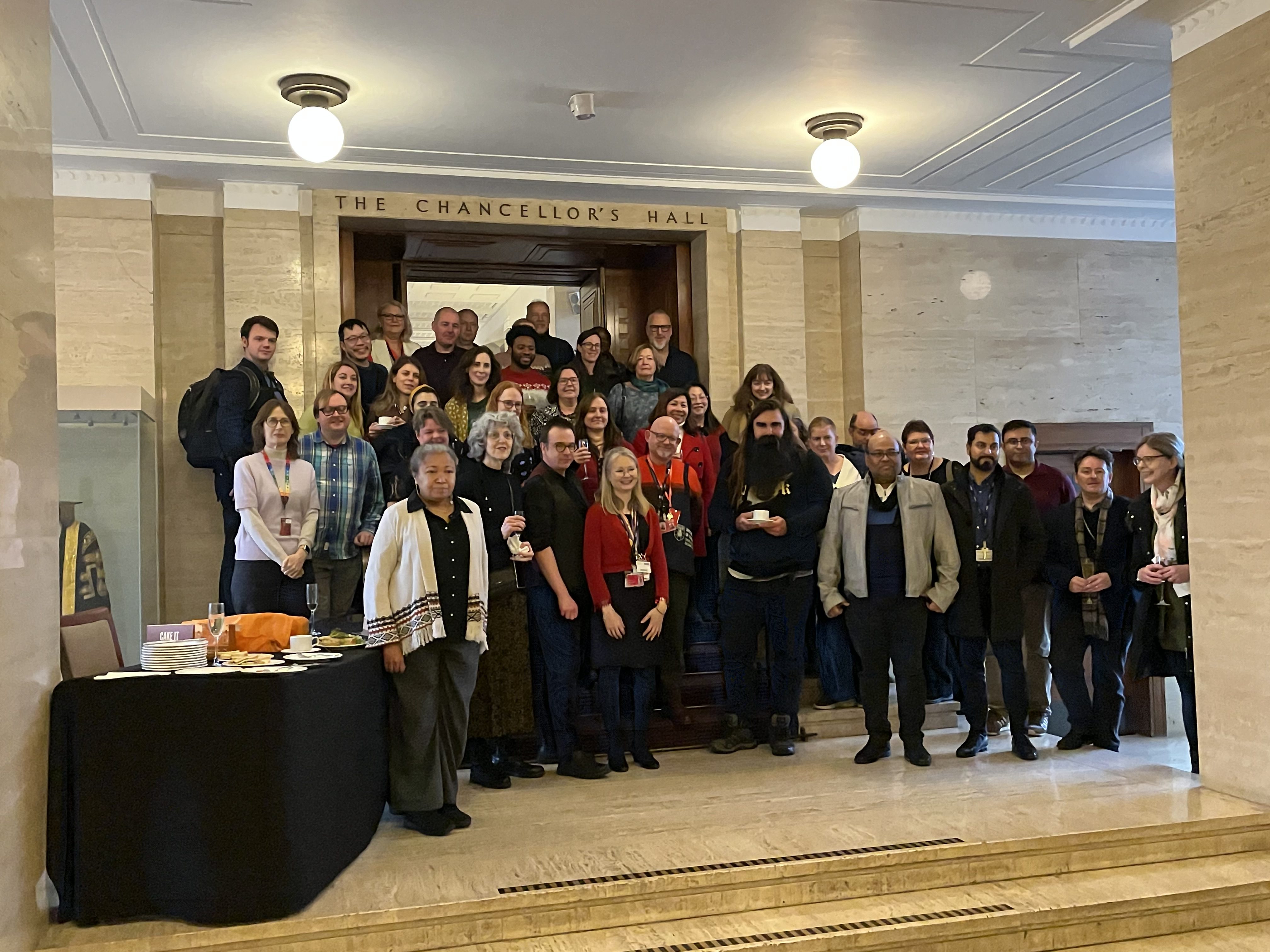
At the event I had a couple of interesting conversations. One was with a manager, who spoke about the challenges in joining collaborative ventures, and needing more support from senior management. We know that collaboration often needs to come from the top, but there is also the need to delegate that downwards, to enable collaboration at different levels in the organisation as well.
In another conversation someone provided feedback on the report, which he stated he “had read thoroughly” and even quoted lines from the report. He said it was an excellent report and much needed. This was nice to hear.

Did some more work on the UUK project, did some stuff with the KPMG report next steps, and created a template for the position papers for the E in NREN activity.

I can not quite believe that it is December already (or is that again). Guess it must just be an age thing.
Pretty much a similar week to last week. Took some leave, did some more work on the UUK project, did some stuff with the KPMG report next steps, and thought more about the position papers for the E in NREN activity.
Had a pre-emptive call with a university on Jisc’s “coalition of willing”, they were keen to participate and provided some useful insights into what this coalition could look like and what they would do.

So this is weeknote number three hundred. When I started these weeknotes back in March 2019, I did wonder if I would keep it going. Well over five years later and three hundred posts later, I guess I have.
Still sorting things out with my new house, so I took some leave to deal with a couple of issues.
I will be working on a project with UUK on collaboration building on the report we did with KPMG. It will be interesting to see how this goes.
I undertook some scoping and planning on the E in NREN work I am doing over the next few months.
I have been reflecting on coalition of the willing, the report has catalysed a really positive response from many in the higher education sector. We need to think about how we can build on this to ensure that future collaboration takes place.

For the first time in an age I headed up to London for a meeting. I also did London in a day, which was a lot more exhausting than I remember it being. It was very cold, and though there was light snow on the way, I didn’t see the snow and disruption that others encountered.
The principal reason for heading to London was for an in-person discussion and workshop on planning some work around, what we are calling the Education in NREN. NREN stands for National Research and Education Network, in the UK that is Jisc, in the Netherlands it is SURF, whilst in Eire it is HEAnet. These are the national networks for educational providers. Though there are many similarities there are also marked differences between the various NRENs across Europe (and the rest of the world).
It was nice to work in the London office for a change. It’s never our busiest office, and that was even the case prior to the pandemic, but you do see and meet people there.

I had planned to head to the Bristol office on Wednesday, but when I tried to book a meeting room for my two online meetings, there were none available. Over the last year the Bristol office has got much busier, so meeting rooms get booked up very quickly. Part of this, is that not only do we still have a pattern of hybrid working, which means a lot more online meetings. The fact we are hybrid has also meant that are patterns of recruitment are less dependent geographically, which exacerbates the number of online meetings and calls that people are having. All this means that the number of calls in the office is higher than it was before the pandemic and there is increased demand on rooms for people to have online meetings in.

As well as the in-person meeting on the E in NREN, I had a fair number of meetings across the week, as I start to do more work in this area.
I am still continuing to work on the optimisation of operations and data following the publication fo the KPMG report I had been working on. I had a meeting about some collaboration with another agency on some next steps on some collaboration proposals.
In addition I wrote up some thoughts on next steps with KPMG report.

Across the sector there has been discussion about talk about the OfS report from last week. For example from WonkHE.
Last week’s update from the Office for Students (OfS) on the state of institutional finances for the HE sector in England brought any lingering sense of cheer from the recent announcement on the indexation of undergraduate fees to an abrupt halt. Based on the latest data available on student entry this autumn, OfS confirms that its warning in May that the sector’s recruitment forecasts had a degree of “optimism bias” has proved true.
It now appears the question of what will happen if a higher education institution fails, is less about if and more about when. The OfS requires all providers to have in place a student protection plan, to ensure a continuity of studying for students of a failing institution. The objective of these plans is to protect the students, however not the staff or the institution as a whole.
I do think that over the next year or so, we will see struggling universities merging and collaborating more closely, rather than waiting to fail. Though the independence mentality of the institution may mean that rather than merge, an institution will just keep cutting costs.
We live in interesting times.

After being on leave for most of last week, though I worked for most of the week, I also took a few days leave.
I was in the office on Tuesday and during my lunchtime walk I went pass our old offices at Castle Park. The block has been surrounded by scaffolding for what seemed like a really long time. They have renamed the building BLOK. What I found quite interesting was the addition of a café on the ground floor. I can imagine if we had remained in that building that myself and others would have probably drank a lot of coffee there.

It is looking like that the university cash crisis to get worse despite tuition fee rise. This week the OfS published a report on the financial sustainability of the higher education sector. Despite earlier positive perspective of an improved outlook, the new report notes
Our analysis of recruitment trends suggested that providers’ financial forecasts were based on predictions of student recruitment that were too optimistic.
The OfS notes that bold and transformative action is needed to address financial sustainability of the sector.
Many providers will need to take increasingly bold action to address the impact of these challenges on their financial position in the short, medium and long terms. Where necessary, providers will need to prepare for, and deliver in practice, the transformation needed to address the challenges they face. In some cases, this is likely to include looking externally for solutions to secure their financial future, including working with other organisations to reduce costs or identifying potential merger partners or other structural changes. We recognise that cultural and other barriers in the sector may deter institutions from considering some of these options, and so it is important that options are identified and evaluated with sufficient time for action to be taken.
The action required by the sector is one of the core reasons why Jisc with KPMG published a report on collaboration.
Even with the rise in tuition fees, the increase in employer national insurance will negate much of that benefit. We also know that the impact on the sector varies, some institutions will be able to weather the storm better than others. As the OfS says bold action is needed. This is a time to think differently.
The news story was also reported on the BBC
Almost three quarters of universities in England will face financial problems next year – despite tuition fees increasing, the BBC has been told.
David Kernohan on WonkHE has written an in-depth piece on the report which makes for interesting reading.

At the end of the week I was reminded of this speech by John F Kennedy.
We choose to go to the Moon in this decade and do the other things, not because they are easy, but because they are hard; because that goal will serve to organize and measure the best of our energies and skills, because that challenge is one that we are willing to accept, one we are unwilling to postpone, and one we intend to win, and the others, too.
I was involved in a webinar with senior managers from across higher education discussing the report we have just published with KPMG.
One participant remarked that collaboration and shared services in some entrenched areas of higher education was hard and that we may, as a sector, might want to focus on areas which are new or easier.
I do think that, just because it is hard, doesn’t mean we shouldn’t look at some areas. There are very likely benefits that go beyond that area as well.

The main event this week was the publication of the report I have been working on over the last few months.
Commissioned by Jisc and produced in partnership with KPMG in the UK, Collaboration for a sustainable future outlines how institutions can leverage digital, data and technology collaboratively to unlock efficiencies, reduce costs and contribute to a stable, sustainable future.
The report reflects on the possibilities of collaboration and sharing across higher education, as well as highlighting current exemplars and importantly the challenges.
The report is the start of a journey and hopefully will catalyse discussion and debate within higher education.

I was mainly on leave this week as I was moving house. One reason for taking leave was that I wasn’t sure how long it would take to sort out connectivity in the house. In the end, the internet was one of the first things that was working fine. I had sorted the provider out the week before, given them my moving date as the activation date. They sent the router to my old address, so when I moved it was literally a simple process to plug the router into the power and then connect it to the modem.

I took some leave this week, so less intensive (from a work perspective) than more recent weeks.
We had the budget this week, and it wasn’t the budget for higher education. No sign of that fee increase everyone has been hoping for, nor was there any new funding. Of course the increase in employer’s National Insurance contributions had meant that wage costs across the sector have gone up. The Universities and Colleges Employers Association has calculated that this measure will add around £372m to the sector’s pay bill.

We have been planning the launch of the collaboration report that we finalised the draft of last week. There have been a few issues this week, so we have been delayed by a few days. Nothing serious, but it is important that we cover all the details and make sure everything is signed off. I also did some internal briefing documents for internal stakeholders.
Had a meeting about the education in NREN. Across the world there are various NRENs. These are the national research and education network (NREN) and each is a specialised internet service provider dedicated to supporting the needs of the research and education in each country. The Netherlands have SURF, and in the UK, we have Jisc. There have been discussions across various networks about raising the importance of the E in NREN. How can NRENs better support education. I do think in the UK, Jisc provides a lot of support for education across further and higher education. Could we do more, and what is happening in Europe? Lots to think about and find out.

I had a conversation with Lawrie about the lack of innovation in learning technology in higher education, now before you say artificial intelligence, let’s just put that to one side and focus on other aspects of innovation. The mailing lists are quiet, I am not seeing the blog posts or yore, and as for new technologies, is there anything out there which is truly innovative? Back in the day, well twenty years ago now… we were on the cusp of an innovation revolution. In 2004, there was no Twitter, no Facebook, no YouTube. The iPhone wasn’t going to be seen for another three years, while it would be six before we saw the iPad. Yes in 2004 we had smartphones and tablets, but it would be the way in which Apple designed their versions which revolutionised how consumers (and then students) would use them. Over a ten year period we saw massive changes in consumer technologies, connectivity, web services, which all impacted on learning and teaching.
Since then, not so much.
Another thing we discussed was how the financial constraints on higher education could be impacting on the role of learning technologists within higher education. There is an invalid assumption that because of covid, we all know how to do it now. Combine that with the lack of flashy innovation, then the visibility of the hard work of learning technologists might be lacking. When your work moves away from discovery into embedding, then the profile of what you do becomes less visible. Big flash events about how a single cohort are using a new technology is exciting, whereas embedding use of the VLE across the entire university has a greater impact but isn’t as high profile. Sometimes talking about what you are doing and the impact it is having on the student experience is just as important as actually doing it.