All posts by James Clay

Quiet – Weeknote #335 – 1st August

Final week of the year, the new Jisc year starts 1st August.

This time of year is somewhat quiet with both universities empty and a lot of colleagues in Jisc taking a summer break. I had a break earlier in July, but am planning to take some, more time off later in August.

Having finalised virtually everything that needed doing for the last year, I have started planning for the next twelve months.

I have three key things to work on. The first is continuing the work on E in NREN, working with colleagues across Europe on building on the work of NRENs in the education field, and in the main student mobility.

The second is looking at the Lifelong Learning Entitlement (LLE) and what this means for higher education in the realm of digital, data, and technology, and what are the implications for Jisc’s work.

The third focus is also a continuation piece, working on sharing and collaboration. Last year we published Collaboration for a Sustainable Future, and I also spent a lot of time working on strand 2 for UUK’s Transformation and Efficiency Taskforce. Next year is looking at how Jisc can support the sector on building on both the report, and the work of the taskforce.

Radical Collaboration – Weeknote #334 – 25th July

I headed to the Bristol office this week, in the main as the car was getting a service, but also, I do like working in the office on a regular basis.

This week saw the publication of the Radical Collaboration Playbook.  This report is one of the key outputs for Universities UK’s (UUK) transformation and efficiency taskforce which was established in December 2024 to understand where further opportunities for universities to save costs and transform their operations exist. It has become clear in this process that one of the greatest opportunities lies in collaboration – in building on what exists and in finding novel ways to deepen partnerships across the sector.

This is quite a substantial piece of work, covering 74 pages. My first reading and first impressions was that this was a detailed piece of work and certainly well worth looking at if you are looking at mergers, collaboration, or sharing. Though one question it doesn’t, and couldn’t answer, is when do you make the decision to merge? Do you wait until everything is falling apart or even afterwards? Do you plan for that possible future now? Or, what about biting the bullet and merging now, before things get bad.

This is the outcome from strand 3 of the UUK Phase 1 Transformation and Efficiency Taskforce. I have spent much of the last year working on strand 2.

Though there appears to be an appetite for collaboration, I haven’t seen much evidence for actual collaboration or sharing over the last twelve months. Will that change over the next year, who knows!

people
Image by StockSnap from Pixabay

Went through a third draft of my objectives for next year. Our year runs from August to July, in line with the academic calendar. They cover three main areas, continuing the E in NREN work I have been doing, likewise a similar objective looking at optimisation and collaboration. The third objective is looking at the LLE (Lifelong Learning Entitlement) in UK higher education and what it means for Jisc.

Refreshment – Weeknote #333 – 18th July

slice of lemon
Image by Myriams-Fotos from Pixabay

Back at work this week after taking a week’s leave and a holiday. There were just 111 emails in my inbox, I had cleared my inbox before going on holiday. As many were updates, spam, and various Teams notifications, it didn’t take long to clear them out. What I did find was that there were three new pieces of mandatory refresher training. Well, that made it clear what I needed to do this week.

Tuesday, I headed into the Bristol office to work. It had been a while since I was last in the office, well two weeks ago, and I had been on leave for a week. I usually try and get to the office at least once a week, though if I am away at an event or a conference, I may miss that week.

There was lots of rain on Tuesday, so plans for a nice lunchtime walk were thrown out of the window.

Started working on my objectives for next year, the new Jisc year starts 1st August. I also started a new Confluence site and will set up a new JIRA project as well for task management.

I was on leave on Friday.

Original Lemon Flavour – Weeknote #331 – 4th July

lemons
Image by Neale Bacon from Pixabay

I actually got to our Bristol office this week, after spending what felt like the most of June travelling across the UK and Europe. Over the last few weeks I have been to Brussels, Belfast, Brighton, Nottingham for work. In addition I have been visiting University open days, so have also travelled to Bristol, Bournemouth, Plymouth, Worcester, Oxford as well.

It’s nice to get to the office and work, as well as meet people. I don’t really like going to the office if I have numerous online meetings, as I could be anywhere and stuck in an office looking at a screen to me isn’t really a real reason to be in the office. Though it has to be said the air-conditioning was welcome in all this heat we’ve been having.

Gromit sculpture

This week saw the presentation of the almost finished strategic outline cases to the UUK Transformation & Efficiency Taskforce at their final meeting. This has been a huge task, but really interesting piece of work.

It’s that time of year when I need to undertake some mandatory refresher training. This time it was Data Protection & Data Governance, and Information Security.

I took a volunteering day, it’s nice that Jisc allows staff to take time off for volunteering.

A lot of the week I was finalising a proposal (with NREN colleagues) on NREN support for pan-European student mobility.

It’s Tuesday, so it must be Nottingham – Weeknote #330 – 27th June 2025

This week I was up in Nottingham attending and presenting at Networkshop. My session was on collaboration. I did enjoy the keynotes from the conference, listening to Klaas Wierenga on the history of eduroam was insightful. I can’t quite believe that eduroam in less than twenty four years old, then again Wi-Fi isn’t that old really either. It was nice to meet up with colleagues from Jisc at the conference as well.

Nottingham is quite a trek from Weston so it takes a while both to get there and get back.

My first visit to Nottingham was as a child visiting my aunt and uncle. My main memory was thinking how small Sherwood Forest was and how on earth did Robin Hood hide from the Sheriff of Nottingham when the forest was so small… Of course what I didn’t realise was back then the forest was huge in comparison to the size of the forest today.

Over the last twenty five years I have made quite a few visits to Nottingham, for events, conferences, and sometimes staying there when travelling further north.

Exploring the city now I realise I still don’t really know the place and found it hard to get my bearings. I would walk up one street and find myself somewhere completely different to where I expected to be.

I did spend some time reviewing one of the business cases for the UUK project I am working on, going through the comments from various stakeholders. I did need to write some new sections, and other areas needed a rewrite.

I also looked at the concept plan for the NREN work I am participating in.

At the end of the week I took a volunteering day, it’s nice that Jisc allows staff to take time off for volunteering.

Designing Next Generation Digital Experiences – Weeknote #329 – 20th June 2025

Took some leave this week.

microphone
Image by StockSnap from Pixabay

Was part of a panel session at the Higher Education Digital Experience Conference 2025. Our session title was Designing Next Generation Digital Experiences: What’s Next?

  • Raising the bar: How do we match students’ expectations on the digital experience?
  • Removing barriers: How do we advance digital literacies and capabilities?
  • A driver for success: How can the digital environment act as an enabler for improved engagement and outcomes?
  • What’s next? Embedding next generation AI and personalisation into the digital learning space
  • The product of the future: What should platforms, digital spaces and content output look like in 2035?

I did make some notes, which I think I might write up as a blog post.

Had a meeting with our copyeditor about some prospective articles on collaboration and sharing.

Spent time working on NRENs 4 Education proposal to European Commission.

I also attended various UUK Collaboration project update meetings

Undertook the preparation for Networkshop next week, where I am presenting about collaboration.

Brighton Rock – Weeknote #328 – 13th June 2025

After attending a conference in Belfast last week, this week I was off to Brighton for TNC25. TNC is the conference for the NREN community.

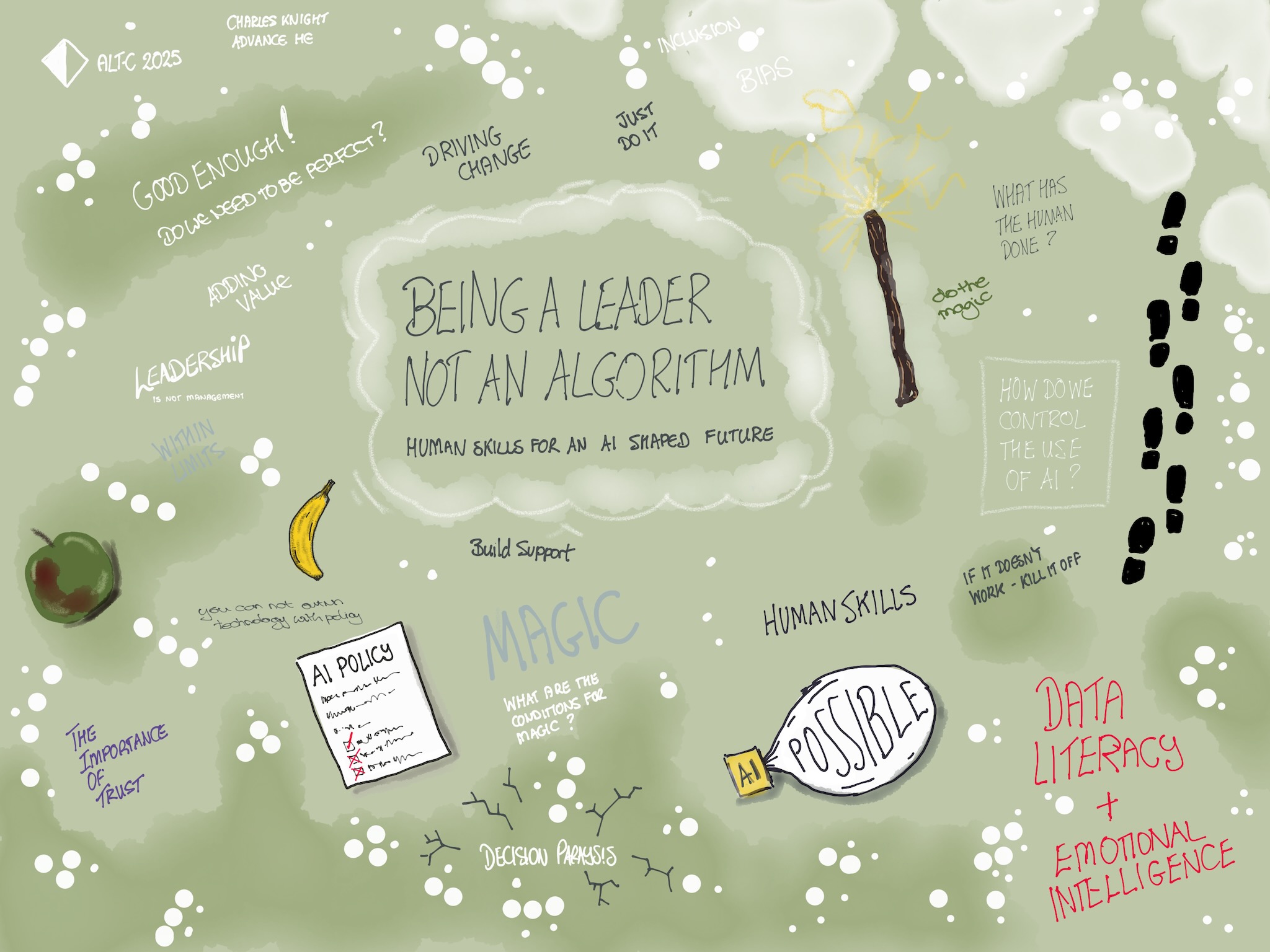
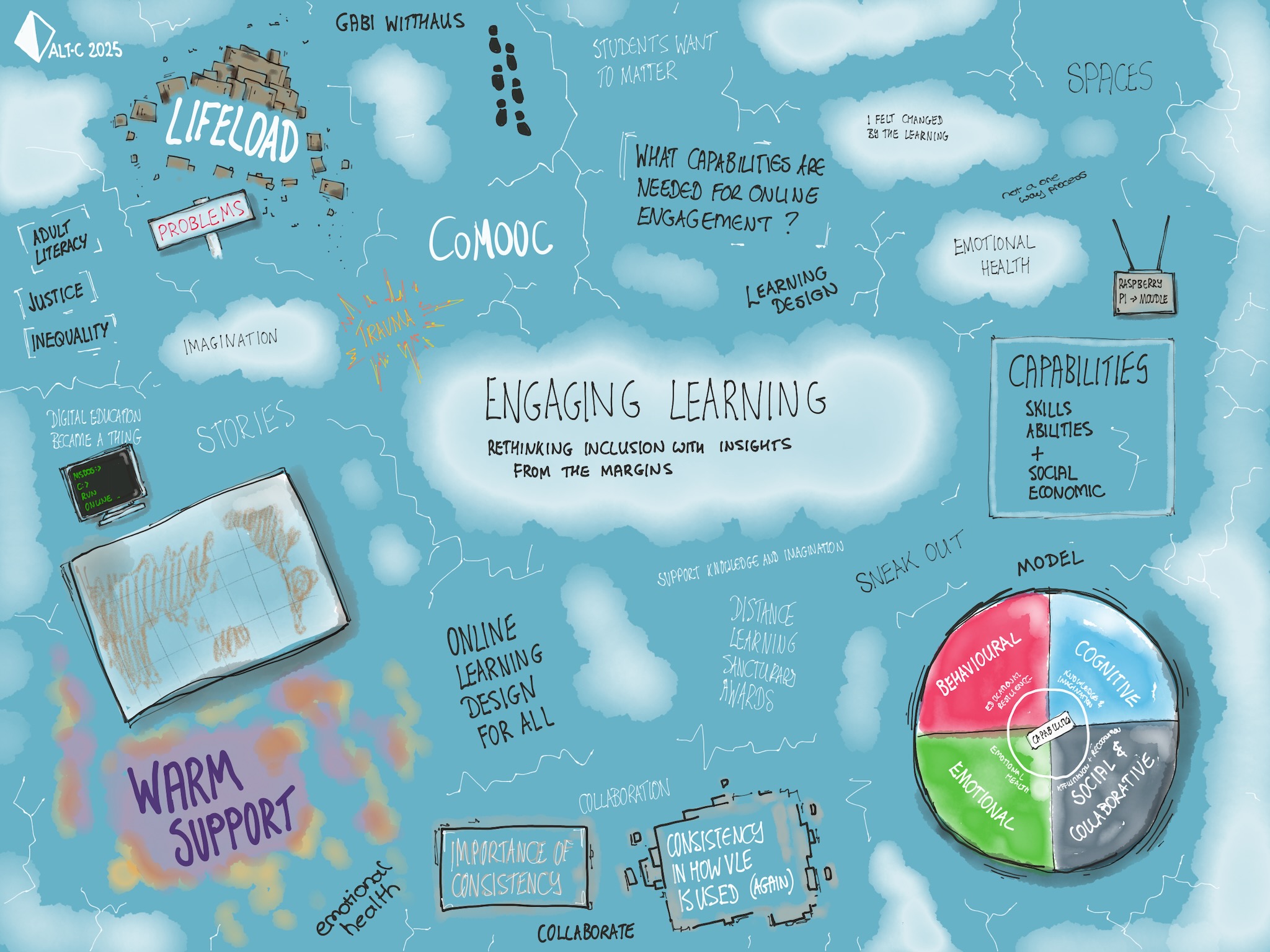
One of the sketchnotes I did.

At the conference I did four different key things.

  • Delivered presentation in the TF-EDU side meeting
  • Delivered presentation in the BoF NRENs 4 Education session.
  • Delivered presentation in the REFEDS side meeting
  • Supported Jisc stand at TNC25

I also attended NRENs 4 Education planning and development (side) meeting as well. Here we were working on an NRENs 4 Education proposal.

Attended an  UUK Collaboration project update meeting and also spent time reviewing  feedback on UUK Collaboration project strategic outline cases (new nomenclature for what were the business cases).

The week after next I am presenting at Networkshop, so reviewed my presentation and presentation notes.

Are students at breaking point? Via WonkHE

 More than two-thirds of full-time undergraduate students undertake paid work during term time, up from 42 per cent in 2020 – while students report a notable decrease in time spent on independent study as they balance employment and academic commitments. The ⁠Advance HE / HEPI Student Academic Experience Survey also finds that 37 per cent of students perceive their course as good value for money (down from 39 per cent in 2024), and a record low of 56 per cent of students would have chosen the same course and university if they had their time again.

Three-quarters of students report that cost-of-living pressures have notably impacted their studies, nearly one-in-five students have taken on more debt than planned (particularly affecting home students), and other impacts include reduced spending on course equipment, lower participation in sports and societies, and increased commuting costs. Financial challenges mean that 6 per cent of home students selected a different course than they had planned to, and 7 per cent selected a different institution than they had planned to.

Is university still going to be a viable option for many prospective students?

Towards a new era of collaboration – Weeknote #327 – 6th June 2025

Titanic Belfast
Titanic Belfast by James Clay

Having spent last week in Brussels, this week I was over in Belfast attending the EUNIS 25 Congress. I was supporting a workshop session on student mobility. as part of our work on NRENs for Education, or as I have been calling it internally E in NREN.

There were lots of interesting sessions, I think for me one of the challenges the sector faces, is that yes there are data and technical issues that need resolving, but there are only part of the solution. Some of the real challenges is rethinking the operating model and making those cultural process changes required to take advantage of the work being undertaken with standards and data.

Spent some time preparing for events and meetings I am attending in Brighton at TNC25.

The Universities UK Transformation and Efficiency Taskforce have published their first report, Towards a new era of collaboration.

Universities UK’s (UUK) transformation and efficiency taskforce was established in response to significant financial pressure on the higher education sector in all four nations of the UK. Our aim is to tackle the challenges we collectively face, to support the efforts of individual universities to achieve greater efficiency, and to seek opportunities for collective action to help our universities go further and faster than they can alone. This report is the first of three outputs from the taskforce, and together these mark Phase 1 of a long-term commitment to embark on a new era of collaboration.

I have been working on phase two of the work, though not sure if there will be a similar public facing publication.

As with much of the communication about collaboration, the challenges facing the sector, means the real challenge for many universities will be taking that first step towards collaboration. What and where should a university collaborate and with whom.

WonkHE had this perspective on the publication.

The case for university collaboration in the UK has been made with increasing frequency as the financial squeeze starts to make itself felt in profound ways. That said, there has been little tangible activity – the report points to longstanding structures such as the University of London federation, existing networks of research collaborations, and strategic working with local stakeholders. The taskforce adds the multi-academy trust-esque group structures employed by the (HE and FE) University of the Highlands and (cross sector) London South Bank to the list., and there is a nod to the world of sharing expensive research infrastructure too.

Interesting blog from the Competition and Markets Authority

Our universities are one of the UK’s greatest success stories – they produce world-class research, drive innovation across the economy and remain critical to equipping people with the skills they need to get on in life. Skills are, of course, crucial to economic growth and a successful industrial strategy, both of which we support. However, we know that many higher education providers are facing very challenging financial situations and that greater collaboration between universities could help support the sector. This is where competition law – and the Competition and Markets Authority (CMA) – can play a role. While some collaborations are more problematic under competition law, there are many areas where they are beneficial and pose no competition law risks. We can also support collaborations that benefit the UK by making clear that we won’t prioritise enforcement.

Life is short, eat more Belgian chocolates – Weeknote #326 – 30th May 2025

It was a shorter week this week with the late Spring bank holiday, which meant for many it was half-term. For me I was off to eat some Belgian chocolates in Brussels.

I have visited Belgium quite a few times over the years, we went to Ostend a lot when I was a child. When I did some college trips to Amsterdam in the 1990s, we travelled by coach through Belgium, we also stopped at Bruges, which I am planning to visit again in the future. Last year on the way back from Germany we stopped for a flying visit to Ghent. We had thought about visiting Brussels, but time was against us.

This week I was in Brussels for a couple of in-person meetings. I had caught the Eurostar from St Pancras, having travelled up to London from Weston to Paddington. I find it quite amazing that the train from London to Brussels takes just two hours. Having made my way across Brussels using the metro I checked into my hotel, the Marriott Courtyard EU.

I also did some preparation for the session I am supporting which is taking place at the EUNIS Congress next week in Belfast.