So do you like books, or do you like reading?

I am still of the opinion that e-Books and e-Book Readers are going to be big! Both Apple and Microsoft are working on devices which can be used to read e-Books.

I know that some people like books, well I like reading and e-Book Readers offer the reader a lot more than a traditional book.

With an e-Book Reader I can carry more than one book, I can carry a lot more than one book. I can carry documents too. The screen is reasonably large enough too so that it is easy to read. The battery life is pretty good too, much better than a laptop or a phone.

So why would you read a book on a phone?

Well Kevin Tofel from jkOnTheRun makes a very good point:

Think about it this way — if you’re always carrying your phone and an unplanned short opportunity arises to read a book, you don’t want to whip out a computer, do you? In a situation like this, you’re not limited to how much space you have. You can read with just one hand. You don’t need great lighting. It’s simply a win-win, all around.

This I agree with this view, there are times when you want to read and if you have your phone on you, then being able to quickly do some reading

e-Books are not about replacing books, in the same way that online news sites don’t totally replace physical newspapers, or YouTube replaces TV.

Likewise e-Book Readers don’t replace computers; what both e-Books and e-Book Readers do is allow reading to happen at a time and place to suit the reader.

So do you like books, or do you like reading?

To Retweet or not to Retweet

So what do I mean by “retweeting”. Well if you don’t use Twitter or don’t like Twitter, time to move on to the next blog post or the next thing in your newsfeed.

Twitter for me is becoming more and more a useful tool to support me in my day to day job. It is my community of practice. From Twitter I gain useful links, advice, ideas, events; I build relationships which allow for collaboration, projects, conferences and more.

Twitter is slowly replacing a lot of my e-mail communication as it is faster and more useful.


One of the strengths of Twitter has been the RT or re-tweet, the way in which you “forward” tweets from someone in your network to others who follow you. Not everyone who follows you follows all whom you follow. Make sense? Well look at it this way, at the time of writing David Sugden @dsugden follows me. He follows 74 people. I follow 421 people.

So I see something that I think is worth sharing from one of the 421 people I follow, so I retweet it, this way David sees it as there is a good chance he won’t have seen it. Likewise the 1309 people (minus spammers) who follow me will also see it.

So why do people do it? What content do they want to share?

Well I do it and I do it for a variety of reasons.

Here’s one…

zretweet004

RT @josiefraser The VLE: Dead Again? Come to the debate 16 Dec with @grahamattwell @timbuckteeth @jamesclay @nicksharratt http://u.nu/8smt3

I RT’d this Tweet as I thought my followers would be interested in knowing that there was to be another dead VLE debate. Not everyone who follows me follows Josie Fraser.

I also RT stuff I have posted, as a way of re-broadcasting a Tweet, because though people follow me, I know (as I do) don’t read every Tweet I post all the time.

One of the attractions of Twitter for me has been the simplicity of the interface and concept. Despite numerous tools available for Twitter, on my desktop I have stuck with the web interface.

One of the (many) reasons I don’t like (and as a result don’t use) Facebook is the complicated interface and features – well that and all those annoying bits like poking, zombies and farming…

Twitter though has started to add extra functionality and features to the service.

Some of these have come from the community, for example using @ to reply to someone was something the community brought to Twitter and was added to the system, as was the # hashtag to allow users to easily search for tweets about events, places, conferences, coffee, etc…

Now something new has arrived from Twitter, they have integrated retweeting into the web interface.

zretweetnew

Unlike the simple RT @name and then quote they have used a very different system. What happens is if I retweet somebody’s tweet, that tweet in it’s entirety appears in my followers Twitter stream with a little note that says that I retweeted it.

Now I know some may get confused with this, thinking I don’t follow that person why has their tweet appeared in my stream… Twitter have come up with a pop up box that may allay that confusion.

retweet006

Likewise the system doesn’t allow you to edit or add a comment. However though Twitter have added this functionality, you don’t need to use it, you can as I am sure I will continue to add RT and edit the retweeted post.

This though has some issues, especially in the way in which some people edit the post or add extra content.

Back on the 22nd October I posted the following tweet about the Windows 7 Burger.

retweet005

OMG! http://bit.ly/2o317H oh dear….

I got retweeted by Stephen Hodge.
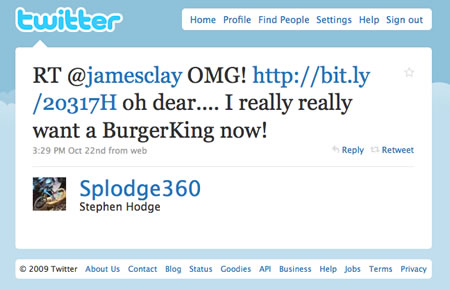
retweet002

RT @jamesclay OMG! http://bit.ly/2o317H oh dear…. I really really want a BurgerKing now!

Now it would appear that I said I really really want a BurgerKing but I didn’t, I don’t even go to Burger King!

I did think about correcting Stephen, but didn’t really think it would change anything, so just left it. But I am guessing some people may have thought I wanted a burger!

The new way of RTing from Twitter will stop that happening, but also means that things like this won’t happen!

retweet003

People use Twitter in many different ways and that’s always going to be a part of the issue of whether to RT or not to RT. You may want to have a look at my previous blog post on Ten things people say about using Twitter, but really they shouldn’t that looks at the way in which many people tell you how to use Twitter.

The problem with RTs is that yes you may see the same thing a few times, but remember the one time you see something once and then you will value the RT. Don’t ask people not to RT, if you don’t like what they’re doing, don’t follow them, others may value their RTs.

A conference with a difference

Those of you who know me will know that I quite like online conferences and have participated in a fair few over the years. JISC are running another of their innovating e-learning conferences this November.

The JISC Online e-Learning Conference 2009 takes place between the 24 and 27th November.

Innovating e-Learning 2009 is just around the corner

Book now for the fourth JISC online conference ‘Thriving, not just surviving’ 24-27thNovember!

What are the challenges facing 21stcentury institutions? What opportunities does technology offer to help overcome those challenges? You can contribute to these debates in the company of leading thinkers, broadcasters and academics.

The 2009 programme features keynotes from:

Charles Leadbeater, (leading authority on innovation and strategy); Nigel Paine(writer, broadcaster, organisational learning specialist and former Head of People Development at the BBC); Rhona Sharpe(Oxford Brookes University) and Helen Beetham(JISC Learners’ Experiences of e-Learning theme); Peter Bradwell(Demos) on The Edgeless University.

Sessions include Brian Lamb(University of British Columbia) on opening up educational content, Graham Attwell, Martin Weller(The Open University), Rob Howe, (University of Northampton) debating the demise (or otherwise) of educational institutions, Becka Currantand colleagues (University of Bradford) on using new technologies to engage and retain students, Alan Staley (Birmingham City University) on acquiring workplace skills while on course, John Kirriemuirand Kathryn Trinder(Glasgow Caledonian University) on making the most of virtual worlds in teaching and learning, Mike Neary(University of Lincoln) onengaging key stakeholders in the design of physical learning spaces.

Looking for something else? You can also follow new work by JISC projects on transforming delivery of learning with mobile and web 2.0 technologies, and engaging employers and professional bodies in the design of the curriculum. James Clay(Gloucestershire College) returns as the conference blogger, guided tours of Second Life and opportunities for hands-on experience of innovative learning environments and resources in the Have-a-Go area complete a rich and innovative conference programme.

Innovating e-Learning 2009welcomes delegates from further and higher education in the UK and overseas. Proceedings take place in an asynchronous virtual environment so can be accessed wherever and whenever is convenient to you. Keynotes will be delivered live in Elluminate, a collaborative web conferencing platform (recordings will be available post-session).

Innovating e-Learning 2009 is a simply unmissable conference experience. Find out more and register now at www.jisc.ac.uk/elpconference09

Delegate fee: £50

There are a few advantages of online conferences over traditional face to face conferences, feel free to add to them in the comments.

With an online conference it is feasible to go to all the presentations and workshops even if they are at the *same time*.

If you are a reflective person, then like me the question you actually want to ask the presenter is thought of as you travel home on the train, with an online conference you have a chance to reflect and ask that question.

You can attend a meeting at the same time as attending the conference.

You can teach a lesson at the same time as attending the conference.

You can watch Doctor Who at the same time as attending the conference.

You can attend the conference at 2am, useful for insomniacs and those with small children.

Having said all that it is useful too to make time for the conference, shut the office door, work from home for a bit, wear headphones, move to a different office, work in the coffee spaces in the college.

You can see presentations again, you can pause them, you can ignore them and (virtually) walk out without feeling you may be offending someone as their talk doesn’t relate to you as you thought it did.

The coffee is usually better.

Apple “less enthusiastic” about e-Books

I have at recent conferences been talking about e-Book Readers and the possible new products from Apple and Microsoft.

In a recent article from MacRumors, an analyst having spoken to various Apple executives published a research note. One of the interesting tidbits was on the online book market.

Apple was “less enthusiastic about the online book/newspaper market, given unattractive industry structure.

If there is any truth in this, then how would this impact on the rumoured Apple tablet? No idea to be honest.

However Apple has managed to change the music industry, they could change the publishing industry.

e-Book Readers, are they the future?

On Ollie Bray’s blog a comment was made on Ollie’s post about e-Books.

Neil commenting on the blog said:

I don’t think e-book readers will cut it. They will please a few – gadgeteers and the followers of Oprah (or would that be Jonathan Ross over here?) – but I think they will only be a niche product. After all, you can already read e-books on many phones, netbooks and PCs, so why would you want a specialist device?

Which would you rather spend on – a class set of Kindles (at £175 each) or a set of iPods touches (@£149)? No-brainer really. ANd you are never going to get a head to spend that kind of money twice.

I do agree that in terms of functionality that the iPod touch (currently) is superior to the Kindle, but you do need to ask what functionality are you looking for when purchasing a device.

I am going to disagree with  Neil about the e-Book, personally I think they are going to be one of the next big technologies.

Many negative things were said about early mp3 players and notably the iPod. If you go back to 2001 the following comments were made which are not exactly positive about Apple’s music player.

The iPod does cost considerably more than the nearest competitor with a portable hard drive…

…analyst Tim Deal dinged the $399 price as “a little high.”

“I question the company’s ability to sell into a tight consumer market right now at the iPod’s current price.”

“Apple lacks the richness of Sony’s product offering. And introducing new consumer products right now is risky, especially if they cannot be priced attractively,”

Stephen Baker said that the iPod will likely stand out for its large storage capacity but predicted that the device may have trouble digging out a niche in the market.

The iPod has “good features, but this is a pretty competitive category,” Baker said. “The question is whether people want that robust of a feature set with that high of a price.”

Look where the iPod is now!

Let’s take Niel’s comment:

After all, you can already read e-books on many phones, netbooks and PCs, so why would you want a specialist device?

If you rewrite this as

After all, you can already listen to mp3s on many phones, netbooks and PCs, so why would you want a specialist device?

That’s what many people said about the iPod and the early mp3 players.

e-Book readers are supplementary to netbooks, iPhones, iPods and PCs, not replacements.

They also have one big advantage over those devices for e-Books and that is battery life.

I have to charge my iPhone on a daily basis, I charge my e-Book reader once a week.

For me the Kindle and Sony Reader are generation one devices, and as the technology matures and changes I expect to see better and smarter products.

The rumours are that Apple and Microsoft will both release an e-Book Reader type product in the next twelve months. These devices will certainly raise the profile of e-Books and the market for devices to read them.

Mobile e-Learning Stuff

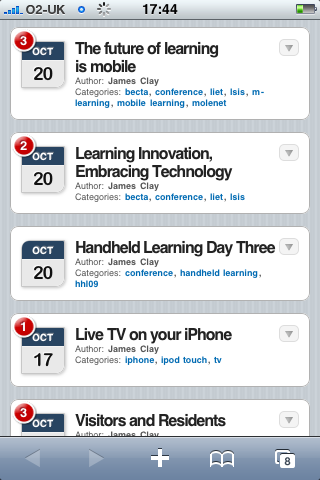
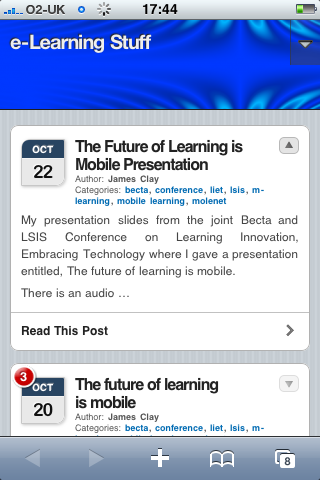
WordPress have upgraded their CSS so that when this blog is viewed on a mobile device, it renders in a format which is much more readable.

IMG_0236

This is an excellent move and makes reading blogs (well this one) whilst mobile so much easier.

So what are the red numbers?

IMG_0235

The number of comments on each post.

There is of course a WordPress App for the iPhone which means that mobile blogging is much easier and faster.

From a learning perspective what this does mean is that reflective blogs are much easier to access, you can read and blog when and where you have the time and the motivation and not just when you are on a computer.

At last…

One day this may all change…

chargers

Photo source.

According to a report on the BBC News, there will be on day a standard charger for mobile phones.

A new mobile phone charger that will work with any handset has been approved by the International Telecommunication Union (ITU), a United Nations body.

What this will mean is that if you do run out of charge you should be able to borrow someone’s charger without worrying if it will fit your phone.

Of course one of the advantages of this is that if educational institutions want to provide charging points they don’t need to worry about trying to provide the multitude of chargers currently available.

So when is this going to happen… not for some time. It will be 2010 when the standard will appear on new phones, and after that it could take a few years as people replace their phones.

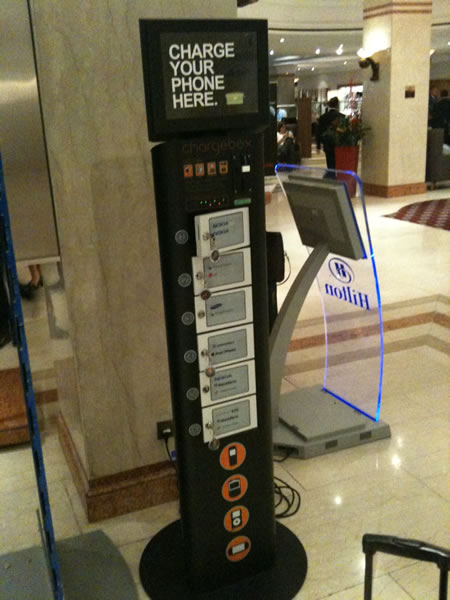
In the meantime educational institutions may want to consider secure charging points such as this.

multiphonecharger

Why?

Well with the way in which the phones of today can be used for learning from over the web to video and audio, the batteries just don’t last long enough.

I am now looking forward to the day when I can carry one charger for everything, not just my phones!

news and views on e-learning, TEL and learning stuff in general…