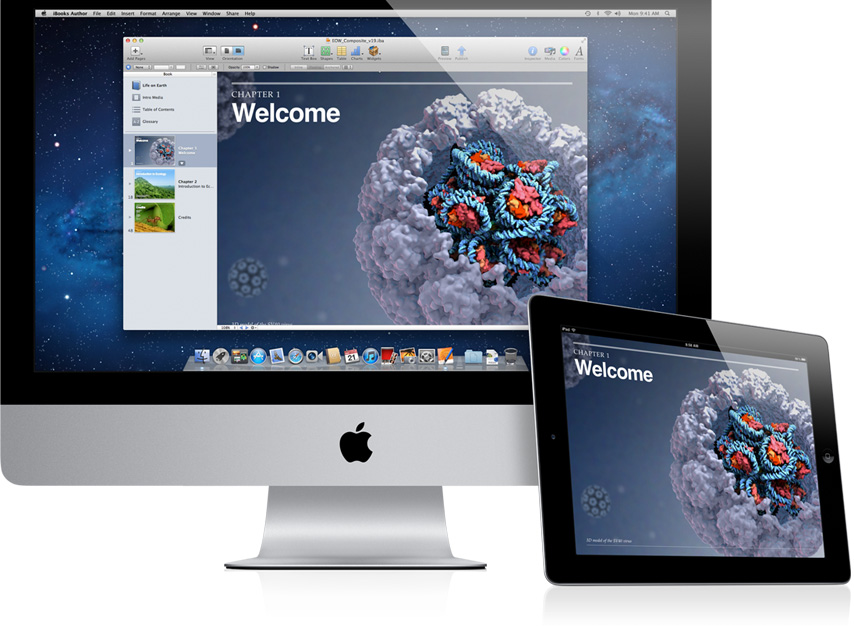
iBooks Author

A new free tool, iBooks Author, from Apple that should mean creating content for iBooks on iOS will be much easier.

Today in New York, Apple gave a presentation which announced three new products and services for education, iBooks 2, iBooks Author and an iTunes U app.

I wasn’t too impressed with iBooks 2, on the other hand, iBooks Author I think has real potential for practitioners in allowing them to easily create content that will work on the iPad. Practitioners have been wanting a simple tool that allows them to create simple content with added bells and whistles. This will I think have a greater impact than the textbooks for iBooks 2.

Why?

Well practitioners now have a tool that allows them to not only easily create content they can give to their learners, it also gives universities, colleges and schools the ability to convert and create content, that they can they give away within iTunes U, but also sell in the iBookstore to learners, not only in their institution, but also sell to other students across the world. You will also see individual practitioners creating and selling educational content that before was only mainly done by publishers and software companies. With iBooks Author there is now a tool that is not only free and simple to download, it is also very easy to use. Practitioners who are using Keynote and Pages (or even Powerpoint) will find that it is relatively simple to reuse or convert content, publish and sell it on Apple’s iBookstore.

Having given iBooks Author a try, in a similar vein to iWeb if you don’t mind following the Apple template then the app will work just fine. If you want to go out of the box? Then at this time the app isn’t a solution and you will find it very frustrating.

The export options are limited to iBooks, PDF and text. The PDF option is horrible in that it exports the “pages” in frames with a watermark underneath each one, and none of the media work, even though PDFs can support video and animations. There is also no ePub export option available either. It was rumoured that Apple would be using a ePub3 standard with HTML5 extensions that would allow the use of interactivity and media. Now that may very well be the case, but they are using their version of it which means that firstly any book you create will only really work on the iPad, and won’t work on other readers such as the Sony Reader let alone the Kindle. Secondly if you didn’t want to use iBooks Author to create an iBook then you probably wouldn’t be able to create (easily) an iBook using the ePub3 standard with HTML 5 extensions.

So there is no easy way to export as ePub or import ePub. From the perspective of the average practitioner this isn’t going to be an issue, but for some learning technologists this will probably create some real headaches if they are trying to reuse or repurpose existing content.

I can certainly see a lot of practitioners and institutions deciding to create and sell content using iBooks Author and as a 1.0 release I think it has potential, however it currently reminds me too much of iWeb and not enough of Keynote. For “normal” people I think it will be “awesome” and “magical” for everyone else it will be iWeb.

Get iBooks Author in the Mac App Store.

“Reinventing” Textbooks, I don’t think so!

So has Apple reinvented the textbook?

I don’t think so.

Today in New York, Apple gave a presentation which announced three new products and services for education, iBooks 2, iBooks Author and an iTunes U app.

With iBooks 2 it is now possible to read e-books that also contain media and interactive content

I have to say to Apple and all those sites out there that are saying iBooks 2 has reinvented textbooks, I don’t think so. I felt a little underwhelmed by the textbooks that were announced by Apple. They are for all intents and purposes digitised textbooks with some fancy video, slideshows and other effects. There are already apps within the iOS App Store that provide a similar experience, the Dorling Kindersley releases for example. I have already reviewed some of these in my review series, and I think some of those, such as Eureka, are much more innovative and exciting.

Don’t get me wrong, the use of video, animations, slideshows, 3D diagrams, interactivity can be so much better than the diagrams and photographs in a paper book. We mustn’t though forget that interactive doesn’t always mean engaging. Sometimes something very uninteractive and be very engaging, likewise in the past many interactive textbooks (we called them CD-ROMS back then) did not engage learners. It takes a lot of skill and thought to create engaging interactive content, and clever animations and video is only part of the picture.

What is missing is the Apple magic in the user interface. iBooks and devices such as the Kindle work for “normal” books such as novels and non-fiction where the reader moves from one page to another in a linear fashion. From a user’s perspective, the experience is comparable.

However this is not how academic textbooks are used by learners. Learners rarely (if ever) read an academic textbook from page to page. No they are more likely to flick through the pages to the relevant chapter or section, flick back to other parts of the book as they make notes, sometimes on the book (annotations) but also on paper (or using a word processor). Now you can do that in iBooks 2, but not nearly as easily and smoothly as you can with a paper book.

In May 2010, I wrote about how the Seattle Times outlined how student at the University of Washington did not like using the Kindle compared to using printed books.

There were some interesting results and comments from the pilot. 80% would not recommend the Kindle as a classroom study aid for example. However 90% liked it for reading for pleasure.

Though I hazard a guess that maybe a slightly lower percentage would not recommend the iPad as a classroom study aid, I said back then:

This is a lesson that educational publishers need to recognise when publishing content to platforms like the Kindle and the iPad. Though novels are linear and as a result eBook formats can “work” like a printed book, educational books are used differently and as a result eBook versions need to work differently. Students need to be able to move around quickly, annotate and bookmark.

Creating a digital copy of an academic textbook for a lot of learners is not going to work, as it doesn’t allow them to use the digital textbook in the way that they would use a paper copy. There needs to be a paradigm shift in understanding how learners use content, so that the advantages that a device such as the iPad can bring to learning are fully exploited and learners are not left thinking that the digital version is a poor relation of the paper textbook.

Those advantages that Apple outlined in their presentation that the iPad is portable, durable, interactive, searchable and current are just part of the story, digitising content misses out on the other advantages that the iPad brings to the desk. The touch interface offers so much more than just highlighting and flicking backwards and forwards in a linear fashion. Magazines such as Eureka and Wired have started to understand that, I am surprised that Apple haven’t.

There is also a complete lack of communication and sharing within iBooks 2. Learners are unable to share their annotations, copy their notes to their peers, discuss the content. All that is missing from iBooks 2, it is about consuming content, individually and then probably writing about it using Pages or creating a spreadsheet in Numbers.

The new textbooks in iBooks 2 make the mistake of creating a digital equivalent of the paper book with a few added bells and whistles and does not take advantage of the iPad interface and connectivity that could add so much. Textbooks need a new way of thinking, however this time Apple are not thinking differently enough.

What do you think?

iPublisher or iBooks U

Tomorrow there is going to be an announcement from Apple in New York.

As you can see from the invite the event is about education. The word on the street (well on the rumour sites) is that this is something to do with electronic textbooks, as major publishers have been invited to the event. This wouldn’t be too much of a surprise as it was hinted at in the Steve Jobs biography.

In terms of academic e-books I think we may see either a new way of looking at e-books with much more media within them, or possibly a new way of selling them, by chapter for example as demonstrated by Inkling.

We use to buy music either as albums or singles, now with the iTunes Store or Amazon we can buy individual tracks from albums. I am sure similar changes will happen with books, with e-books just been the start of this process.

One thing I have said is that publishers need to move away from the traditional approach of selling the whole text book as an e-book and start thinking about selling individual chapters to users, in the same way that we can buy individual episodes of a TV series.

I have said we should move away from digitised versions of print books and take advantage of the digital medium with interactive content and media.

We may also see an iBooks for the Mac too; at the moment you can only read iBooks on an iOS device. So if you have an iPad or an iPhone, great you can read e-books from Apple, however if you have a Mac then you can’t. It would make sense that if there are going to be lots of academic e-books for iBooks, and many students will only have a MacBook then there will be a need for iBooks for the Mac.

So what about the creation of content for iBooks? There has also been a lot of discussion and rumours about a possible Apple e-Book publishing tool announcement. At the moment it is quite difficult to create nice looking e-books, yes you can do it in Pages, but it’s not easy or perfect. So the rumour is Apple may announce something like Garageband or iWeb, but for creating e-books. If they announce support within iBooks for the EPUB 3 standard then within iBooks it will be much easier to view and engage with interactive e-books; then we will need a new tool that allows us to easily create EPUB 3 e-books.

This new app, which I guess could be called iPublisher, would allow people to easily create and edit e-books that can then be read in the iBooks app or any e-book reader that supports EPUB 3. There might even be an iPublisher Pro that enables Publishers to create more sophisticated e-books.

Part of me hopes that we will see an “iPublisher” app, but part of me thinks if that was going to happen then why would Publishers (who would be threatened by such a tool) are invited to the event. So as a result I am slightly sceptical that we won’t see an iPublisher tool, but hoping that we will.

Something else we might see tomorrow is iBooks U in the same way the record companies have iTunes and Universities can have their own iTunes U, I wonder if as well as an iBooks academic store, we also have an iBooks U where Universities and Colleges can publish their own iBooks to the EPUB 3 standard, complete with multi-media and interactive content, something that in the past we may have called a learning object.

iBooks U wouldn’t exclude an iPublisher app, if we look at music or audio, we have iTunes Store for commercial content, iTunes U for academic content and within iTunes we have podcasts for other audio content, to which people like me can publish using a tool such as Garageband.

So if we have an iBooks academic store, iBooks U for content from Universities and Colleges, we could also have a “place” for content created by people like me, using a tool that may be called iPublisher…

Well that’s what I am thinking, what do you think?

Dermandar Panorama – iPhone App of the Week

Dermandar Panorama – iPhone App of the Week

This is a regular feature of the blog looking at various Apps available. Some of the apps will be useful for those involved in learning technologies, others will be useful in improving the way in which you work, whilst a few will be just plain fun! Some will be free, others will cost a little and one or two will be what some will think is quite expensive.

This week’s App is Dermandar Panorama.

“While many iOS apps offer panorama stitching, or even capturing and stitching, few make it as easy as Dermandar Panorama … it’s really hard to take a bad panorama.” – Macworld.

Features:
Fully automated capture system
Blazing fast stitching, see the results in no time
Full light exposure control
Immersive 3D viewer, pinch or double tap to zoom, autoplay…
Full 360 panoramas
On-device local gallery
Web gallery to enjoy thousands of public panoramas
”Near me” gallery, see panoramas near your location
No need to register anywhere to save your panoramas on your device
Sign up/sign in and upload for free to Dermandar.com

Sharing:

Save to your Photo Album
Facebook, share a link to an immersive 3D viewer page (HTML5 and Flash)
Twitter, tweet a link to an immersive 3D viewer page (HTML5 and Flash)
Email the panorama as an image or as a link
Copy the link (to paste it somewhere else, like in an SMS)

Quick-start guide:

Hold the device in portrait mode and avoid tilting it (straight vertical !)
Tap the START button
Rotate the device to the left or right
When the two shapes on top form a circle, an image will be taken automatically
Keep rotating the device in the chosen direction
Tap the FINISH button or put the device in landscape orientation to stitch and view the panorama
Tap the Gallery button anytime to cancel shooting

£1.49

I have tried a few panorama apps before, I quite like PhotoSynth and You Gotta See This! both of those however don’t really create “true” panoramas.

I bought Dermandar Panorama some time ago on the recommendation of a friend, but never really tried it out in anger, as in taking an actual panorama.

The process for taking a panorama is very simple and literally is almost point and shoot.

The process was simple and clear and I was quite pleased with the end result.

I thought the stitching was quite seamless and a lot better than other panorama apps I have used.

There are various options for sharing your panorama, but you can simply save to your camera and roll and then do whatever you want to from there. You can get an account with Dermandar, but it isn’t necessary to, in order to use the app.

A future update will bring higher resolutions which will be useful for print.

Overall I was really pleased with this app, it’s easy to use, and produces really good results.

Get Dermandar Panorama in the iTunes App Store.

Blurred

Are your reading this on Sunday, over a cup of coffee, or are you at your desk on Monday morning?

For many the distinction between working and leisure is getting very blurred. When does work end and when does home begin?

Can you “switch off” at the end of the day or are you checking the Twitter, e-mail, the VLE or other online services from home, on the sofa, whilst eating your tea, in bed just before your turn out the light, or if you have an iPad after the lights go out! Is checking the Twitter actually work anyway?

Technology can blur the demarcation that exists in the work-life balance, making it very easy to do work stuff outside the core hours of your institution.

Of course for learners the very technologies that blur the lines between home and work, can blur the demarcation between study and everything else. For many learners there is no demarcation, they can will study where and when they want to, in the past they may have used books and paper, now they use mobile browsers and e-book readers. The informal learning of the past was constrained, often to an individual activity, today informal learning can be, thanks to technology, an asynchronous or synchronous, collaborative, group experience. Many learning activities that would have been considered formal before, can now, through technology, be part of the informal learning that happens. Think about lectures, which are considered structured and formal, with YouTube, other video services, lecture capture, can now be accessed when and where the learner wants them, so blurring the formal and the informal. Discussion forums on the VLE allow seminar style activities to happen without the constraints of geography or time.

So is learning getting blurred in your institution?

What are the implications for teachers and learners?

100 ways to use a VLE – #83 In a workshop

Many vocational courses will have practical sessions in workshops, kitchens or salons. In these sessions learners will observe, try and practice real world skills. Learners will often be assessed in these sessions too.

The VLE, often thought of as a tool for remote learning, can be useful in a workshop situation. It can be a source of advice, guidance and support, and as a place to record evidence and assessment. If

Most workshops probably won’t have PCs in them, but as more and more learners have mobile devices to hand and VLEs become more accessible via the mobile browser, it is now easier for learners to access and interact with the V!E than it was a few years ago.

An instructor could demonstrate a skill, record it on video and then upload it to the VLE. Learners could then watch the embedded video, click a link to the video, or download the video; to watch it on their laptop, tablet or phone. So if they need reinforcement of or a replay of a demonstration then they can just get it from the VLE. Uploading to the VLE also means they can get it a later date, in another session, at home or in the workplace.

There may be handouts available for a session, by placing these on the VLE it removes the need to have paper copies, learners can download and print if they prefer paper, likewise they could just read from their device. These could cover the practical aspects of the session or health and safe guidance.

Using cameras or camera phones, learners can record themselves or their peers undertaking practical activities, these can then be uploaded to an e-portfolio linked to the VLE or up to the VLE as an assignment.

There are of course some serious considerations to think about, how would the use of PCs or mobile devices in the workshop impact on safe practice in the workshop? Is there sufficient wireless capacity in the workshop? What about workshops that have an environment that isn’t suitable for standard laptops or mobile devices? There are rugged computing devices available for not nice environments which could be used instead.

A practical or workshop session is an opportunity for learners to gain and practice skills, the VLE can be a core part of the session in providing additional resources, a place for assessment and recording.

Running Pilots

Pilots running for their planes

So are you thinking about running a pilot or a trial?

How many pilots do we need? Or is it more a question that we need to run a pilot at our institution before we think about “rolling” it out across all curriculum areas. I am also aware of successful pilots in one curriculum area which have been followed by virtually identical pilots in a second curriculum area… Why? Well the learners are different! Really! How different, they have two heads or something? That actually raises a question on any pilot, well successful pilots have resulted in a roll out across the whole institution?

We do see institutions that use tools such as Powerpoint across the institution, similarly we see some institutions have embedded the use of the VLE. However was this via projects and pilots? Or was it something different?

Do pilots actually help institutions move forward in using learning technologies or are they causing problems rather than solutions?

Do you read about pilots and projects from other organisations? Do you follow their advice when implementing new technologies or do you decide to run your own pilot? If we don’t learn from pilots that others do, is there any point in doing or talking about pilots?

I also had a recent conversation where the institution was going to do a pilot as it couldn’t afford a mainstream rollout of the technology. Now this I really didn’t understand, you already know from the research undertaken that the technology works and has a positive impact, however rather than buy enough for the institution you’re only going to buy enough to repeat the pilot already done. Why couldn’t they buy enough? Well they weren’t given the funding.

So….

Maybe the question is, why aren’t the people who are making the financial decisions reading the research and project outcomes?

Hmmm….

Personally my view is that if there is only enough money for a pilot, it’s probably not worth doing and you would be better off spending the money on reinforcing and enhancing the use of a technology you already have. However many might see that as boring.

I thought I would mention some of things I have done at my institution in relation to the introduction of new technologies and the impact they have had.

e-Books

When the JISC Collections e-Books for FE announcement was made, I immediately signed the college up. I recall talking to a colleague who said “so which group of students should we pilot this with”. I thought for a minute and wondered why we needed to do a pilot or a trial. Hadn’t JISC Collections already done that, seen the need to provide the collection and given us an opportunity. So I replied, “no we’re not going to do a pilot, we’re going to launch it for all learners and tell everyone about it, the pilot projects have already been done by JISC, e-books do work, they support, enhance and enrich learning, why on earth would we want to repeat that work, to get the same results, oh and get no funding to do it?” As a result of the mainstream launch of the e-books into the college, we now have learners and practitioners using e-books to support their learning. No need to do a pilot, we knew it worked elsewhere, so why wouldn’t it work at our college?

Video Cameras

I could go on about Flip’ping Pilots, but when an opportunity came to purchase some SD card based video cameras, rather than buy a set of 15 and see how they worked out with groups, we purchased over 300 cameras. The result was just what I expected. More practitioners creating and using video in their teaching. Learners using video for assessment and reflection. Availability of the cameras was the real issue, having lots of them meant that whenever someone wanted to use one, either they had one in their pocket or could get hold a class set really easily. Was I concerned about spending that amount of money on cameras that wouldn’t be used? Well probably slightly, however pilots and projects done elsewhere had demonstrated again and again that video had had a really positive impact on teaching and learning, so why wouldn’t it work at our college?

Clickers

I remember seeing a demonstration of Activexpression by Promethean at my college and been very impressed, the main reason I liked the system over other “clicker” systems including the Promethean Activote was that you could use the system without needing to spend ages preparing the questions in advance.

However another thing I knew, from reading about projects that had implemented clickers in other institutions was that staff didn’t use their sets of clickers very much because they weren’t sure if they would be available, but when they did use them they really thought they worked effectively. The lesson was simple, ensure you have enough clickers available. We also had a need to make assessment more engaging and “fun”, clickers or voting units seemed like an ideal solution based on the work done elsewhere. So once more when some funding was available, we purchased 1500 Activexpression handsets, nearly enough for a hundred classes! They were made available in a range of departments. The result? Well most of the sets were used and used on a regular basis to the point where they are embedded into practice. However I should say not all departments engaged with the technology and some were left in cupboards. However after a period of implementation and relection we relocated the sets not been used. The result was across many curriculum areas the clickers were been actively used to enhance and enrich learning. I had seen the results of many pilots and projects that had used clickers and voting units, so why wouldn’t it work at our college?

iPads

When the iPad first came out, I didn’t think it was going to be the radical device for me that it has eventually come to be. In the end I was really impressed with the device and how it improved my efficiency and workflows for my job. As a result I bought every member of the management team in my centre an iPad. As well as the Libraries and e-Learning, my centre includes Construction, Engineering and Schools Liaison. I certainly didn’t see this as a pilot or a project, much more about them benefiting from the lessons I had learnt. I have had quite a few people in the college come and ask me to provide them with iPads (like I have the budget for that) or have asked to “pilot” them with a group of their learners. As far as I am concerned there have been lots of iPad pilots and projects elsewhere in the world and my college doesn’t need to repeat those experiences, the lessons have been published, the problems identified and many of the issues resolved. For me the question is now, now are iPads useful or will they enhance and enrich learning, no the question for me is, will iPads solve a specific problem we have in the college, will they increase retention and achievement for a particular cohort? If I can answer those questions I can then ask the question will the cost of the iPads be outweighed by the benefit they will bring? We don’t have that many iPads at my college, those that do have them, find they are really useful and have had quite an impact on their work. Elsewhere other iPad projects have demonstrated the value they can bring to learning, so why wouldn’t it work at our college?

Thinking differently

So with all the wonderful stuff that has been discussed at various conferences and events, I wonder how many of you are thinking about your next project, your next pilot, your next research grant bid… Do I only want to do a pilot because a) everyone else is doing a pilot and b) it means I get an exciting new gadget to play with c) I need to be seen to be doing new and innovative stuff. Pilots are fun, aren’t they?

Or are you thinking differently, thinking about why wouldn’t this work at my place? Why can’t I do a mainstream roll out of this new technology.

Are you thinking differently?

Fotopedia Heritage – iPhone App of the Week

Fotopedia Heritage – iPhone App of the Week

This is a regular feature of the blog looking at various Apps available. Some of the apps will be useful for those involved in learning technologies, others will be useful in improving the way in which you work, whilst a few will be just plain fun! Some will be free, others will cost a little and one or two will be what some will think is quite expensive.

This week’s App is Fotopedia Heritage.

This app was recently selected as one of the top 50 apps of all time in Apple’s new Hall of Fame. With 25,000 awe-inspiring photos, this much loved app has been called the world’s largest photo book, an inspiring travel guide, an entertaining teaching device and even a bed-time relaxation tool.

Created in cooperation with the UNESCO World Heritage Centre, Fotopedia Heritage provides a virtual passport to the hundreds of sites that constitute the world’s collective cultural and natural human legacy.

With our thanks to the Fotopedia community of photographers who created or contributed so many of the world’s most beautiful and representative photos, while curators carefully sorted and selected them to provide a stunning experience.

Free

I quite like photo browsing apps, the Guardian Eyewitness app for example is really nice.

What Fotopedia Heritage does is curate a series of photographs from various soures (including Flickr) and presents them as online slideshows.

What makes this useful for learners over just searching sites aimlessly is the curation of the images themselves. Imagine a Travel & Tourism student doing a project on Venice, well here are a series of images that show the beauty of Venice.

One of the issues I do have with the app is the navigation, it wasn’t entirely clear how to navigate the collections through the menu at the bottom of the screen. This is an ongoing issue I find with many iOS apps that there is an inconsistent approach to button and menu placement. It means that you need to learn how to use each app individually rather than learn how to use a standardised OS interface that can then be applied to each app. However that is not unique to iOS, the same can be said for Android, HTML5 Web Apps as well as Windows and OS X.

What’s nice about the images within the app is that it tells you the licensing so if you want to re-use the image (say in a presentation) you can knowing that you won’t be infringing copyright. It also means that practitioners can use the photographs too, for their presentations, handouts or learning objects.

You can of course visit the Fotopedia website via your computer, but the nice thing about an app is that it provides a focus for the user. It also has nice features that enable you to share or download the images you find that you want to use or keep.

It’s an universal app so will also work on the iPad and would make for a nice photo frame app with slideshows.

Overall an app that allows you to browse some wonderful images, and for some courses these images will be really useful for the learners and practitioners on them.

Get Fotopedia Heritage in the iTunes App Store. Update: no longer available

Technical Hitches

Things can go wrong. I am sure you have probably attended a conference where the technology has “failed” for the presenter. The thing is these things happen, sometimes the technology fails and stuff that is planned either can’t happen or needs to be postponed. These technical hitches or failures can also happen in the classroom.

The sad thing is I know for practitioners this is the reason why they won’t engage with using learning technologies or see the potential problems as a good reason for not using them.

Of course it is important that learning technologies that are in classrooms are reliable and work when needed. However as with everything sometimes things do go wrong and stuff doesn’t work.

However this is not a justification for not using learning technologies.

Traditional teaching and learning technologies fail too. Got chalk, but can’t find a board rubber perhaps? Got a traditional whiteboard and someone has used a permanent marker on it? The photocopier is jammed or run out of paper? No more ink for the bander machine? For those of us of a certain age will remember these technical hitches happening on a regular basis in our institutions.

Many of us will also have experienced the pain of double-booking. You go to your classroom or lecture theatre, only to find that someone else is already in there.

Similarly in 2009 we had the worst snow for twenty years and less than a year later we had the worst snow for forty years.

What happened institutions were “forced” to close. You could say that the transport infrastructure and the physical buildings had “failed” and didn’t work.

The question is what did we do when traditional stuff didn’t work? What we did, as teaching professionals, was use our experience and skills to re-jig what we had planned, we may have even rescheduled. Instead of using the blackboard, we would have used paper. With a marked whiteboard, we may have changed rooms. When rooms are double booked we move rooms. With snow, we catch up later.

Rarely would people say, that’s it, as the college was closed, I am never going to use a classroom again as it’s unreliable. Just because the whiteboard wasn’t available to the permanent marker, I can’t see teachers or lecturers deciding that in future it wouldn’t worth the risk in using it, just in case it happens again.

There is something about confidence in using technologies (old or new) and it is also the confidence in knowing what to do when things don’t go as planned. The thing is, million to one chances happen nine times out of ten. As a result we change our plans, work around the problems, but we shouldn’t just stop using a technology because it didn’t work once!

news and views on e-learning, TEL and learning stuff in general…