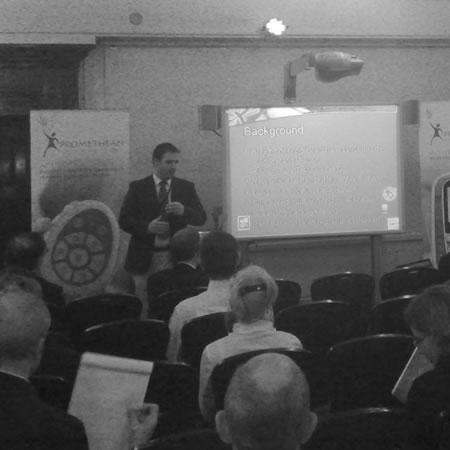
Thursday at mLearn 2008

Yesterday (Thursday) was another good day at mLearn 2008.

I really enjoyed Jon Trinder’s session on chasing mobile technology. Though he apologised for the negativity but did raise the question of institutional barriers to the implementation of mobile learning.

There are some key points here, even if you are implementing mobile learning, how are you testing, is it just technical testing, or do you undertake usability testing with actual real life users.

Andy Ramsden’s session on Twitter was also fast paced, amusing and interesting. Out of the audience about half had Twitter accounts, but only a few were actively using it.  We didn’t really get a chance to elicit reasons why they weren’t using.

Thursday at mLearn 2008

Mick Mullane’s session on podcasting was similar to ones I had seen before, but was nice to view again in a very academic conference. He was very enthusiastic about podcasting, just a pity that he couldn’t do his live demo as there was no free wifi!

The reason I was in Mick’s session was that I was in the room for John Cook’s session on the appropriation of learners’ devices for learning. Which was a nice theoretical model which is akin to my views about using the learners’ own devices.

The future is mobile

Mike Short from O2 has given a very good presentation on the state of play of mobile technologies in UK (and across Europe) for his keynote here at mLearn 2008.

He gave some interesting statistics like in the UK population, 121% have a mobile phone. In Italy the figure is 154% whilst in France it’s only 83%.

The future is mobile

I enjoyed the keynote, I may not agree with everything that Mike says in terms of the “future” but he does back up what he says about now with some good data from the GSMA.

Of course Mike is from business and though he talks about education and education possibilities, it was obvious to me that business and leisure are the main drivers when it comes to mobile data and mobile devices.

A question to ask is that if we want to move and embed mobile learning into the world of education, how do we work with major mobile data providers and mobile device manufacturers that we are serious about this. Overall our purchasing power (in the UK) must be huge. Is it because it is not the sector which is buying iPhones, but individuals and institutions, which means we have little influence as a sector on the mobile business.

Can we change that model?

Starting mLearn 2008

So the conference proper has started after the disappointing pickled cauliflower reception.

Alas there is no free wireless, so though I can use my 3G phone, I can’t use my laptop or iPod touch. Though I can enter text on my phone, I am terrible at writing on a 1-9 keypad so I am writing this using a word processor.

So far we have had a (very long) five minutes introduction to the conference and now John Traxler is going through the housekeeping and is now introducing Diane Laurillard.

Diane Laurillard presenting her keynote, “towards a pedagogy-driven account of mobile learning”.

Digital technologies are not typically optimised for learning or teaching… but are optimised for business and leisure.

Now presenting a common framework of representation.

Diane now presenting her conversational framework.

Question, can you describe informal learning?

Diane says her conversational framework challenges the learning design.

What are mobile technologies good for?

Personally I think she misses the point.

A lot of arguments against digital tools can be equally applied to non-digital tools such as books, journals and blackboards.

Tools are tools regardless of whether they are physical or digital.

She seems to be applying traditional learning design to designs which use mobile devices.

She seems to have missed that mobile learning is (or should be) about the mobility of the learner.

I wonder if she has heard of Web 2.0?

Her example misses the fact that learners who are not even at the art gallery can contribute and join in the learning activity.

Digital technologies for not typically optimised for learning. Nor are most physical technologies and environments.

Her model seems to miss the point of the real advantages of mobile learning.

mLearn 2008

So it’s mLearn 2008 time. Two years ago it was in Banff in Canada, last year it was in Melbourne. This year it’s in that exotic of places… Telford.

Well it’s the conference content and the people why you go to mLearn not the location.

Looking forward to the conference, should be very informative and interesting.

So first it was off to the reception. Now I was expecting a buffet, alas I was mistaken. There were some crisps and pickled cauliflower which I am guessing is some kind of local Telford delicacy. So now I am very hungry.

The coffee is usually better…

Those of you who know me will know that I quite like online conferences and have participated in a fair few over the years.

JISC are running another of their innovating e-learning conferences this November.

JISC Online Conference – Innovating e-Learning 2008: 4- 7th November

Programme now available online.

The programme has a range of presenters and facilitators including quite a few from FE, Richard Everett, Geoff Rebbeck, Ellen Lessner, Andrew Williams, amongst others. There will be quite a few people from FE attending as well.

There are a few advantages of online conferences over traditional face to face conferences, feel free to add to them in the comments.

With an online conference it is feasible to go to all the presentations and workshops even if they are at the *same time*.

If you are a reflective person, then like me the question you actually want to ask the presenter is thought of as you travel home on the train, with an online conference you have a chance to reflect and ask that question.

You can attend a meeting at the same time as attending the conference.

You can teach a lesson at the same time as attending the conference.

You can watch Merlin at the same time as attending the conference.

You can attend the conference at 2am, useful for insomniacs and those with small children.

Having said all that it is useful too to make time for the conference, shut the office door, work from home for a bit, wear headphones, move to a different office, work in the coffee spaces in the college.

You can see presentations again, you can pause them, you can ignore them and (virtually) walk out without feeling you may be offending someone as their talk doesn’t relate to you as you thought it did.

No more do you have to stand on platform 12 at Bristol Temple Meads wondering if the delayed 18.19 is in fact ever going to arrive before you freeze to death.

The coffee is usually better.

The coffee is usually better...

A few disadvantages as well…

No bag, so nothing to add to that huge collection at the back of the cupboard in the office…

No physical freebies, no mouse mats or mugs…

From the JISC, further reasons to attend.

Innovating e-Learning 2008 will put you in touch with e-learning ‘thinkers and doers’, both nationally and internationally – with a vibrant social scene,  it’s a great place to network

Innovating e-Learning 2008 also offers a wealth of content to engage with, if it’s new ideas you’re after – 10 expert sessions plus 3 keynotes make this an extremely rich and engaging event

Being held online, it has some unseen advantages – a pre-conference reading period gives you a chance to cover a lot more than is possible at  a f2f conference and you have a chance to think about what to ask the presenters

If it’s debate you’re keen on, a high degree of interaction between participants and presenters is another plus of the conference – last year’s Innovating e-Learning was highly praised for ‘the sheer amount of real interest and useful conversation’ it generated

The content this year is the most wide ranging yet – from Using Second Life for learning and teaching (tours with experienced guides available free!) to Mobile technologies – disruptive or enabling? With expert presenters, this is a chance to explore what you have heard about, but may not yet have put into practice

Innovating e-Learning 2008 is for further and higher education – the programme for 2008 has widespread appeal

Innovating e-Learning 2008 still costs only £50 per delegate and can be accessed online at times and places convenient to you. This has to be the most cost-effective staff development event ever!

Book now for JISC  Innovating e-Learning 2008 :  4-7 November 2008

100% of last year’s delegates thought the conference was good value for money. Here’s what some delegates said last year:

Peter Whitfield, City College Manchester
I have enjoyed this so much!  Even though there are frustrations in bringing about change.  I will take away a desire to me more disruptive in my designs for learning and make no apology for tossing tired models out in favour of creativity, collaboration and student-centred activities.  And with the motivation of the inspirational presentations and discussions at this conference I will be less apologetic for doing so.

Karen Pinny, Birmingham College of Food, Tourism and Creative Studies.
I have found this discussion really encouraging and stimulating and will be going away with a reinforced enthusiasm to explore some of the issues further with my unsuspecting students!

Finally the JISC have asked if I will be the conference blogger, hmmm, do they realise what they have done….

Go, you’ll enjoy it.

Can I legally download a movie trailer?


Disclaimer: ALL information containing in my post is for informational purposes only and should never be construed as legal advice. For proper legal advice you should consult a lawyer.

Imagine the scenario if you can, you are a Media Studies teacher. You wish to use some movie trailers in a classroom session, so that the learners can analyse the content and structure of the trailers and compare the features and similarities between each one.

Now you could use a computer suite and each learner could access the relevant movie site and view the trailer online. However this doesn’t really help as the video plays once and sometimes you want to see part of the trailer again and again. Now if only the learners could download the trailer, or even better could the teacher download the trailers and make them available to all the learners via a local network server, so enabling fast and easy access.

Well technically this is possible, however is it legal?

Can I legally download a movie trailer?"

There are many tools available online which allow you to download videos from sites such as YouTube (usually through a Firefox extension or similar). They basically “scrape” the code for the video link from the website and then download the video file, providing you with a Flash based FLV file, some tools will convert this on the fly into an AVI or WMV if required.

However this article makes for interesting reading on the legality of doing this.The website in question (which is quite a respected tech blog) had given instructions on how to use video downloading tools to download streaming video from a site such as YouTube.

From the article YouTube states quite clearly that:

Currently, YouTube is a streaming-only service. We do not permit users to download the videos we host on our site. We believe our Terms of Use are clear on this point, but in light of the confusion which came to our attention today we are considering revisions to our Terms of Use to avoid any further confusion. It is important to many of our users who have uploaded and licensed content to YouTube that their content is authorized for streaming-only.

If a site streams a video to you, generally you don’t have the right to download that video as they are only making the video available as a stream.

Media-Convert.com which I have mentioned before, use to do this via it’s web based video conversion service, enter the YouTube URL and before you could say “is this legal” you would have a video in the format of your choice. They were soon stopped from doing this.

So downloading a streamed Flash based video is not an option, what about Quicktime based trailers from the Apple website?

For personal use, I can use Quicktime Pro on a Mac (and on Windows as well). What Quicktime Pro allows you to do is to save a Quicktime video to your hard drive. Once the trailer has loaded onto my computer in the browser I can save a copy to my hard disk for later viewing. I can even download the 1080p HD versions which look very nice even if they don’t fit on my computer screen as it’s too BIG.

Quicktime Pro is not the free video viewer but the paid for upgrade, which is about £12 per license for educational users (it’s £20 for “normal” individuals). There are other things you can do with it as well, I use it for making video and audio recordings on my Mac for example. I have also used it to trim audio recordings and some of the export functionality does make life easier…

Note the term “personal use”, most film trailers online are only available for personal use only. I would be surprised by any movie site which would allow a teacher to download movies for use in the classroom.

Apple in their terms of use for example make it quite clear what you can and can not do with any trailer you download from their website:

…no Content may be copied, reproduced, republished, uploaded, posted, publicly displayed, encoded, translated, transmitted or distributed in any way (including “mirroring”) to any other computer, server, Web site or other medium for publication or distribution or for any commercial enterprise, without Apple’s express prior written consent.

This would mean downloading and distributing it to students in a classroom situation would be viewed as illegal unless you had the permission of the movie trailer copyright owner.

Similar guidance is available on most other movie sites I checked. For example on Warner Brothers website is says:

You may access and display Material and all other content displayed on this Site for non-commercial, personal, entertainment use on a single computer only. The Material and all other content on this Site may not otherwise be copied, reproduced, republished, uploaded, posted, transmitted, distributed or used in any way unless specifically authorized by WB Online.

You could write and ask for authorisation and permission, sometimes this may be given, more often than not it won’t.

Legally students could download their own individual copy for their own analysis. However this may not always be possible, especially if you have network congestion or a slow internet connection.

So is there a solution, well yes, if you go for an alternative solution which is forgot online and go back to broadcasting.

Now an easier way would be to digitally record the trailers from the TV and use digital copies of them. You won’t even need an ERA licence, as the ERA does not cover adverts from the TV. Though if the trailers are part of say a film programme then these programmes probably are covered by the ERA licensing scheme and appropriate action should be taken accordingly.

However if it is an advert, under the Copyright Act you have a statutory right (therefore can not be taken away from you) to show recordings of TV broadcasts for educational purposes.

From the ERA website.

Are there broadcasts I can’t record under the ERA Licence?

Yes, only broadcast material owned or represented by ERA Members is licensed through the ERA Scheme for off-air recording. This means that some contents of certain broadcasts and material included in them, such as advertisements, are not covered by the Licence because ERA Members do not own or control the rights in them.

However, if you record these broadcasts for non-commercial educational purposes, your recordings in the ways relevant to the ERA Licence will not infringe copyright, unless a certified Section 35 licence applies. This is because Section 35 (1) states that where works are not covered by a certified scheme, then educational establishments may reproduce and communicate them electronically on-site without infringing copyright. You will need to adequately acknowledge, i.e. label, any broadcast recordings you make under Section 35 (1).

Also worth look at the ERA restrictions as well.

I have made recording just like this using an EyeTV device on a Mac (I have also used a Windows Media Centre as well, but never again…) I just set the video to record for a few hours (takes GB of space mind you) and then go through the adverts until I find the one I want (or one that’s similar). For movie trailers I would recommend recording the adverts during film programes on ITV or Channel 4, or during films.

If you do have an ERA licence then recording film programmes will help, as some of these will have trailers in them.

My Elgato EyeTV device captures from Freeview so I get a really good quality digital video file, it’s roughly the same quality as DVD. The editing tools make life really easy well to trim and edit the video you need. There are Windows TV Capture devices, some of them are just small USB sticks which slot into any USB port.

Though there are legal barriers that are getting in the way of the learning here, there are also solutions as well.

Photo source.

Are you a resident or a visitor?

One of the things we seem to do in the world of e-learning is categorise ourselves and our learners into groups.Are you a resident or a visitor?

One of the key pieces of work on this was from Marc Prensky on Digital Natives and Digital Immigrants. Now I was never really very happy about this idea that if you were old (like me, well I am not that old, but it’s sometime now since I first sent e-mail, 1987 I think it was) you were only a  digital immigrant and young people were digital natives.

However when I looked at the students at my college, I couldn’t see this age divide at all. Yes it was true many of the students were very happy and capable with handing digital devices and playing games, but not all.

We had some digital natives that fitted the description, but we also had a fair few that didn’t. There were students who didn’t and in some cases couldn’t use the internet and the web, not because they hadn’t been immersed in a digital world since birth, but because they didn’t want to. Also there are issues with many students in relation to the digital divide; they may play video games, but don’t have access to the web.

I also couldn’t see how myself fitted into this, I may not fit the digital native sterotype, but I knew (well others told me) that I was very much immersed into a digtial world and used the internet in ways in which they couldn’t fathom or understand. Was I merely a digital immigrant?

From my experiences on the web I met many digital natives and quite a few of them were over forty!

So it was quite refreshing to read on Dave White’s blog a post about residents or visitors to the online world. Like a few others, notably Andy Powell and Josie Fraser, I quite like this concept.

There are some who live in an online world and see the internet as part of their everyday life. This I can identify with. It was for example very strange at ALT-C 2008 to meet Kev Hickey, someone I knew very well from Jaiku. Over the last year we had discussed many e-learning issues and shared experiences of applications, but also I had seen his photographs from Blackpool, I knew the names of his dogs, I felt he was someone I would call a friend.

Are you a resident or a visitor?

So it was very weird to actually meet him in person at ALT-C. He is just one of many people I know from online in just my e-learning sphere, better wave to Lisa at this point…

I can quite easily see how that I can be a digtial resident, living part of my life in an online world. I do use the internet a lot and do use a range of online services and applications to make my life easier, to communicate, to share, to drink coffee and to have a bit of fun as well.

Working with many staff in the college (and quite a few students as well) I often find that they are merely visitors, using the online world when it suits them and meets their needs.

I’m reminded of a member of staff at a training session who was quite vocal about being a “technophobe” and didn’t want to use technology in her teaching (note the word teaching and not learning). So basically I ignored her, there were staff there who were interested. As we moved around the room, another member of staff started talking about how she used learning technologies, how she used the VLE and then she remarked on how she used MSN chat to converse with her students at a time and place to suit them. At this point the “technophobe” spoke up and said, “oh I use MSN chat all the time to talk to my daughter in Australia”. For me she is the perfect example of a visitor to the online world, using the technologies when  it suits her needs and ignoring the potential that other tools, services and applications could offer her and importantly her learners.

Having said that, on Josie’s Blog there was a comment from Mike Amos-Simpson which I think is worth repeating.

I think that perhaps when its considered as a ‘world’ it maybe makes too many people feel like aliens!

I agree with Mike that calling it a world could alienate people, but then again so does using the terms like digital native and digital immigrant.

So are you a visitor or a resident? Or do you prefer native and immigrant?

news and views on e-learning, TEL and learning stuff in general…