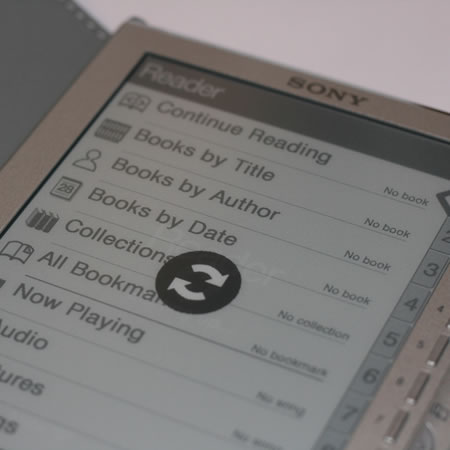
Sony eBook Reader software for the Mac

Only yesterday I mentioned that Sony were releasing new eBook Readers, today another piece of news from Sony.

I do have the older PRS-505 model and though I have two hundred odd (old) books on there (which came with the device) I haven’t really made best use of the Reader, partly as the software was Windows only and I generally on a day to day basis use a Mac.

So I was pleased to hear today that Sony have released eBook Reader software for the Mac. It was relatively easy to download, install and use.

Might start using the Reader more now…

Download the software from Sony.

Sony launches challenge to the Kindle

sonyebookreader0309

I do like the concept of e-Books and have a Sony e-Book Reader. I also would really like to have an Amazon Kindle, but alas they’re only available in the US.

The BBC News reports on the launch of a new Sony e-Book Reader.

Sony has launched a wireless e-reader which allows users to download electronic books on the go.

Analysts said Sony’s Reader Daily Edition is a direct challenge to Amazon’s best-selling Kindle device.

The $399 (£250) touch-screen device is able to store up to 1,000 novels and can download books over a high-speed mobile network.

It also has an application that can be used to “borrow” books from local libraries for 21 days.

In a recent presentation I gave, I talked about e-Books and how I felt that the Sony e-Book Reader was a first generation device, from which new and better devices would emerge.

By adding connectivity (like the Kindle) Sony has made the e-Book more useful and allows immediate satisfaction, it’s similar to the way that Apple’s iPhone allows you to download music immediately.

Think of the impact of this on the learner, they can be in college, at home, in a coffee shop and they can immediately download to their e-Book reader their assignments, readings, handouts as and when they want or need them.

Regardless of new media, interactivity, in education we still do rely on the printed word, books, journals, handouts. By making them available on an electronic device with a long battery life, it makes it much easier for learners to access information as and when they need it.

I am however slightly disappointed and concerned when I read:

The device will be available in the US from December.

Will we ever get a connected e-Book device in the UK?

The VLE is Dead – Symposium Abstract

Death of the VLE Symposium at ALT-C 2009.

graveyard

Background

The future success of e-learning depends on appropriate selection of tools and services. This symposium will propose that the Virtual Learning Environment (VLE) as an institutional tool is dead, no more, defunct, expired.

Ideas to be explored

The first panel member, Steve Wheeler, will argue that many VLEs are not fit for purpose, and masquerade as solutions for the management of online learning. Some are little more than glorified e-mail systems. They will argue that VLEs provide a negative experience for learners.

The second member of the panel, Graham Attwell, believes that the VLE is dead and that the Personal Learning Environment (PLE) is the solution to the needs of diverse learners. PLEs provide opportunities for learners, offering users the ability to develop their own spaces in which to reflect on their learning.

The third panel member, James Clay, however, believes that the VLE is not yet dead as a concept, but can be the starting point of a journey for many learners. Creating an online environment involving multiple tools that provides for an enhanced experience for learners can involve a VLE as a hub or centre.

The fourth panel member, Nick Sharratt, argues for the concept of the institutional VLE as essentially sound. VLEs provide a stable, reliable, self-contained and safe environment in which all teaching and learning activities can be conducted. It provides the best environment for the variety of learners within institutions.

The session will be chaired by Josie Fraser.

Structure of session

The symposium will begin with an opportunity for attendees to voice their opinions on the future of the VLE. Each member of the panel will then present their case. The panel, with contributions from the audience, will then debate the key issues that have arisen.

Intended outcomes

By the end of the debate, participants will be able to have a greater understanding of the evolution and possible extinction of the VLE and the impact on learners.

A summary of the key points of the discussion will be syndicated on several blogs and other online spaces, and delegates will be encouraged to tweet and live blog the discussion as it happens in real time.

Photo source.

Oh, very nice, new Nokia Laptop

This looks very nice. The Nokia Booklet 3G.

Wonder how much it will be? Probably tied into a contract of some kind.

After more than 25 years as a pioneer and leader in the mobile industry, Nokia will bring its rich mobility heritage and knowledge to the PC world with the new, Windows based, Nokia Booklet 3G.

Powered by the efficient Intel Atom processor, the Nokia Booklet 3G delivers impressive performance with up to 12 hours of battery life, enabling people to leave their power cable behind and still be connected and productive. Delivering the rich experience of a full-function PC inside an ultra-portable aluminum chassis, the new mini-laptop weighs 1.25 kilograms, measures slightly more than two centimeters thin, and has the features one would expect from the world’s leading mobile device manufacturer.  A broad range of connectivity options – including 3G/ HSPA and Wi-Fi – gives consumers high speed access to the Internet, including Nokia’s broad suite of Ovi services, and allows them to make the most of every moment and every opportunity.

The mini-laptop also comes with an HDMI port for HD video out, a front facing camera for video calling, integrated Bluetooth and an easily accessible SD card reader. Other premium features include the 10-inch glass HD ready display and integrated A-GPS which, working with the Ovi Maps gadget, can pinpoint your position in seconds and open up access for a truly personal maps experience. The Nokia Booklet 3G also brings a number of other rich Ovi experiences to life, whether its access and playback of millions of tracks through the Nokia Music Store, or using Ovi Suite to sync seamlessly from your Nokia smartphone, to your mini-laptop, to the cloud.

The Nokia Booklet 3G will widen the Nokia portfolio, satisfying a need in the operator channel, and bringing another important ingredient in the move towards becoming a mobile solutions company.

Further information, including detailed specifications, market availability and pricing, will be announced at Nokia World on September 2. For more information on Nokia World, visit: http://events.nokia.com/nokiaworld/home.htm

It’s not dead… yet…

Why we can’t bury the VLE just yet…

cpr

There are many people out there who believe that the institutional VLE is dead and we should allow learners to use their own PLE (personal learning environment) and/or a selection of Web 2.0 tools and services.

For example Steve Wheeler in Learning with ‘e’s says in a recent blog post on the death of the VLE that:

The institutional VLE is led by the entire institution and is therefore slow to respond to change, whilst the personal web is led by one user. The personal web has one more key advantage – it is owned by the individual who created it.

In another of his blog posts, Steve argues that

I have previously argued that VLEs tend to constrain students into particular ways of thinking and stifle creativity. I also maintain that most proprietary VLEs have been designed by businesses not by teachers, and therefore are unfit for purpose.

To be honest I don’t actually disagree with Steve on principle. I do believe that in order for learning to be accessible and personalised for all learners, institutional services often fail as they provide a service for all which can only meet some of the needs of some of the learners. Eventually learners will be able to choose the tools they want to use and when they want to use them. For those learners the VLE will be dead.

However we do need to question whether we bury the VLE now or wait…

Why wait?

Well Steve argues that learners are able to utilise the online tools and services available on the web to facilitate their learning.

There’s a big problem with this, in that most learners do not know how to use the web effectively and many of these only “visit” the web to do some stuff.

The concept that the majority of learners are adept at using Web 2.0 tools and services, are engaged with social networking and importantly are able to apply these skills to learning is a flawed concept at this time.

Most learners are not using these tools for anything let alone learning. There are no digital natives and there isn’t a Google Generation. Various papers have been published on this subject.

From my experience, most e-learning professionals aren’t engaging with the Web 2.0 tools and services out there let alone learning professionals. At ALT-C 2008 for example, six hundred delegates who were coming to a learning technology conference, and of those less than 8% were using Twitter! Though I expect the situation to be different at ALT-C 2009 I still don’t see the majority of the delegates at that conference engaging with the very technologies that are supposed to be replacing institutional tools.

Most learning professionals aren’t engaging with the web tools and services, so will learners?

Most learners who engage with post 16 learning could in theory already choose a personalised individual route to learning and use the wide variety of tools out there. They don’t choose that route though, they choose to engage with their learning via a physical learning environment, a college, a university, they choose to engage with a learning environment which is led by the entire institution and is therefore slow to respond to change.

If the VLE is dead then  maybe we need to ensure that the physical learning environment is buried alongside. However it will be some time before we see the demise of the physical learning environment, why it’s not perfect, but it does a job.

Steve in his recent blog post concludes:

All things considered, it is inevitable that the personal web will win in a straight fight against the institutional VLE. The VLE has had its day and will meet its demise, even though its supporters cannot see it coming. The personal web is on the rise.

The personal web will probably win, the personal web however is currently the domain of a select few individuals and not embraced or used by learners. For these learners they need guidance and advice on what tools they should use. This does not need to come from tutors alone, however where do these learners start from? Where should they go first? They need some kind of starting place (and dare I say it) some kind of portal to their learning.

The VLE can be that starting point.

Using an institutional VLE does not preclude using other Web 2.0 services and tools, on the contrary, a VLE and web tools can be used together. For example this blog has an RSS feed which feeds directly into my institutional VLE. I use Slideshare to host my presentations which I can then as well as embedding into this blog, also embed them into my institutional VLE too. As well as embedding presentations, I also embed YouTube videos, videos from this blog and other sites too. My delicious tag cloud is embedded into the VLE to allow staff to see what I am bookmarking. My Twitter stream is streamed into the VLE to allow staff to stalk track my activity.

The VLE is not perfect, but it does a job that with the current cohort of learners and teachers could not do by themselves.

Eventually the VLE will be replaced as are all tools, but at this time we can’t afford to bury a tool which for some is their starting point on their learning journey.

Is the debate over?

No it’s just beginning. You can join myself, Steve Wheeler, Graham Attwell and Nick Sharatt at ALT-C 2009 in our symposium, “The VLE is dead” where we will be presenting and debating these issues.

Is the VLE dead?

Not yet.

Photo source.

Advantages of an online conference

I was going through the media I had uploaded to my blog when I found this.

This was a video I made for last year’s JISC Online Conference when I was the official conference blogger. It outlines some of the advantages of online conferences.

The blog, Letters from the Edge was well received last time and the good news is that I am going to be blogging again at this years online conference.

Got a 3G Dongle? Know your limit!

So have you got a 3G dongle?

Do you know your limit?

Do you know how much you will be charged if you go over that limit?

If you’re on O2 and go over by just 1GB you would be facing a £100 bill!

The BBC reports on the issue of 3G bandwidth caps on mobile broadband services.

Mobile broadband users face stiff penalties for exceeding their download limits even though most aren’t aware of what those limits are.

I use a Vodafone 3G dongle and though the Windows software (on a single computer) does measure how much data use the Mac connection software (in other words what I normally use) doesn’t. Generally I guess that my usage is fine as I don’t use the dongle everyday and rely on my home and work internet connections and not just the mobile broadband connection.

However I know some people and some learners have a 3G dongle for their internet and that’s it! Using a 3G dongle everyday would be getting close to their limits if they were downloading podcasts and watching online video.

Do you have a 3G dongle? Do you know your limit?

news and views on e-learning, TEL and learning stuff in general…