Tagxedo

I’ve used Wordle a fair few times and it is a very clever way of showing how and which words are been used for a piece of text or a webpage.

Over the weekend I was introduced to Tagxedo which is a similar tool, but has a lot more functionality and you have a lot more control. This is what I created within a minute or two using this blog as the source for the text.

You can change colours, put the words into a shape. You can add multiple sources into the word source. So lots of flexibility.

It is currently in beta, so some of the features will “disappear” unless you upgrade to the “pro” version.

So at this time it is a fun tool that will allow you to create infographics which for some learners will be a great way of showing what a piece of text or website is “talking” about.

e-Learning Stuff Podcast #071: Get a grip

James talks about the forthcoming iPad 2. He now has Gingerbread for Android. Tagexdo, a Wordle type web application. Firefox 4 beta is now available.

With James Clay.

This is the seventy first e-Learning Stuff Podcast, Get a grip.

Download the podcast in mp3 format: Get a grip.

Subscribe to the podcast in iTunes/a>

Shownotes

100 ways to use a VLE – #41 Field Trip Planning

Well there is often a lot of preparation and paperwork involved in a field trip for both learners and practitioners. No matter how much paperwork you give the learners, often they forget what they need to do, what they need to bring, or even when the trip is and where they need to be…

Having run a fair few field trips in my time, we have had to wait while a student ran home as she had forgotten her passport. Students who missed the bus as they thought the trip was the following week. Students who didn’t bring their assignments and handouts, as they assumed I would!

The VLE is an ideal location to place all that paraphernalia, paperwork and information for any field trip. So all the pre-trip stuff that needs to be done, from risk assessment, completition of forms, equipment lists, the paperwork, etc… place it on the VLE to allow easy access to it by the learners at a time and place to suit them.

As well as pre-trip planning, it can be used on the field trip itself. You do need to consider if you are expecting learners to access the VLE whilst actually on the field trip. In this case you will need to consider what your expectations are for learners in relation to the use of the VLE, and to ensure that the learner are aware of those expectations.

You will need to consider connectivity for those that will be accessing the VLE. You will need to be aware of the sort of devices that the learners will be using.

So if your learners are using the iPod touch to access the VLE, is there free wifi somewhere in the vicinity of the field trip? If they are using the iPhone or iPad, make sure you don’t have any links to Flash video or activities. If they are going to be using laptops or netbooks, where can they use them sitting down? Are there cafés or other places where they could go?

Once the logisitics of remote access to the VLE is sorted, you can then make decisions about how you are going to support the task from the VLE in the field.

Mobile connections are much slower than connections in college, so it’s vital that any resources are made to be downloaded as quickly as possible.

The VLE could also be used for post-trip evaluation and reflection. Students could post their thoughts on the field trip, photographs and links to videos on YouTube etc….

One other key benefit for practitioners is that after using the VLE for the first time for a field trip, when it comes to doing the trip next year with a new group, you will already have all the stuff ready on the VLE.

Do you prefer printed books?

A study group for the book industry in the US has found that:

…most college students say they prefer textbooks in printed rather than e-text form.

They also found:

About 12% of the students surveyed — mostly males, and often MBA-seeking or distance learners — said they prefer e-texts to printed texts because of their lower cost, convenience and portability.

So what does this tell is about the use of e-books in education?

That we should ignore e-books and only buy paper books?

Go back to the point “students say they prefer”, preference is about making a choice, and choice is important. Preference also can mean that both options are liked, but students when asked to make a choice, prefer printed books over e-books. For example I like tea and coffee, but prefer coffee.

There is another issue here in how textbooks are used by students. I wrote about this last May following a report in The Seattle Times that:

It would appear that students at the University of Washington don’t like using the Kindle compared to use printed books.

There were some interesting results and comments from the pilot. 80% would not recommend the Kindle as a classroom study aid for example. However 90% liked it for reading for pleasure.

The implication is that the Kindle did not work in the classroom, however as a device to read books it works fine.

This is a lesson that educational publishers need to recognise when publishing content to platforms like the Kindle and the iPad. Though novels are linear and as a result eBook formats can “work” like a printed book, educational books are used differently and as a result eBook versions need to work differently. Students need to be able to move around quickly, annotate and bookmark.

The experiences at the University of Washington show that the issue wasn’t really with the Kindle, but was much more about the format of educational text books in the ebook format.

I would argue that the results of the BISG survey is a similar issue, in that the merely digitising academic textbooks is not how we should be creating academic e-textbooks.

Students do not use textbooks in the same way that they read a novel. Digital textbooks need to evolve as do e-book readers. The iPad is starting to show the potential of what can be done, but more work needs to be done on how students use textbooks and how they could use digital versions of the textbooks.

The JISC work on e-books is certainly a start on this and makes for interesting reading.

We are still in the early days of how e-books will be used and can be used.

BBC iPlayer – Android App of the Week

BBC iPlayer – Android App of the Week

This is a regular feature of the blog looking at various apps available. Some of the apps will be useful for those involved in learning technologies, others will be useful in improving the way in which you work, whilst a few will be just plain fun! Some will be free, others will cost a little and one or two will be what some will think is quite expensive. Originally this feature focused on iPhone and iPad apps, however I have now expanded to include Mac, Windows and Android apps.

This week’s App is BBC iPlayer.

Free

The BBC have released an App for Android devices for BBC iPlayer. I have now used it a few times and it works okay, however it’s not perfect. If you have a Froyo 2.2 Android device then you can install Flash and access the BBC iPlayer site through that, but to be honest when I tried that a few months back, I wasn’t too impressed either.

The main difference between the web version of iPlayer and the app is that you can watch live TV on the app, though you will need a TV licence.

The main problem is you don’t get the smooth playback that I get on the iPhone or the iPad. If I play videos direct from the phone I do get smooth playback, so I don’t think it’s an underpowered hardware issue.

However if you read the BBC blog, it maybe the reason…

To download and use the app you’ll need a device that uses Android version 2.2 and has Adobe Flash 10.1 Player installed. Our Flash streams need a powerful mobile phone processor and a Wi-Fi connection to ensure a smooth viewing experience, which means that only newer, more powerful Android 2.2 devices connected via Wi-Fi can support the Flash 10.1 streaming experience.

Having said all that I am pleased to see the BBC not ignoring Android and just producing the iPad app. It’s free so check it out for yourself and see if it works better for you.

I do wonder though if we ever see similar apps from ITV or Channel 4? Possibly?

100 ways to use a VLE – #44 Collaboration

When I hear the word collaboration I am reminded of the 1970s BBC series Secret Army. Collaboration during the war was something nasty and not to be done. And if you were caught there were repercussions.

Okay so that’s me…

Collaborating together is something we should be encouraging learners to do. Once they enter the workplace they will (as we do) work together in teams, across departments as part of their job.

Collaboration is not only a way of learning, it is an essential skill for the modern workplace.

Collaboration for a learning objective can take many forms. Working together on an assignment, a presentation, a seminar. Learners can collaborate to gather resources and links for the whole group. Leaners can collaborate across different curriculum area for a common goal that benefits them all.

Collaboration for a group task or assignment is something that happens a lot on many FE courses. Students need to form groups, or be assigned into groups, plan, research, analyse and write a group assignment. The end result may be a written piece of work, or could be a presentation, a radio programme (podcast) or a video.

Getting learners within a group to collaborate on sharing links and resources is an effective way of getting learners to work together, but also use a wider range of resources than if they worked individually.

Making learners from different curriculum areas collaborate on joint projects, can be challenging, but very rewarding. We have had make-up students work on performing arts students who then working with motor vehicle engineering students undertook a piece of performance art.

In each of these scenarios, learners will need to collaborate. Though there are many tools out there that learners could use, and I am sure many would use Facebook, there is an implication that all learners want to and can use external third party tools. The VLE though not an ideal solution, has many functions that allow groups to collaborate together, share resources, discuss and also importantly feed into and out to those other tools and services (such as Facebook) that learners will use in addition to the VLE. It also allows for cross curriculum collaboration as learners from different areas will be able to use a common tool.

Using the VLE will allow the gathering of evidence for collaboration which is often a requirement for some assignments.

Collaboration is not always easy, using the VLE can be the oil that allows learners to engage with a collaborative activity.

100 ways to use a VLE – #17 Keeping on top of the subject

If you want your learners to do well and get the best grades possible they need to do a little (or a lot) more than what they do in lessons and homework. There is only so much time in a teaching week, and only so much non-class based work that we can expect the majority of learners to do (and have the time to assess effectively). Competent learners will realise early on, more so on HE courses, that they have a responsibility to do more than what is “given” to them. They need to read around the subject as well as the provided reading lists, they need to look at extra original sources in addition to those they receive in class. They should also be reflecting on what they have studied and assessing where they are.

This is often expected to happen in HE, and in FE should happen progressively to support the transition from FE to HE.

There are various ways of providing systems and mechanisms to allow learners to keep on top of the subject, the VLE is just one of many ways that will support and enable learners to stay on top of their subject.

By embedding RSS feeds, extra links to additional resources, links to e-books, etc… those learners who want to take their studying to the next level will have easy access to what they need. Adding in blogs and discussion forums will allow learners to reflect and discuss relevant areas of the subject at a higher level.

Of course this will only really work if both the practitioner and the learners buy into the concept. One practical way of supporting the process is to bring in your learning resources team (library staff) and get them to start the process and creating the relevant area on the VLE. Initially they could create more generic areas for subjects rather than ones that focus on specific qualifications.

If quality of achievement is an issue for an area then using the VLE as one mechanism for enabling learners to keep on top of a subject is a quick win. It may also have an impact on retention as learners who are behind on a subject could use any such area on a VLE to catch up.

Posterousing the Learner Voice

Talking with a manager today we were discussing how we could use various technologies to capture the learner voice. In the FE sector the learner voice has become strategically important and is part of the inspection framework.

There is a great focus in the Common Inspection Framework on involving learners in developing policies, provision and activities. This builds on the learner voice concepts and involvement strategies that are common in the FE sector. Ofsted are likely to expect similar strategies across all provisions, not just colleges and LSC provision.

It’s not as though we didn’t listen to learners in the past, we certainly did, but we probably didn’t have the systems and processes to effectively capture the learner voice and importantly feedback to them.

In my own college we have a robust system for capturing the learner voice across the college, however it doesn’t capture all the feedback. Sometimes learners want to provide feedback on their own curriculum area (which they can do as part of the college wide learner voice) but may not think it important enough to talk about at a college level, but want their voice heard at a “local” level. Also though the system is robust it may not always capture everything. There is also a need from a local perspective in capturing evidence that would feed into the Self-Assessment Report (SAR) and be used to develop a plan for the following year.

So back to the conversation with the manager.

We both knew that we could tap into the existing system, but wanted to allow learners to use video and audio. We already have the technology in the classroom and the library to capture video and audio (using the iSight camera and microphone built into the iMac). Learners could also capture video and audio using their mobile phones, these media files can then be easily moved to the computers or sent direct.

The key question then was where should the learners send their media files?

Using e-mail was rejected very early on, we have limited space for our e-mail and archiving and saving attachments seemed very clunky and time consuming. That was also the reason using gmail was also rejected.

We also wanted a simple system for learners, so using a service like Blogger or WordPress went out the window.

In the end we started looking at Posterous.

Posterous originally started as a service that allowed you to use a single e-mail account to send “stuff”. Posterous would then convert the stuff into a blog with separate postings for each individual e-mail. Posterous will also automatically encode the video and audio too. But this would only work (at that time) with a single e-mail account, so not entirely suitable for the needs of the manager.

However recent updates from Posterous have created a mechanism that would work for capturing the learner voice.

You can create a Posterous blog and then “anything” sent to a specific e-mail account you choose, whateveryouwant@posterous.com. So you can give that e-mail address to your learners who can then send their video and audio files to it. They can also send text, or photographs of handwritten comments.

Once received at Posterous, the e-mail (with the stuff) is held in a moderation queue, once moderated it will be published. Now you probably don’t actually want this content in the public domain (dirty laundry and all that) another nice feature of Posterous is the ability to make the blog private.

So learners can easily create media files, using college equipment or their own devices or phones. They can e-mail these to Posterous, which will encode it for the web. The manager can get notifications via e-mail and so will know when learners have posted stuff. They can moderate the “postings” so they appear on the blog. They can then view what the learners have said. The manager can also open out the blog to other staff who have an interest.

At this level the system works quite well.

To take a stage further, the manager can add tags to postings, making it easier to see if there are pattens or collate from different groups.

The learner voice is important, using technologies such as Posterous makes it easier for learners to use different media and for some learners a different mechanism that they prefer, to enable their voice to be heard.

Flipboard – iPad App of the Week

Flipboard – iPad App of the Week

This is a regular feature of the blog looking at various apps available. Some of the apps will be useful for those involved in learning technologies, others will be useful in improving the way in which you work, whilst a few will be just plain fun! Some will be free, others will cost a little and one or two will be what some will think is quite expensive. Originally this feature focused on iPhone and iPad apps, however I have now expanded to include Mac, Windows and Android apps.

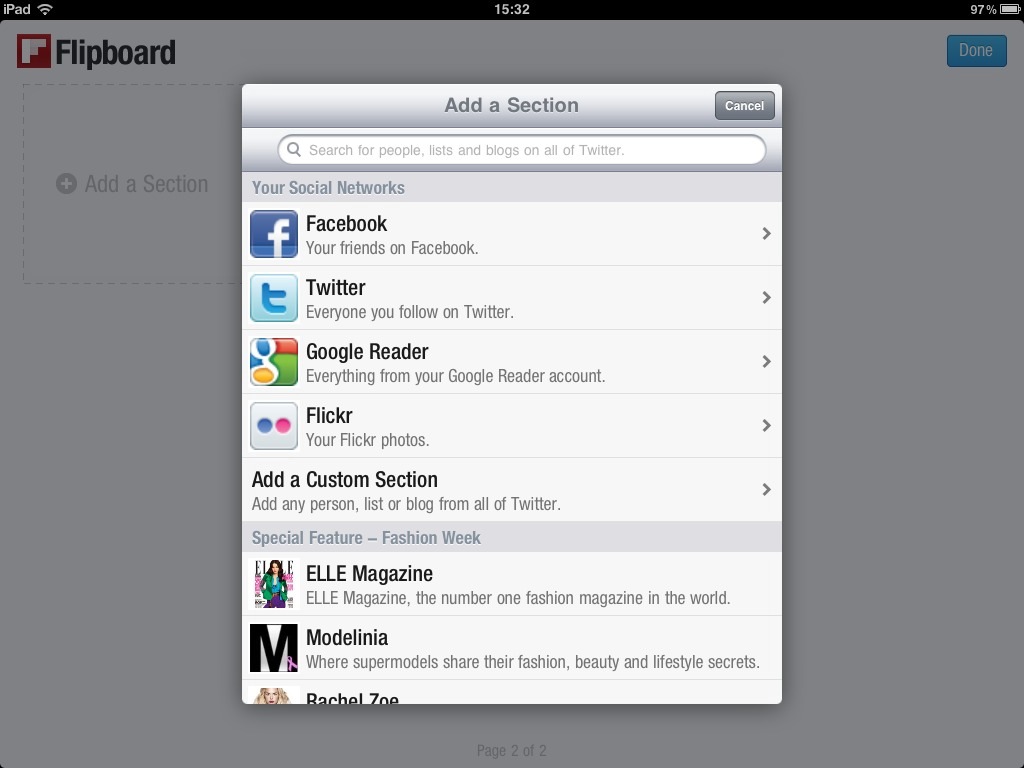
Named Apple’s iPad App of the Year and one of TIME’s top 50 innovations of 2010, Flipboard is a fast, beautiful way to flip through the news, photos and updates your friends are sharing on Facebook, Twitter, Google Reader and Flickr. See your social media in a magazine layout that is easy to scan and fun to read. Share articles and photos, comment on posts, and like or favorite anything. Customize your Flipboard with sections created from your favorite people, lists, groups and blogs on Twitter, Facebook, Flickr and Google Reader.

Your Flipboard is everything you care about in one place. It’s your magazine. It’s your Flipboard.

This week’s App is Flipboard.

Free

When Flipboard was first released it was hailed as the app the iPad was made for.

Robert Scoble said:

What is Flipboard? It turns your Facebook and Twitter account into something that looks like a magazine. It also lets you build a custom magazine, either by choosing from Flipboard’s pre-built curated “boards” or by importing Twitter lists. This is a very powerful and engaging way to read Twitter. You can also turn a single person’s Twitter account, or a single brand’s Twitter account, into a Flipboard. For instance, you can follow Techcrunch on Twitter with it and it will turn Techcrunch into a beautiful magazine-like interface that’s easier to read than any other reader.

Even Apple liked it a lot and called it their iPad App of the Year 2010.

Now to be honest I did quite like it, but certainly didn’t think it was that “fantastic”. It did what it did very nicely, however it couldn’t be configured to suit my specific needs. It had little support for RSS or Google Reader, so though it was worth flicking through now and again, other RSS readers seemed more useful.

The most recent update though added some new features which now make what was a good App into a really useful more innovative App.

Flipboard now syncs with Google Reader, making it much more useful if you subscribe to various different news sites and blogs.

It is now easier to view Flickr.

You can strip down what you see from your Twitter or Facebook streams.

It is now much easier to share across different networks what you are seeing on Flipboard.

Oh it seems a little faster too…

So basically the app is a different way of engaging and interacting with other sites and services. It does it in a way that is easy, simple and intuitive for most people.

It does seem a little weird that an app which emluates the page turning of a mgazine or newspaper is such a popular app for the iPad. Maybe we are all a little analogue in our own way and appreciate the ability to flip over pages….

Get Flipboard in the App Store.

Using the Activboard more

Last week I wrote about using the VLE more. This post is about using the Activboard more. Activboard is Promethean’s brandname for their Interactive Whiteboards.

Probably better to read this post and the VLE post in conjunction with my blog post on cheese.

Using the VLE and the Activboard is one part of a wider strategy in increasing holistically the use of ILT in our college to enhance and enrich the learning process. It isn’t nor has it been about using JUST the VLE for web based learning, or ONLY using the Activboard in the classroom, it’s about using the available technology to solve problems and improve the learning experience. We have Activboards in every teaching space, this benefits the learners by providing a computer and internet access to every teaching space. They also ensure that every teaching space has a projector, speakers and a printer.

Yes there are issues and problems with IWBs however like any learning technology there are things they do well and things they do badly. Do they reinforce a particular style of teaching, well only if you let them… Bad teaching is still bad teaching regardless of the technology available and other systems and protocols should be place to improve the quality of learning. No one is forced to use the Activboard for every session, but practitioners have the choice.

At a very simple level many practitioners will use the Activboard in the same way they would use a traditional whiteboard, by using it to take notes, write responses, or provide guidance to learners on the subject and topics in that lesson. The Activboard has many advantages over whiteboards with the main ones been: it has multiple pages; it can be prepared in advance; it can be saved.

The multiple page feature of the Activboad allows all the text and commentary from the lesson to be available throughout the lesson. With a traditional whiteboard you would rub off what had been done and start afresh. With the multiple page functionality it is possible at the end of the lesson to review every Activboard page that has been done.

The multiple page feature also means that it is possible to prepare Activboard pages in advance. Yes you can use Powerpoint or another presentation tool, but sometimes it is easier or makes more sense to use the Activboard.

The fact you can save Activboard sessions means that this takes the use of a whiteboard to a new level. Practitioners will be able to reuse sessions in different lessons (either with different groups or the following year). Sessions can be printed, they can be given to a learner or placed in a teaching file. If practitioners save, print and export their Activboard sessions, both learners and practitioners can access these sessions at a time and place to suit them. By exporting sessions as PDF, these resources can then be e-mailed or placed on the VLE for remote access.

In my mind these “basic” functions of the Activboard should be seen to be normal usage by practitioners.

So the next question is how do practitioners take their use of the Activboard to the next level?

You could use the process I outlined in my article using the VLE more. Get the practitioners from a particular curriculum area to attend a session on the different capabilities of the Activboard. This session should be not too long, a hour is certainly practical. Within the session various functions of the Activboard are demonstrated and a short explanation on a learning or administrative problem that it solves.

All the practitioners then choose at least one function that they will use with their learners on one of their courses. This could be using the Activexpression learner response systems, using audio and video within the Activboard, drag and drop, etc… There are lots of ideas on Promethean Planet.

They will then report back (say in a team meeting) on the impact and outcome of using this functionality, before choosing the next feature, and so on… They may want to involve their learners in this process too.

This is about moving the responsibility of using the Activboard to the practitioner, and their continuing personal development in the use of the Activboard to enhance and enrich the quality of the learning experience.

news and views on e-learning, TEL and learning stuff in general…