Category Archives: stuff

It’s Day Two…

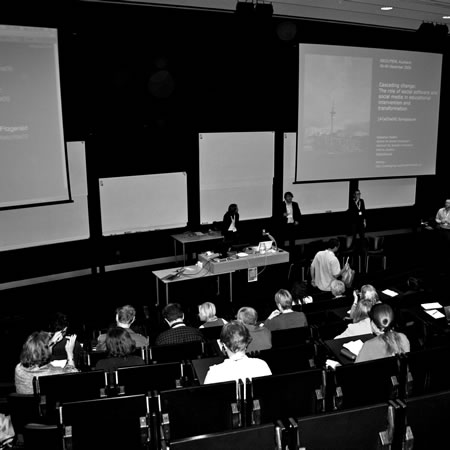
It’s day two of Handheld Learning 2009 and we start with the keynotes (preceded by industry announcements). Graham Brown Martin starting the conference with a hard hitting commentary on the state of the learning economy.

Later we have Malcolm McLaren and others…

I am speaking in the Social Media for Learning session on Twitter at 5.30…

Handheld Learning 2009

Today I am going to Handheld Learning 2009, probably the biggest conference on mobile learning.

There is lots on at the conference and for it is quite a busy conference. Today I am at the HHECKL Fringe event with our excellent Gadget Cool Wall. Later I hope to be on the Pecha Kucha with twenty slides and twenty seconds for each slide.

Monday evening is the Awards Evening and that should be fun.

On Tuesday there is a lots on and I have the final slot in the Social Media for Learning session. I am presenting on the Value of Twitter.

Wednesday I am presenting in the MoLeNET session on our Glossy and Shiny projects.

The nice thing about Handheld Learning is that it is about all types of learning and all types of sectors. There is a research strand, there is an exhibition, keynote speakers and lots of different strands and sessions.

Some excellent people are going and some of these are also presenting.

Looking forward to it.

Mobile Broadband too slow

3gdongle

From BBC News.

A survey by comparison site Broadband Expert suggests that UK mobile broadband providers are delivering services “far lower than advertised”.

Almost three and a half thousand broadband connections were tested over a five month period.

The firm found that users recorded an average download speed of 1.1Mbs, substantially lower than advertised.

The advertised speeds are sometimes in my opinion a bit over the top, for example Vodafone advertise 7.2Mbps which is really fast, however though I believe I have had that speed probably once, in London, I generally get a much lower speed.

However I agree with the expert critcism of the report, this is mobile broadband we’re talking about, though I would like to get a consistent 7.2Mbps I know that the technology doesn’t work that way. If I am moving, if other people are using their 3G devices, buildings, the weather and other stuff.

I have been pleased with my Vodafone 3G and T-Mobile 3G speeds, what are your 3G experience like? Do some people have high expectations for a technology which personally I am surprised works at all.

Photo source.

WiFi, no MiFi

So you want to be connected to the internet on the move? Or you need connectivity at a conference without wifi?

Yes you could get a 3G USB dongle or stick, but that only allows a single computer to connect.

What happens if you also want to connect your mobile device, a second laptop, what happens if there is more than one person and only one dongle?

In the past the solution I used was Joikuspot which was an application which ran on my Nokia N95 phone. It acted as a wireless access point, it connected to the internet via 3G and then shared that connection over the phone’s wifi connection with other devices. It was a very clever technology which made life easier for me. There were a few downsides, the main was battery life, it drained battery from the N95 really fast, so was only useful for an hour or two or when the phone was plugged into the mains. Of course this meant that I couldn’t use the N95 as a phone, as the battery would be drained. Another problem I had was with devices such as the Nokia N810 and Sony PSP which would not connect to the Joikuspot wireless network. The reason was a limitation in the Symbian software which meant that the phone acted in ad-hoc mode for wireless rather than infrastructure. The N810 and PSP had issues with connecting to an ad-hoc network. It did however work fine with the iPod touch which was how I mainly used it.

I was very interested to hear from Andy Ihnatko on MacBreak Weekly about the MiFi. A battery powered 3G wireless router. Using a 3G SIM it would connect to the internet and then allow  up to five wireless clients to connect and share that 3G connection. With a four hour battery life, could be charged via USB and about the size of a credit card, it seemed ideal. Of course I didn’t expect to see it in the UK, probably only available in the US on Verizon or Sprint…

mifi2

I did an internet search (as you do) and found it on sale at Expansys (without a contract). Ordered and delivered.

Using a SIM from a Vodafone 3G USB dongle it was  very simple to set up and configure and I would recommend that you use the details from Ross Barkman’s excellent website on connection settings for GPRS/3G to save having to work out where the information is on your providers’ website.

You can configure it wirelessly, and the first things I did was rename the wireless network and add WPA2 security.

Once configured it is simply a matter of turning it on, waiting for it to connect and then connect your laptop (or other device) to the wireless network.

It works very well and felt faster than using the USB dongle!

One problem I have had is the MacBook Pro losing the wireless connection and being unable to re-connect with the result the only solution was to reboot the MiFi. I am now trying just WPA as I think it is a MacBook Pro wireless issue rather than a MiFi issue. Or it could be an issue with the fact I was on a train!

I do like the MiFi and it does what it says on the tin.

You can now get the MiFi from 3 on a contract or as PAYG. This is much “cheaper” than buying the unlocked MiFi, but of course you get less flexibility as a result.

Got a 3G Dongle? Know your limit!

So have you got a 3G dongle?

Do you know your limit?

Do you know how much you will be charged if you go over that limit?

If you’re on O2 and go over by just 1GB you would be facing a £100 bill!

The BBC reports on the issue of 3G bandwidth caps on mobile broadband services.

Mobile broadband users face stiff penalties for exceeding their download limits even though most aren’t aware of what those limits are.

I use a Vodafone 3G dongle and though the Windows software (on a single computer) does measure how much data use the Mac connection software (in other words what I normally use) doesn’t. Generally I guess that my usage is fine as I don’t use the dongle everyday and rely on my home and work internet connections and not just the mobile broadband connection.

However I know some people and some learners have a 3G dongle for their internet and that’s it! Using a 3G dongle everyday would be getting close to their limits if they were downloading podcasts and watching online video.

Do you have a 3G dongle? Do you know your limit?

Infringement of Copyright

I have in the past delivered a fair few workshops on Copyright for JISC Collections, at ALT-C and across the country.

One question I am sometimes asked is “how easy is it to get caught” and “what will they do”. Most cases I know of which involve FE have been settled way before it gets to the court (or the press); however now and again cases involving copyright infringement do come to court.

This case is interesting because of the defendent, well they should know better, and the accusation that they ignored the concerns of the company involved.

FTS said it raised its copyright concerns with West Yorkshire Police in late 2006, but that the force and Hirst went on to repeat the alleged infringement in a 2007 update to their software, dubbed OLiVE. The package was made commercially available.

The issue with infringement of copyright is that the law is complex and surrounded by myths, so it is easy for any educaition provider and the staff who work there to at some point infringe copyright. They may do so accidently, they may do so thinking that they are okay too, or in extreme cases deliberatly infringe copyright. An institution needs to consider how it will react to any concerns that arrive at their door over cases of infringement of copyright. The key thing that you shouldn’t do, is ignore it and hope it will go away.

Augmented Reality

Today at the MIMAS Mobile Learning event, Gary Priestnall – Associate Professor within the Geographical Information Science research group, School of Geography, University of Nottingham, and manager of the Nottingham arm of SPLINT (SPatial Literacy IN Teaching) gave a really interesting presentstion on his work on augemented reality.

I do think that augemented reality has huge potential for learning and for providing information to learners, not just in an interactive engaging way, but in an accurate way as well.

TAT has been doing some work on augemented reality.

When someone views you through their handset’s camera, pre-selected info and social networking links appear to hover around you, letting your new found friend in on more than just your pretty smile.

So is this creepy or no different to putting your Twitter name on the final slide of your conference presentation?

via Engadget

Wifi – Venetian Style

venicewifi

BBC reports on Venice’s new wifi network.

The Italian city of Venice has launched what is believed to be the most extensive, wireless internet system anywhere in Europe.

Ten thousand kilometres of cables have been laid, establishing wi-fi hotspots just about everywhere in the city.

So now when in Venice you will be able to use your laptop, UMPC, micro-laptop, wifi phone,  iPhone, even an iPod touch to connect to the internet over wifi.

Here in the UK we have Norwich however not much else seems to be happening with city wide wireless networks. Gloucester doesn’t have one, neither does Bristol; my two big local towns. Even finding free wifi is problematic with most wifi hotspots are charging, sometimes silly amounts of money.

If we are serious about personalisation of learning, mobile learning and enhancing e-learning, we need to allow our learners to be able to communicate, collaborate and reflect anywhere, anytime and at a pace to suit the learner. This more often then not, means that the learner needs to be connected. If they are using the VLE, Web 2.0 tools such as Twitter, blogs, e-portfolios, or whatever; all these tools generally need an internet connection.

3G which isn’t available on all devices: is too expensive for most, not reliable enough for all, patchy for some and leads to digital exclusion.

City wide wireless networks like in Venice and Norwich would allow learners to access learning when and where they wanted to.

Photo source.