The first mobile telephone using Google’s Android software is due to be unveiled on 23 September.
It will be available on the US network of T-Mobile and is expected to be on sale in October.
The first device to run the search giant’s operating system will be a handset from Taiwanese firm HTC called the “Dream”.
No price for the phone has been given yet but it is expected to be below the important $200 (£107) price point.
So why the interest in the phone?
Well as the BBC article goes on…
Google announced its plans for the Android phone software in November 2007 with a declared aim of making it easier to get at the web while on the move.
More and more people are using their phones less for making phone calls and more for using the web whilst on the move. Apple’s iPhone showed that you could use the web on the move, will Google’s Android do more than just the web?
A few days ago I posted about using Vodpod to embed a Flickr slideshow into a blog hosted on WordPress.com (just like this one).
However though it did seem to work, after a few hours the blog entry looked like this!
Hmm, problems.
Re-embedding initially seemed to work, but after a few hours the above error would return.
Hmmm.
Well it should work, everything I read online said it should work. Vodpod has worked with other sites before on my blog.
Hmmm.
After some more searching I found this forum article on Flickr. In that long list of comments I found that the problem arises from the Vodpod Post to WordPress button and Firefox 3.x It would appear that the two are not compatible.
If you use the Vodpod Share Video link then this “fixes” the problem and your slideshows should work as expected.
Edit: Well I thought it had fixed it. It hadn’t. Trying now with embedding the slideshows using Safari rather than Firefox 3.x and seeing if that makes a difference. If that doesn’t work out then I am going to stop trying.
Decided to broadcast my question to the MoLeNET 2008 Question Time panel live over Qik. I was asking the question how should colleges address services such as Qik, Flickr and YouTube in regard to privacy, data protection and copyright. All views expressed are those of the individuals only.
I am currently attending and presenting at the MoLeNET 2008 Conference on mobile learning. As I add more images to my set this slideshow should add them automatically. Fingers crossed.
In a previous posting I mentioned Flickr slideshows, I also mentioned that WordPress.com blogs couldn’t use the code, as WordPress.com stripped it out.Well look here I have embedded a Flickr slideshow into this blog entry. I used Vodpod to do this.
The Official Google Blog has a really insightful and interesting posting on the future of internet video. One interesting statistic is that thirteen hours of video are uploaded to YouTube every minute!
What Google think is that:
In ten years, we believe that online video broadcasting will be the most ubiquitous and accessible form of communication. The tools for video recording will continue to become smaller and more affordable. Personal media devices will be universal and interconnected. Even more people will have the opportunity to record and share even more video with a small group of friends or everyone around the world.
I am not even sure it will take as long as ten years!
The new compact MP4 Flip’esque cameras that are now available make it even easier to shoot and upload video.
At ALT-C I was broadcasting video live from my phone over the internet, I recorded, edited and uploaded a video in 30 minutes in a workshop.
I wanted to share my video of the ALT-C and I was very able to do so and in HD!
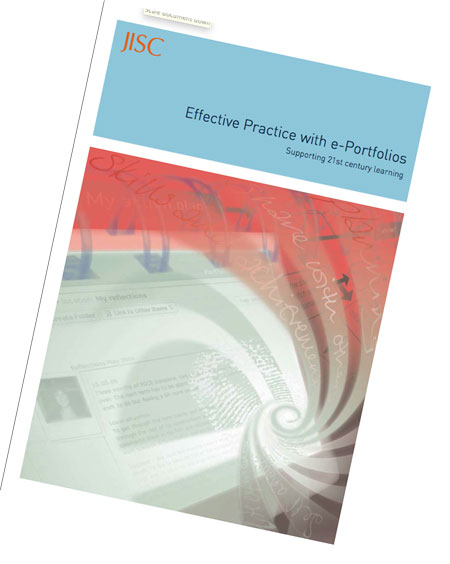
The JISC have published their newest publication, Effective Practice with e-Portfolios.
Launched at ALT-C in September 2008, Effective Practice with e-Portfolios draws out key points from established and innovative examples of practice in further and higher education and from a selection of significant JISC-funded projects on e-portfolios.
The publication complements an infoKit on e-portfolios which synthesises the main outcomes from JISC-funded projects in this field and covers the main drivers, purposes, processes, perspectives and issues around e-portfolios. Audiences for both resources will be those whose roles might involve use or implementation of e-portfolios as a tool for learning: learners, practitioners and managers in FE and HE, including IT and network staff; professional bodies; those involved in initial teacher training and in the management and implementation of PDP practice.
This online resource encompasses a broad spectrum of e-portfolio use and development and offers a valuable synthesis of JISC-funded projects on e-portfolios in recent years.
One of the nice things about the ALT Conference is the Conference dinner. In previous years the good stuff was the company and the conversation.
This year, that was just as good, but the food was pretty good too!
In an interesting move, ALT worked with local FE colleges to design and cook a menu, and what a fantastic job they did. The colleges working with the catering staff at Headingly Cricket Ground (where the meal was held) created, cooked and served a fantastic meal.
Anyway here is my video of the evening.
I did shoot this in HD using a similar camera to this Panasonic HD Camera. I then imported the video from the SD card into iMovie 08. This is a much quicker process than using tape and capturing that way. Once in iMovie, I edited the clips I had taken and added caption cards. The final cut was then exported into a Quicktime format, before been imported into iMovie HD 06.
Why import it into the previous version?
So I could add some special effects. I transformed the film into black and white, before I “aged” the film adding dust, hairs, scratches and a bit of a wobble….
I also removed the original soundtrack, which because of the environment was full of crowd noise! I then found some excellent royalty-free creative commons licensed silent movie type music, which downloaded and imported into the movie. The movie was now finished.
Now I could have converted it into suitable format and then uploaded to Youtube. However what I actually did was import it back into iMovie 08 and uploaded it to YouTube that way.
One of the reasons I go to ALT-C is the workshops! Now don’t get me wrong I enjoy the short papers and some of the longer ones even interest me. The keynotes can be inspiring, whilst the demos can inform, but I seem to get more out of the workshops than the other parts. Though it has to be said that I did also enjoy the debate and discussion at the F-ALT events.
Last year at ALT-C 2007 one of the workshops I enjoyed was the Web 2.0 Slam, from which Hood 2.0 was born.
We decided to do a talking heads video, influenced by Monty Python, Smith and Jones and Pete and Dud.
We had 30 minutes to develop, write, create, film, edit, export and upload this video. Shot in one take it’s not perfect, but it was never suppose to be perfect.
We enjoyed making it, and the other workshops delegates seemed to enjoy it too – they voted us the winners in the workshop vote.
I was surprised to find out later that a lot of people thought we had created it the day before, or even before ALT-C. No we actually created it in 30 minutes. Thanks to a wonderful camera a Panasonic HD Camera and iMovie ’08 on my MacBook Pro it was possible to shoot, edit and export a short film like this. Obviously the technology can’t do anything about the acting.
It wasn’t as easy I make out. I didn’t have a SD card reader, and the Panasonic HD Camera I used records onto SD cards. Helen’s laptop did, so I had to copy the files from the SD Card onto my 1GB USB stick which I did remember. I then managed to import the HD video files from the USB stick into the MacBook Pro. I then realised I had left my DVI-VGA adapter in my accommodation and there wasn’t one to be found. Hmmm, so I had to export the movie from iMovie as a Quicktime movie, I then used VisualHub to export the movie to a Windows Media format, copy back to the USB stick and show the audience on Helen’s laptop. I couldn’t use Windows Movie Maker (as you may have thought) on Helen’s laptop as it doesn’t support the HD footage from the HD camera.
BBC reports on the survey from Becta about how schools need to use e-mail and SMS to communicate more with parents.
Many parents would like school reports on their children’s performance texted or e-mailed, a survey says.
One in 12 of the 1,493 parents polled by government education technology agency Becta said schools kept them informed using these methods.
But 68% of parents said they wanted schools to use such technologies to keep them up to date more frequently.
Of course if schools are to take heed of this survey, then FE Colleges need to do likewise. Does your FE College already communicate to the students by e-mail and/or SMS text messaging? Can the students communicate back?
news and views on e-learning, TEL and learning stuff in general…



 I then imported the video from the SD card into iMovie 08. This is a much quicker process than using tape and capturing that way. Once in iMovie, I edited the clips I had taken and added caption cards. The final cut was then exported into a Quicktime format, before been imported into iMovie HD 06.
