
Effecting change

So it’s day two of Ascilite 2009.

I walked slightly late into the opening session, which was a presentation from Blackboard (who are the Premier Sponsor of Ascilite 2009). Despite chuckling at a few things that the presenter said (there is no way whatsoever that Blackboard can be described as an open platform). There were some interesting developments from Blackboard on how they are integrating Web 2.0 services into Blackboard. Those of you who have read my recent posts on the VLE is Dead debate will know that I wrote then that the VLE can be a tool to enhance and enrich learning and be a portal to a world of Web 2.0 tools and services. Now when I wrote this I was in the main referring to Moodle, the open source VLE. It would appear that either customers have been asking, or that Blackboard is fearful of the open VLE or Web 2.0 and are now making their product more open to plugging in services and tools that are available on the Web.

After that we had the ever excellent Professor Gráinne Conole, who delivered her keynote, entitled: Pushing the boundaries into the unknown, trajectories of user behaviour in new frontiers.

I enjoyed her presentation, and I was also attempting to live blog her keynote on Cloudworks; not sure if I made a success of that. Live blogging is an art, and not one I think I have mastered yet. Maybe it’s because I am more of a reflective person. This blog article for example is been written at 6.30pm, quite a few hours after Gráinne delivered her keynote.

Cloudworks is really starting to grow on me as a collective tool. The resources on the VLE is Dead debate for example have made it much easier to direct people to the superb collection of blog articles on the subject. Gráinne’s overview of the site and the ways in which it can be used was very illuminating.

After Gráinne came Peter Mellow who very cleverly used the two projectors to deliver two linked presentations. Though first we were all made to stand up.

He made some really interesting points on how we have been doing exactly the same thing for the last two thousand years in education…

Over the rest of the day I attended a variety of sessions, some good, some excellent and some, well some not so good.

Tonight is the conference dinner in the SkyTower, should be fun and a great chance to discuss and continue the conversation.

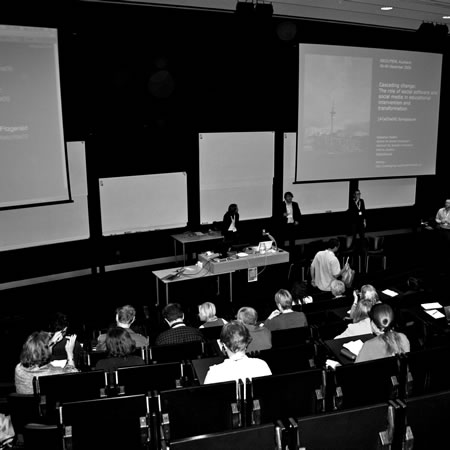
Small interventions, fundamental shifts

This morning I was at one of the Symposia at Ascilite 2009, Cascading Change: The role of social software and social media in educational intervention and transformation.

In recent years social media and social software tools and practices have been applied in numerous implementation and pilot studies in higher. Some have been driven by explicit educational goals, while others seem to have been inspired by the attractive, technical flexibility of an emerging decentralized landscape of loosely-coupled, networked tools and services and its alleged potential for changing the dominant patterns of institutional provision of ICT in education. This symposium brings together a diverse and international group of researchers to explore the problems and limitations of using social media as a leverage point for second-order change in higher education. It aims to engage contributors and the audience in theoretical and empirical reflection on possible directions for further conceptual and methodological development in that area.

This was an interesting debate and as is usually the case there wasn’t sufficient time for a lot of discussion. I was hoping with the Twitterfall screen up that we could have an online debate, however Twitter decided to have a big fail. Ah well.

One of the questions that came up was why with all these “interventions” why is change so slow or not happening.

My opinion is that these changes or interventions we make that we report at these conferences are always small and tiny and therefore can’t make a huge differences. We need to make major interventions at a institutional or even at a societal level if we are to effect fundamental change.

I also wonder if the culture of how we work is also a barrier to systematic change. In HE especially with a focus on research and publication, there is less incentive to effect change and more incentive to carry on researching and attending conferences and getting papers published.

People with the power to effect change do not (in the main) attend such conferences and therefore such changes do not happen at an institutional level.

Of course change does happen at an institutional level, but often with administrative systems rather than teaching and learning. For example does your institution use e-mail or MIS ?

As with the MIT OpenCourseWare and other similar initiatives in this area we can see that sometimes there can be fundamental shifts in the ways institutions work.

So how do we move things along…

Ascilite Day #1

So here we are with the official start of the Ascilite 2009 Conference. As I write this it’s late Monday morning in Auckland, but late Sunday evening back home in the UK. It feels weird blogging and tweeting about the conference, whilst people I know back in the UK are getting ready to go to sleep.

With a traditional Māori welcome we then launched into the traditional conference openings from the great and the good.

The first keynote of the conference was form Dr Scott Diener of the University of Auckland. He is an advocate of Second Life and described how he saw how Second Life was going to change education. He was very passionate about Second Life and its use in education. He demonstrated his island live to the audience.

Now I have talked about Second Life before and as you may know I don’t really “get it”.

I either seem to be the technology luddite with the red flag walking in front of the Second Life car, or maybe Second Life is not this life changing and social changing technology that many think it is.

Now it may be just me, for example I can see some real potential and benefits of Augmented Reality technologies, but don’t see similar opportunities with Second Life.

Of course this doesn’t mean I am right, but what do you think?

ASCILITE 2009 Day -2

Well after what feels like a week of travelling I have arrived in New Zealand ahead of ASCILITE 2009.

I am jointly presenting a workshop on mobile learning on Sunday 6th December. I am also delivering the final keynote on the 9th December.

I am hoping to take away lots of stuff and ideas from the conference. Hats the thing about conferences is that there are ideas and thoughts that you can take back and implement at your own institution. I also see this conference as an opportunity to see what happens here on the other side if the world. We have many things in common but also differences in climate, calenders, seasons and culture.

I will be blogging and also using video to capture my thoughts as the conference progresses. I will link to these blog entries from both the conference hub (which uses Moodle) and from Cloudworks.

More later…

Does learning happen on a VLE?

I have had quite a few people comment and say that learning doesn’t happen on a VLE and that it is merely a glorified content repository. Now I am sure in many institutions that this is certainly the case.

However in the same way that learning sometimes does and sometimes doesn’t happen in a physical environment. I should note that the classroom is not the only physical learning environment that learning can take place in. Physical learning environments can be classrooms, the home, workshops, salons, kitchens, work places or in the field (you know literally in a field). Before you make the blanket comment learning doesn’t happen on a VLE, how do we know that learning takes place in a physical learning environment? The environment is either conducive to learning or not conducive. We carry out checks on learning and assess that learning has happened. These happen in physical learning environments and can happen in VLEs too. You can check by using the same checks and assessments you would use to check for learning in other environments. You can also use new and innovative checks and assessment methods using technology too.

There is no way that we can categorically say that learning can not happen on a VLE. If we do then we must also say that learning can not happen on the internet period.

So then have I seen learning happen on a VLE?

Well yes. In the same way I have seen learning take place with Web 2.0 tools and services.

I have seen some fantastic work with the use of audio and video on the VLE combined with a VLE discussion forum.

I have seen learning happen with wikis on the VLE. Just because the functionality of the wiki or discussion forum in a VLE may not match those found elsewhere on the web, doesn’t mean they should be dismissed. Simple tools do not mean simple learning; though it should be said that complex tools doesn’t mean complex learning either. These are tools and regardless of their simplicity or complexity, they can be used for learning.

We mustn’t forget that the VLE is generally rarely used in isolation, it is used to enhance and enrich all kinds of learning. When a VLE is dismissed because it is just used as a repository I wonder what these people think of libraries and books. Libraries are repositories of knowledge and information, do we dismiss them? No we do not. But in the same way that Libraries work best when learner are guided by information professionals, their peers and their teachers; VLEs also work better when learner are guided by information professionals, their peers and their teachers.

So does learning happen on the VLE?

Of course it does.

Join the debate in Wolverhampton on the 16th December 2009.

Don’t kill off the VLE…

Don’t kill off the VLE, for many staff it’s their only option. For some if they didn’t have the VLE they wouldn’t use anything else.

Yes wouldn’t it be wonderful if every practitioner, teacher and lecturer was well informed about the wealth of online tools and resources out on the web. The reality is that they’re not. Just ask yourself what percentage of staff in your college are using Twitter?

The problem with saying that the VLE is dead it assumes that both practitioners and learners will move over to free web tools and services. Now some will, some will thrive on that. This is the reason why others may say that the VLE is dead or should be dead. However I disagree as if you kill off the institutional VLE then a substantial proportion of learners and practitioners will not move onto free tools and services.

For many practitioners the VLE is still an alien beast which they are not familiar with and more importantly not making the best use of. Yes you could argue that this is because the VLE is not fit for purpose and that it is a slow clunking tool that no one wants to use. Lets stop though and ask if this is the case. Isn’t it more likely that the reason some staff don’t use the VLE for enhancing and enriching learning is that they don’t know how to? If they think it is tired and clunky, that assumes that they are comparing it to “snazzy” or “clever” Web 2.0 tools which they are using widely. This is a very small number of practitioners and they are probably using those tools already.

I can’t see practitioners who are not using the VLE, or simply skimming the surface of the functionality of the VLE, making an educated, informed and rational decision about using the VLE. How would they know? How can the decide based on what is probably a cursory glance at at a few features of the VLE without having an understanding of the full and potential benefits of the VLE for their learners.

I have had quite a few people comment and say that learning doesn’t happen on a VLE and that it is merely a glorified content repository. Now I am sure in many institutions that this is certainly the case. However to blame the VLE would be like blaming a classroom for being boring. As anyone who is ever in a classroom soon realises, it is not the environment which matters but what and how you use that environment. A VLE or virtual learning environment is merely replacing or supplementing a physical learning environment. I should note that the classroom is not the only physical learning environment that learning can take place in. Physical learning environments can be classrooms, the home, workshops, salons, kitchens, work places or in the field (you know literally in a field).

If we ensure that practitioners have the right skills, experience and understanding then we can start to ensure that learners have a guided, enhanced and enriched learning experience.

Join the debate in Wolverhampton on the 16th December 2009.

So is the VLE dead or not?

A lot of people out there are talking about how dead the VLE is that you would actually think it was dead. However take a step back, there are lots of people using their VLE, learners are using them to learn, practitioners are using them to enhance and enrich the learning experience.

The VLE is not dead, you could say that the VLE is undead. Now not undead as in zombies or vampires, but undead as in not dead, very much alive and kicking.

Now don’t get me wrong, the wealth of Web 2.0 tools or services out there are fantastic and can be utilised by learners to enhance and enrich their experience. But this needn’t be in exclusion to the institutional VLE, the institutional VLE can be the glue which holds this altogether.

When people often talk about how the VLE is dead, should be dead, or is undead and should be  sorted; they expect learners to utilise the tools of their choice to create their own personal learning environment (PLE). We need to stop confusing the debate over the VLE by implying it is a PLE versus a VLE debate. It isn’t and hasn’t ever been that.

A PLE in my opinion is allowing a learner to choose their own learning environment by utilising tools that are available to the learner. Now where does it say that this specifically excludes institutional tools and services? Why can’t learners decide to use an institutional VLE, an institutional e-mail address, institutional storage?

The key is choice.

We do need to give learners choice about which tools they want to use. We also need to help them make an informed choice.

If all you let learners use is the institutional VLE then you are restricting choice and stopping learners from creating their own personalised learning environment. Services such as XML and RSS allow learners, practitioners and institutions to feed content and communication into whichever environment they choose.

The problem I have with removing the institutional VLE from the equation is that it removes choice and for some learners adds barriers learning.

We know that the so called Google generation and digital natives don’t exist. Some learners are very familiar with Web 2.0 and technology, but many others are not. How do we provide an enhanced and enriched online learning environment to learners that are not confident about entering that environment. The VLE can be that first step, the first port of call for these learners.

The VLE is not dead, that’s what we mean by undead, the VLE can be a tool to enhance and enrich learning and be a portal to a world of Web 2.0 tools and services.

Join the debate in Wolverhampton on the 16th December 2009.

MoLeNET Conference 2009

Today is the MoLeNET Conference, the second conference MoLeNET has had. Last year the conference was at the Emirates Stadium, this year at the Grange Hotel near St Pauls.

Gloucestershire College will be there in force today. Last year I did a ten minute slot on the Glossy Project. This year, Alan Graham will be presenting in the research strand on what we did in the Shiny project in terms of research. Whilst Rob Whitehouse will be doing the ten minute slot on the use of video assessment and the impact on learning. Rob Allen, who has done some fantastic work on mobile learning in plumbing and heating will be on our stand. And…. myself and Greg Smith, the college Principal, will be delivering one of the keynotes.

Glossy and Shiny have had a real cultural impact in the college and I hope to share how we achieved this in the college.

In case you were wondering, our third MoLeNET project is called Sparkly and is about sharing what we do with two partners, Stroud College and Royal Forest of Dead College Royal Forest of Dean College.

Update: Oops that should be Royal Forest of Dean College, must have dead on the brain!

news and views on e-learning, TEL and learning stuff in general…