Category Archives: stuff

Have you got an Innovation Prevention Department?

Here it is day three of Handheld Learning 2008.

It has been a very good conference and a good chance to see what is happening in the world of mobile and handheld learning.

Some really good stuff out there, but some sessions no more than a showcase of a product rather than how it impacts on learning.

This is not a research based conference (unlike mLearn) so there are lots of practitioners here talking about what they do, but there are also suppliers talking (or is that selling) their wares.

First presentation I have seen today was Lt Alex Smith who is using PSPs with Royal Navy personnel for learning. Quite interesting in what they are doing in what seems to be a very traditional teaching environment.

 Have you got an Innovation Prevention Department?

The second session was not really my cup of tea, very much about selling a product to schools.

Third session was presented by Jon Trinder who was presenting about connecting the physical to the virtual.

Best quote of the conference so far came from Jon, “Have you got an Innovation Prevention Department?”.

mLearn 2008

So it’s mLearn 2008 time. Two years ago it was in Banff in Canada, last year it was in Melbourne. This year it’s in that exotic of places… Telford.

Well it’s the conference content and the people why you go to mLearn not the location.

Looking forward to the conference, should be very informative and interesting.

So first it was off to the reception. Now I was expecting a buffet, alas I was mistaken. There were some crisps and pickled cauliflower which I am guessing is some kind of local Telford delicacy. So now I am very hungry.

Becta, they say yes to open source…

Though getting a large amount of criticism from various sources (including this list), the Becta Software for Educational Institutions Framework (SEIF) was never about banning software, but about getting a framework in place to allow schools to “purchase” software avoiding many of the problems and pitfalls that may arise from a school going it alone.

The problem that many found with the SEIF was that it favoured proprietary software vendors and discriminated against open source.

The Sirius Corporation revealed yesterday that it was among 12 software suppliers to have been awarded places on the £80m Software for Educational Institutions Framework (SEIF) agreement.

This means that schools that wish to use linux, Open Office, Moodle, etc… now have a framework which allows them to use the software more easily.

The Register on the story.

Sirius press release.

Are any colleges out there looking at open source alternatives beyond Moodle?Becta, they say yes to open source...

Parents ‘want texts from schools’

Parents 'want texts from schools'

BBC reports on the survey from Becta about how schools need to use e-mail and SMS to communicate more with parents.

Many parents would like school reports on their children’s performance texted or e-mailed, a survey says.

One in 12 of the 1,493 parents polled by government education technology agency Becta said schools kept them informed using these methods.

But 68% of parents said they wanted schools to use such technologies to keep them up to date more frequently.

Of course if schools are to take heed of this survey, then FE Colleges need to do likewise. Does your FE College already communicate to the students by e-mail and/or SMS text messaging? Can the students communicate back?

So do your students cheat?

So do your students cheat?

Never?

They don’t hand in plagiarised work?

How do you know?

Did you know that essays by the bundle are sold on eBay?

Dave Foord (an external educational consultant) has written an interesting blog post on Turnitin which is a piece of software that can be used to detect plagiarised work. He believes that the software also has a value in acting as a deterrent to plagarism.

What are you thoughts?

Open source DTP software

Scribus is an open source DTP package for Mac OS X, Windows and Linux.

Scribus is an open-source program that brings award-winning professional page layout to Linux/Unix, MacOS X, OS/2 and Windows desktops with a combination of “press-ready” output and new approaches to page layout. Underneath the modern and user friendly interface, Scribus supports professional publishing features, such as CMYK color, separations, ICC color management and versatile PDF creation.

Could be an alternative for InDesign, Quark and of course Publsher. Scribus website.

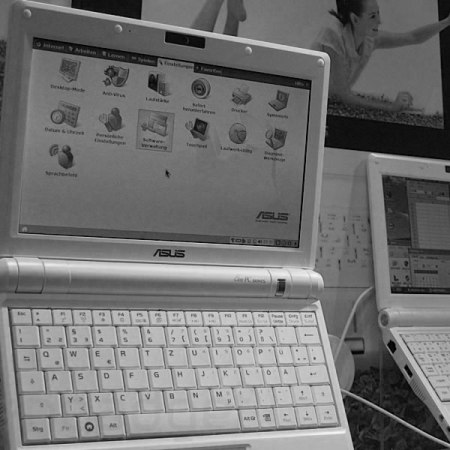
CherryPal launches $249 cloudy mini PC

Is this the future of home computing?

CherryPal launches $249 cloudy mini PC

A small $249 box with access to the web (and 50GB of online storage).

The Register reports that:

Start-up CherryPal is taking pre-orders today for its partly cloudy “desktop” that mashes web-hosted computing, going green, open source, and social networking into a 10 ounce box.

The (self-titled) CherryPal systems are $249, and surprisingly won’t require a monthly subscription despite the fact that most of its storage capacity and several of its features hosted in the cloud.

CherryPals are thinned-down computers running an ultra-low power chip from Freescale. They’ve got 256MB memory and 4GB solid-state capacity.

The future of computing?

What do you think?