
So it was day three of Ascilite 2009 and this was a big day for me as I was delivering the final Keynote.
As I was still doing some final preparation I missed out on the first morning session. After that I attended the Thinking about a new LMS: Comparing different institutional models and approaches symposium
Selecting a new Learning Management System (LMS) is a strategic decision. The LMS is a key part of your institutional culture and shapes not only the student experience but also the future direction of your institution. This symposium describes the experience from the initial selection phase to early implementation of Moodle in four case studies: University of Waikato, University of Canberra, University of Canterbury and Massey University. The central question explored is: how do you successfully implement a new LMS within a large institution? In answering this question, the symposium compares and contrasts different models and approaches to successfully implementing such an important educational innovation and large-scale institutional change. The symposium shares lessons learnt from each university and offers participants an excellent opportunity to hear first hand about the benefits and challenges of adopting an open source LMS in the university sector.
This was an interesting presentation with some useful experiences that were passed on.The experiences by the four institutions had valuable lessons to pass onto any other institution contemplating changing their LMS or VLE.
However I do feel that it shouldn’t have been labelled as a symposium. Now though a symposium originally referred to a Greek drinking party, it is now used to describe an openly discursive format, rather than a lecture and question–answer format.
The LMS symposium was a series of four presentations with a few questions at the end. That is not a symposium, that is a series of four presentations with a few questions at the end…
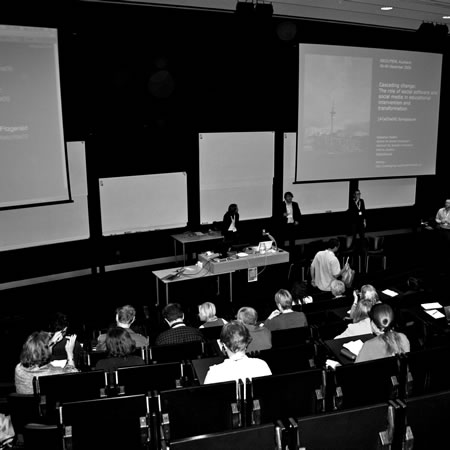
It would appear that I am not alone in thinking that the symposium format needs to be rethought for academic conferences.
Sebastian Fiedler on his symposium said in his blog:
Altogether, our slightly eclectic individual statements/presentations apparently worked as a conversation opener. There was clearly interest in the over-arching theme and present ASCILITErs were eager to chime in an voice their opinions. However, when things just started to get somewhat interesting we already had to wrap up the session and disperse the convention. I found this extremely unfortunate.
He goes onto suggest:
I can easily imagine to simply start with a conversation among a group of informed peers on stage… that gradually draws in more and more participants. It would provide a hyperlink-cloud around the individual contributors to get an idea of where they are coming from, and possible end with recommendations on further readings… plus some form of mediated conversation and exchange beyond the event. No presentations, no lecture halls, no 60 min time-slots.
When I was planning the original VLE is Dead symposium at ALT-C 2009 one of the key issues for me was to ensure that the delegates attending the debate had ample time and opportunity for discussion.
So how did we do this?
Well the first thing we did was get the discussion going well before the conference. The speakers were posting to their blogs with their views. One result of this was that lots of people responded to those blog posts, which continued the debate.
At the symposium itself, we restricted the amount of time to each presenter to just five minutes; Josie in the chair was under strict instructions to stop us after five minutes. I also wanted the presenters not to use PowerPoint, though in the end some presenters did use them.
As a result we had a wonderful debate looking at a range of issues, allowing delegates an opportunity to ask questions, voice their opinions and join in.
Well our symposium worked very well, with a room for 80, we had 150 delegates in the room, and about 200 online. I recorded the debate and that video has now been seen (at the time of writing) by over 1500 people!
So what can we learn from this, especially those that are thinking of putting in symposium submissions and conference organisers.
Lesson 1: Less is more
If you can’t get your viewpoint across in five minutes then you just need to try harder. Likewise I wouldn’t have more than four presenters for an hour debate and no more than six for a ninety minute session. Don’t try and cover “everything” try to keep to a single or simple viewpoint.
Lesson 2: Early start
Start the debate early well before the conference. Get the presenters to blog their viewpoints. Encourage others to debate the issue using their blogs. Use Twitter to get the debate going.
Lesson 3: Amplify
If you can stream your symposium over the internet, use a service such as Ustream. Use Twitter to cover the debate and if possible have a Twitterfall type service showing during the debate.
So ask yourself the next time you consider running a symposium, are you interested in the debate or are you only interested in presenting your point of view.


